
Categoría: Previous Issues Articles

The Conversation Continues… OMGE! Convincing a Skeptic on “Automatic Cancellation”

Welcome back! ECO’s conversation with an OMGE automatic cancellation skeptic was just too [lengthy][complex][exciting] for one day. Mandatory partial cancellation ensures that Article 6 goes beyond zero-sum offsetting (a principle and requirement under Article 6.4 of the Paris Agreement. Mandatory partial cancellation is a process where buyers (like a country or an airline for compliance under the ICAO CORSIA) buy some mitigation outcomes and a certain percentage of that purchase has to be set aside for the benefit of the atmosphere. What’s left would be used by the buyer to help achieve the target.

So here we go… 

ECO: Hi there OMGE automatic cancellation skeptic. How did that discussion on baselines and additionality go? Let’s continue discussing OMGE automatic cancellation. Shall we?

OMGE automatic cancellation skeptic: Yes, I would love to continue our discussion. Im starting to understand your perspective. But, with this automatic cancellation thing:  it just complicates things.

ECO: It is actually very straightforward. We have already been setting credits aside under the CDM for share of proceeds. The logic is comparable. So, we have the necessary experience on how to set this up. In Katowice, countries were in a position to agree on voluntary cancellation for Article 6.4, so this isn’t something new.
... Read more ...
Multilateral Assessment – We’ve Got Questions for You

ECO is excited to see so many Annex I Parties participating in the multilateral assessment of their biennial reports. ECO congratulates Parties for participating and thinks the multilateral assessment can be a great place to share experiences and lessons learned with other Parties in a constructive environment. We look forward to hearing your presentations and answers during the Q&A sessions. 

Since ECO can’t ask questions during these workshops, we figured we’d ask them here:

  • To all Parties

    • Can you provide an update about actions taken to strengthen policy-making processes – in particular in relation to public access to information and public participation – so as to improve climate responses and promote policy coherence in the context of progress made towards meeting your commitments under the UNFCCC?

  • Belgium

    • Like all other countries, Belgium should finalize its Long Term Strategy by the end of next year. Could you explain what the current status of the strategy is, keeping in mind that four governments (and other stakeholders) need to contribute to it?

    • To what extent do the policy measures proposed in your draft and (now almost final) National Energy and Climate Plan correspond to the goal to reduce emissions by 35% in 2030? Does the plan include specific data on the climate effects of the different proposed measures and a detailed overview of investments needs?

... Read more ...

The Just and Equitable Transition: Where is my Home?

Meeting the 1.5°C target means all Parties must transition away from dirty fossil fuels to clean and renewable energy as fast as possible, in line with the IPCC science and deadlines. This shift from dirty to clean power isn’t the whole story though: the necessary energy transition must also be centered in justice and equity, where the rights of Indigenous peoples, people with disabilities, workers and unions, youth, women and gender constituents, local communities, and other structurally oppressed groups, are protected and strengthened in a new inclusive and resilient energy economy. 

The reason is simple. We can’t afford to keep power, both literally and figuratively, centralized – perpetuating systems of exploitation upon which our current fossil fuel economy is built. We need to make sure that government actions factor in and respect the human, social, economic, and environmental rights at stake. 

The problem is that the topic of just and equitable transition hasn’t been afforded a natural home in the negotiations. Yes, it appears under Response Measures, and the Forum looks like it is close to adopting a 6-year work plan to help foster capacity-building and exchange of best practices between Parties. However, just and equitable transition is still not central to ambition goals, NDCs, finance and other commitments.
... Read more ...

When your negotiator says ‘Why do we need Loss & Damage Finance’? Who you gonna call? ‘ECO!’

When your negotiator says ‘Why do we need Loss & Damage Finance’? Who you gonna call? ‘ECO!’

ECO welcomes the new direction from Parties to hone in on the nuts and bolts of the discussion on finance to address Loss & Damage (L&D). What’s clear is that vulnerable, developing countries need assistance to address L&D, so developed countries must urgently ramp-up action and support. Discussions about some of the central issues like improving the effectiveness of existing institutions or assisting vulnerable countries in better planning are all key, but will be largely insufficient without raising new and additional finance to confront the climate crisis. What ECO observed during yesterday’s discussions made it clear that not all countries are on the same page when it comes to L&D finance. Never fear, ECO is here to answer some burning questions to help negotiators find the light at the end of the COP25 ambition tunnel:

First things first. Why do we need additional financing?

At only 1°C of global warming, climate change fuelled events such as extreme heat waves, rampant forest fires, devastating droughts, ecosystems losses, catastrophic floods, and increasingly destructive hurricanes, typhoons and cyclones, are stealing people’s lives and livelihoods. All are examples of climate driven loss and damage impacts that go beyond what people and ecosystems can adapt to.
... Read more ...

“C’mon!!! Do we really need 5 years to decide on 5 year common time frames?

“C’mon!!! Do we really need 5 ye

ECO was becoming increasingly impatient sitting at the common time frames session on Wednesday. For the past years, countries have been contemplating different time frame options. These discussions have demonstrated the clear benefits of a five year common time frame.

During the open informal consultation on Wednesday, nearly every Party said they welcomed a decision on common time frames as soon as possible, with many seeking a decision now. Only the EU suggested that the decision could wait until 2022 or 2023. ECO is disappointed to hear the EU wants to continue the discussion and wonders for what sake. Is this because the EU can’t reach internal agreement on a position? Well, what more do you need? At some point, the EU needs to agree on a position, and there’s no reason for it not to be a five year common time frame — as many of its members already back.  

ECO urges Parties to take a decision on this issue at COP25 and not prolong this any further. But with only two sessions scheduled for the COP, Parties haven’t even given themselves a chance to discuss how to make a decision, never mind make that decision!
... Read more ...

OMGE! Convincing a Skeptic on “automatic cancellation” (Part 1 of 2)

Congratulations! You actually decided to read the first sentence of this ECO article, after seeing such an «eye-glazing» Article 6 concept. 

To make sure that Article 6 goes beyond zero sum offsetting, ECO believes that the only real way to achieve this principle (and requirement under Article 6.4 of the Paris Agreement) is through “automatic cancellation.” What you may ask? It’s a process where buyers (like a country or an airline for compliance under the ICAO CORSIA) buy some mitigation outcomes and a certain percentage of that purchase has to be set aside for the benefit of the atmosphere. What’s left would then be used by the buyer to help achieve the target. But not everyone agrees on this approach. What follows is the first half of a conversation that ECO had with an «OMGE automatic cancellation skeptic.»

*********

ECO: So, I hear you don’t like OMGE being achieved through automatic cancellation. Why don’t you want it? 

OMGE automatic cancellation skeptic: «Well, first off, I think that OMGE through automatic cancellation is a tax on mitigation.»

ECO: No, that’s rather misleading: it’s really a subsidy to developing countries to develop projects that generate mitigation outcomes. Sure, the buyer pays a little bit more for the ITMO, but research shows that if the cancellation rate is 50% or below (and ideally 50% from ECO’s perspective), the sellers, who are likely to be developing countries, will be better off, and so will the planet.
... Read more ...

Keep it in the Ground!

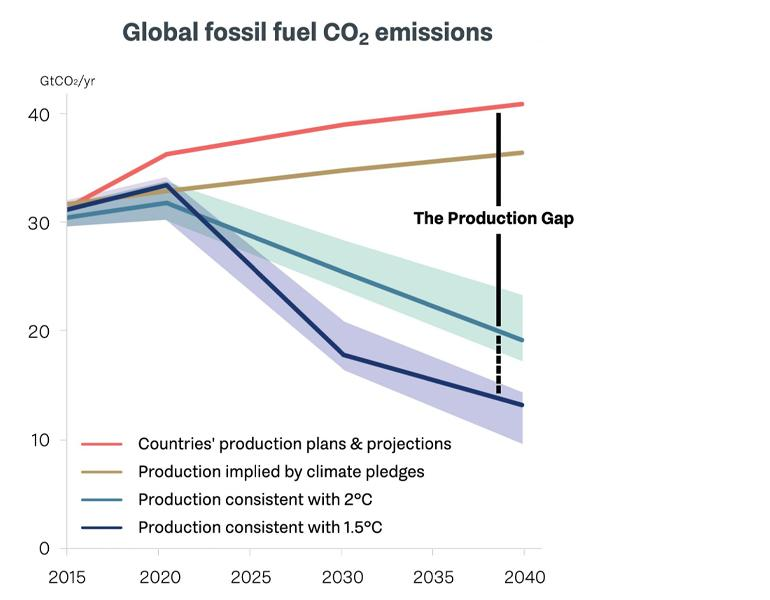
While there is no formal space in the negotiations to talk about the one thing the climate needs most – the rapid and equitable phase out of all fossil fuels – there has been a flourishing ecology of side events making just this point. Yesterday, there were several debunking the curious idea that, in a climate emergency, we can keep expanding oil and gas. The latter is often – most often in oil company ad campaigns – seen as a “bridging fuel”. Perhaps advocates of this view just mean it’s a “bridge” to climate breakdown. There are certainly cleaner and more effective ways to achieve SDG7: “to ensure affordable, reliable sustainable and modern [surely this is the antithesis of ‘fossil’] energy for all.”

A report launched by the Stockholm Environment Institute, Climate Analytics, and other research organisations this week laid out the discrepancy between countries’ planned fossil fuel production and global production levels consistent with limiting warming to 1.5°C or 2°C. It’s carbon-bombingly, climate changingly big:

New “production gap" report shows how fossil fuels hinder ...

At another side event, an advisor to the Climate Vulnerable Forum called upon “Governments and multilateral institutions [to] take bold and decisive leadership to limit fossil fuel production and end the expansion of this industry….
... Read more ...

You have One Job (for the 25th time): Respond to the People and the ScienceYou have One Job (for the 25th time): Respond to the People and the Science

COP decision text might not always be Shakespeare, but it is how the countries of the world express their collective will and intentions on climate change. With the world teetering on the edge of total disaster, and with less than one year to decide whether to lock in NDCs that commit us to more than 3 degrees of warming, the signal that UNFCCC Parties send this year on ambition will have a special importance. 

Wednesday, Parties had their first round of consultations with the Chilean Presidency on the 1/CP.25 decision; the text that will tell us and all people around the world whether or not they are up to the challenge.  Will you do the right thing and send the strong political signal that we need in order for us to again trust you with our futures?

We have been quite clear on our measuring sticks for the 25th gathering of parties — it feels like Groundhog Day, so here we go:

  1. Acknowledge that you will be guided by science and the 1.5°C goal. 
  2. Commit to the highest level of ambition for revised NDCs to be tabled in 2020, well ahead of COP26 and in time for the Secretariat to prepare a synthesis report on the aggregate global ambition level (and seriously you need to deliver those NDCs already by 1st quarter, but there are also other great moments like Earth Day, in April, or the UN Environment Day, in June).

... Read more ...

Indigenous Peoples’ Caucus

ECO is happy to share this part of our platform with the Indigenous Peoples Caucus to help amplify their voice. 

Kia ora, bula, tabea, buorre beaivi, ya’ateeh, Indigenous greetings to you all.

With everything that is on the line this year, with these negotiations and the push by countries to accept a bad agreement, rather than taking the appropriate consideration to ensure a strong Article 6 outcome that protects the rights of structurally oppressed peoples, we are very pleased to announce that as Indigenous Peoples’ Caucus we have been granted a dedicated space in this daily ECO Newsletter to share the issues that are most important to us, and our communities.

The people who are affected first and worst by climate change have also continually presented the appropriate holistic solutions for the climate crisis we are all in. Indigenous Peoples, Disabled Peoples, Women, LGBTQI+, Global South, and Youth are on the frontlines combating climate change within our own communities, and we are here contributing the MOST to a fair COP25 outcome for ALL.

Indigenous Rights, Disability Rights, Women’s Rights, LGBTQI+ Rights, Youth and Children’s Rights are ALL Human Rights, and this is our red line. 

While people with lived experience must be centered and supported to lead across all COP25 workstreams, there is also a huge role for our allies to play. 
... Read more ...

Natural ecosystems: a Real Solution to the Climate Crisis

The huge forest fires raging across many countries send a clear signal — we need to keep our natural ecosystems intact or risk losing the fight against the climate emergency. Indeed, the IPCC 1.5 report was unequivocal: we cannot keep global warming below 1.5°C without tackling the crisis facing nature. ECO notes the buzzword “nature-based solutions” is flying around, looking to collect sweet nectar from fruitful coffers, and pollinating colourful blossoms galore. But we also note that the term “nature-based solutions” lacks clear definitions or criteria and can include activities that do nothing to advance real climate solutions. This has prompted ECO to take the opportunity to use specific language on the role ecosystems play in addressing the climate crisis, and how they can be protected and restored to achieve emissions reductions, enhanced resilience, and biodiversity protection:

  1. The role of ecosystems in climate ambition is not an excuse for greenwashing or continued BAU — we must keep fossil fuels in the ground at all costs.
  2. We need to prioritise the protection and restoration of our natural ecosystems, including primary forests and other intact ecosystems and those still rich in carbon and biodiversity. They are irreplaceable for stable carbon storage and for biodiversity, and we simply cannot afford their continued loss or degradation.

... Read more ...