
Categoría: Previous Issues Articles

The Wrong Direction on Article 6

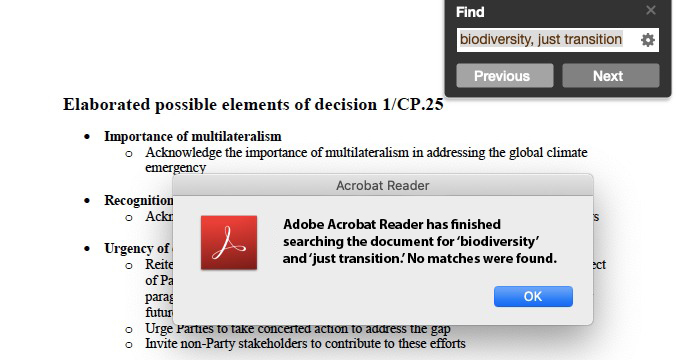
After many hours of waiting on Saturday, ECO was dismayed when it searched the new texts for human rights, safeguards, and clarity on an ITMO definition and found that nothing was there. Sure, there are fewer brackets, but fewer brackets do not magically translate to successful rules that ensure carbon markets won’t lead to harming people and the planet, undermining the Paris Agreement entirely. 

ECO was pleased last week when it heard more countries speaking about the need to include human rights and the rights of indigenous peoples in the rules for Article 6. So, imagine ECO’s dismay when it searched through the text and couldn’t find mention of human rights or social and environmental safeguards. Instead it found only a placeholder for elements of the Paris Agreement preamble. But it’s not about having elements from the preamble, it’s about ensuring that the carbon markets under the Paris Agreement don’t become a tool that allows for the harming of people and the planet. Human rights are not negotiable!

ECO also searched desperately for some clarity on what an Internationally Transferred Mitigation Outcome (ITMO) is. Under article 6, countries will create ITMOs, buy ITMOs, use ITMOs… But does anyone understand what an ITMO actually is?
... Read more ...
At Least Parties Admit It’s a “Very Negative Signal”

It’s really a pretty straightforward question: What should the time frame of NDCs be?

ECO is dumbfounded at the approach Parties have taken to the negotiations on this issue during the COP. After failing to reach agreement on draft conclusions and how to capture the progress from this session in their supposed final session on Friday, the SBI chair gave negotiators an extra 30 minutes. However, 75 minutes later, Parties were still in the same place, despite the co-facilitator’s valiant efforts to keep the common time frames negotiations within the scheduled time frame. 

On Friday, Brazil introduced a provocative option, but by Saturday morning had worked diligently with Switzerland to replace the provocative option with fairly good alternative options (ECO applauds the efforts of Brazil, Switzerland, EIG, and others  who worked to advance suitable options). However, it seemed Parties were determined to load the informal note with nonsensical options, including China, who, on behalf of LMDC, proposed differentiated time frames for mitigation, adaptation, and finance components of NDCs and even proposed differentiated time frames for developing vs. developed country Parties. In addition, they seemed determined to spend a fair bit of time reading these lengthy new options into the record. All these theatrics, and a lengthy debate about bracketing a footnote, and we’re right back where we started: Nowhere!
... Read more ...

Too Late for “Later” on Timeframes!

ECO has a difficult life making choices sometimes. We grapple with choosing which sandwich to eat for lunch or which pavilion has the best coffee. So we sympathise with Parties who have spent a lot of time struggling to decide on their preference for common NDC time frames, debating between 5 years, 10 years, or a 5+5 option.

But it was an insult that only two hours were allocated at COP25 to discuss and agree how to progress on such an important ambition-related issue. Yesterday, it all fell apart. Brazil was provocative with its new proposed option, including to consider the periodicity of the global stocktake (even though Brazil admitted this suggestion was all for show). China passionately reminded everyone in the room that this is a Party-driven process – whilst trying to remove text from another Party. Canada and Australia suggested the issue doesn’t need to be decided until 2023, and the US further suggested the issue needn’t be discussed again until 2022. The US was outdone though by, good friend of climate action, Saudi Arabia who suggested that the issue not even be discussed until 2023. Miraculously, the EU is no longer the ones kicking this can the furthest down the road. 
... Read more ...

Half a Million March in Madrid to Bring Climate Strikes to the COP

With fists up, banners high, and hearts ablaze with conviction, over 500,000 people took to the streets of Madrid last night to strike for climate action. ECO was on the Paseo del Prado to join the marchers — led by the Fridays For Future youth movement — and judging by the emptiness of IFEMA yesterday afternoon, so was most of the COP. 

The massive march, hailed as one of the largest ever public mobilisations in Spain, was one of hundreds of climate strikes around the world this and last Friday to demand increased ambition to address the climate crisis. Ending with a rally at Nuevos Ministerios where civil society delegates collectively read through the People’s Summit 6D Manifesto, the march was a beautiful reminder of the growing diversity of the world’s climate movement. More and more people are demanding real action from their governments on mitigation, adaptation, and loss and damage. 

ECO senses something very different in the air at COP during this year of striking for the climate. No longer is the ‘climate movement’ something to be merely nodded to in plenary speeches — it has taken over the conversation, and its fingerprints are everywhere at IFEMA. Governments are gathered in Madrid just two months after more than 8.7 million people took to the streets for this September’s global climate strikes, marking one of the largest mobilizations in world history. 
... Read more ...

The Sky is not for Shell: Side-event with Shell, BP and Chevron Leaves Many Protecting their Ears

We’re almost halfway through COP25 and carbon markets remain the talk of the day. The International Emissions Trading Association (IETA), which was co-founded by Shell, is going full speed ahead to keep markets high on the agenda. Yesterday, the IETA pavilion hosted six side events on the topic. This is no coincidence. 

Last year in Katowice, the Anglo-Dutch oil and gas giant Shell used the pavilion to boast about its role in getting carbon markets into the Paris Agreement. At an IETA side-event a Shell representative said: “We can take some credit for the fact that Article 6 is even there at all”.

This year, the oil and gas company is back. It is calling for a “simple but rigorous rulebook that … encourages large scale transactions”.But why exactly is Shell so eager to get its way with carbon markets? Maybe because markets could allow Shell to continue producing more oil and gas. On Thursday, the report “Oil, Gas and the Climate” showed that Shell has the second highest projected increase in oil and gas production in the next five years. On the same day, Shell was back at its favourite spot, speaking at an IETA side-event about “markets for natural solutions,” alongside bddies Chevron and BP.
... Read more ...

Part 2: When Your Negotiator Says ‘Why do We Need Loss & Damage Finance’? Who You Gonna Call? ‘ECO!’’

Yesterday ECO answered some developed countries’ questions on why a new finance facility on loss & damage (L&D) was needed, how L&D should be defined, and why new and additional finance is needed to address L&D. Countries loved it so much that they asked ECO a few more questions. So, by popular demand, ECO is back for another round!

Why should there be additional finance?

Vulnerable and frontline communities in developing countries have been inundated with extreme heat waves, rampant forest fires, devastating droughts, catastrophic floods, increasingly destructive hurricanes, typhoons and cyclones, and sea level rise. These climate-drive loss and damage impacts are stealing people’s lives and livelihood, and they go beyond what people and ecosystems can adapt to. Impacted communities cannot be expected to address climate change on their own, especially not without resources, support, and implementation structures in place.

Developed country rebuttal: Why should we split L&D finance from adaptation finance?

ECO says: For many countries, it is necessary that there be both financing to adapt to climate impacts and to address losses and damages resulting from climate impacts that cannot be adapted to. Most financing for adaptation is not able to support the needs of developing countries to address loss and damage.
... Read more ...

The Erosion of Ice and Identity in the Arctic

We all know the reason for our annual COP convergence: avoiding catastrophic climate change. The IPCC told the world that we have the next 10 years to close the emissions gap, but the message from National Inuit Youth Council President, Crystal Martin-Lapenskie, is “Inuit living in the Arctic don’t have 10 years. We are experiencing catastrophic climate change right now.” Inuit knowledge was echoed in the findings of the IPCC Report on Oceans and Cryosphere in a Changing Climate (SROCC) released in September and shared yesterday on the floor at COP25. The report is an example of Indigenous knowledge and Western science saying the same thing: the cryosphere is changing, rapidly and profoundly. Warming oceans and air mean reduced ice coverage, rising sea levels, flooding in low lying areas, and the erosion of our shorelines resulting in relocations of infrastructure and people. For Inuit living in the Arctic, ice and glacial loss is not just a matter of physical changes in the environment, but a threat to Indigenous lives and livelihoods.

Inuit from throughout Chukotka, Alaska, Canada, and Greenland as well as others have been bringing this message of urgency to the COP for decades. Benjamin Qetun’aq Charles, Inuit Yup’ik, Inuit Nunaat (homelands), talks about how Indigenous knowledge systems are evolving due in part to exponentially changing ecosystems.
... Read more ...

Voices from the Front Lines: Loss and Damage: the Price of Carbon in the Philippines!

On 2 December, category 4 typhoon Kammuri made landfall in the Bicol region of the Philippines. Several hours prior, Paula Guevara, a resident in the region, recalls a literal calm before the storm. Then she heard a whistling sound she had only previously heard during typhoon Haiyan in 2013. Her household then lost power. And then came the strong winds and heavy rainfall that lasted through the night.

After a stormy night, her house remained standing, except for the avocado tree in front of her house. This tree had survived previous super-typhoons, but its luck ran out with the fury of Kammuri.

The tree is a literal embodiment of loss and damage that vulnerable communities are facing in the climate emergency. If drastic greenhouse gas emissions cuts do not happen immediately, adaptation and resilience-building measures will not be enough to address climate change impacts in the future.

While Paula’s family was fortunately unscathed, others were not so lucky. As of writing this, 13 people lost their lives, nearly 400 thousand Filipinos were displaced, and more than PHP800 million (US$16 million) of agricultural assets were damaged by Kammuri. 

We refuse to accept that we keep paying the price of carbon. Polluters must pay with their ill-gotten wealth, not innocent people with their lives.
... Read more ...

Australia Needs to Start its NDC at the Starting Line, Not Half-way Through the Race

Imagine if in the Olympics you could get away with starting the race half way down the track. That is what Australia plans to do with its NDC — to carryover a controversial “overachievement” from its modest Kyoto Protocol commitments to extinguish half the effort required to meet its very deficient 2030 target. Australia has admitted it has 367 million tonnes of units. Though you won’t see this mentioned in Australia’s NDC, and ECO wonders if it ever will be, given Australia’s reluctance to update its climate efforts next year. 

With bushfires burning across Australia, rising national emissions, rising coal and gas exports (recall Australia is the third largest exporter of fossil fuels), and failed climate policies — now is the time for Australia’s new Ambassador for the Environment to step up and do the right thing. Cancel these credits that even your Kiwi neighbours admit are not in the spirit of the Paris Agreement. And if any countries have text up their sleeve to stop the use of carryover units from Kyoto, ECO hopes they table it at COP25. 

EU, is this one for you? Leadership extends to ensuring the integrity of the Agreement, in addition to increasing domestic ambition. Here’s an opportunity for true leadership.