
Categoría: Previous Issues Articles

On Equity: Part 2

The following are excerpts from a particularly incisive intervention in the ADP workshop yesterday afternoon. In case you missed it, ECO suggests you take a look. And if you didn’t miss it, ECO suggests you take a look anyway, since it’s a subject Parties need to work much more on:

“What is needed is a process that would allow for a proper equity review of the pledges, to be conducted in parallel with the equally-critical science review.

To that end, the Parties should launch an open, expert process to develop an equity reference framework that is suitable to the evaluation of national pledges. This framework would have to be designed to maximize both ambition and participation. Parties, when making pledges, would be guided by the knowledge that these would be evaluated within both the science and equity reviews.

How to think about such an equity review? The first point is that the demands of equity have already been agreed. This is true at the level of the Convention’s keystone text on CBDR & RC, and it’s true of the four fundamental equity principles – ambition, responsibility, capacity, and development need – that underlie the principle of CBDR & RC and, of course, our shared vision of ‘equitable access to sustainable development’ as well.
... Read more ...
Putting the “2 (degrees)” back in Workstream 2

It is well-trodden ground that there is a huge gap between what Parties say they want (staying below 2°C and keeping the door open to 1.5°C) and what Parties have pledged to contribute between now and 2020 to achieve that planetary necessity. In theory, Workstream 2 has already identified how to bridge the gap through: 1) improving developed countries’ woefully inadequate 2020 emission reduction targets; 2) identifying ways to enable and support developing countries in upping their own pre-2020 ambition; and 3) joint complementary action in addition to the first two areas on everything from phasing out HFCs to fossil fuel subsidies. The task now is to JUST DO IT.

ECO thought “doing it” would require no explanation, but some recent happenings in many developed countries are getting their positions all wrong. First and foremost – and we really thought this was obvious – the thing that needs to go up is the target, not the temperature. For the EU this means moving to 30% – a move which really shouldn’t be that difficult considering that it has already achieved its 20% target almost 8 years ahead of schedule and will actually achieve more than that (around 25-27%) by 2020. How can the EU host 2 COPs over the next 3 years and ask the rest of the world to do more while it decides to take a break?
... Read more ...

Mothers of Ambition

Plato observed in The Republic that necessity is the mother of invention. Parties, he was speaking about you. Humanity formed the State to enable the conditions for sufficient food, shelter and security. Today we face an unprecedented challenge – how will we respond?

At this early stage in developing the global climate agreement in 2015, “ambition” dominates the agenda – and for good reason. The IPCC’s forthcoming AR5 will shine a bright and unyielding light on the planetary emergency we now face.

It’s not just about the need to close the emissions gap. While those 11 gigatonnes will help the atmosphere, they won’t break the back of the politics to get us below 2°C. What is required is for collective agreement to dramatically change the course of human development with the climate clock ticking. So it’s simple: the 2015 deal must deliver ambition compatible with a below 2°C trajectory.

There is a sense in some quarters that a top-down method to achieve that kind of ambition is out of reach politically, so a bottom-up approach will have to suffice. But these underachievers are missing the point. Either they wilfully ignore the fact that climate change will ravage the globe and its inhabitants, or they think Plan B[ottom-up] can keep us out of harm’s reach of unavoidable climate change.
... Read more ...

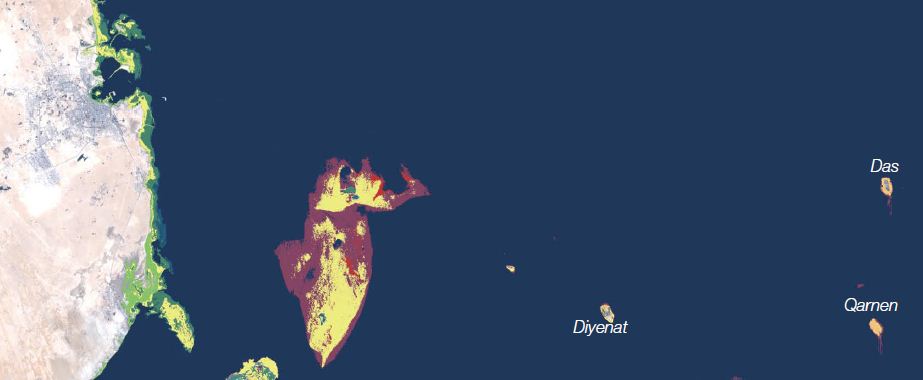
Qatar Corals

image-363

The spectacular coral reefs off the coast of Qatar are experiencing severe degradation from pollution, illegal fishing and other causes. Now climate change threatens to raise water temperatures above those that coral reefs can tolerate, putting the diverse fisheries of the Gulf at risk.
Excerpt from map by EWS & WWF.

Working the Workstream

It was with some optimism that ECO joined the roundtable discussion of the ADP workstream two (“workstream 2 degrees”, as one delegate was heard when entering the room). All Parties had noted the pre-2020 ambition gap with grave concern back in Durban, and after a year of little—if any—progress, Doha seems to be a good moment to get down to work.

However, that’s not quite the way that the US delegate started it. First explaining how failing to adopt domestic climate legislation – which he said would have allowed offsets to do about half of the mitigation job, somehow, constitutes a doubling of ambition – as cuts now need to be done entirely at home. Right…The problem is that while the level of domestic effort will in fact be higher, the atmosphere won’t see a single additional ton of emissions reductions.

ECO rather liked the approach by the Ethiopian delegate who sported the ambition to get the country carbon neutral by 2025 – an undertaking not seen as over-ambitious – if needed support would materialize.

ECO agrees with the developing country delegates who pointed out that there is also lots of ambition work to do outside the ADP: finalising the homework in the KP and the LCA before they close; achieving the highest possible ambition including through getting rid of the hot air for CP2 and beyond; and agreeing common accounting for non-CP2 developed country Parties (the free-riders and ship-jumpers) to ensure comparability of efforts.
... Read more ...

Wild West Carbon Markets

The LCA is discussing the establishment of a new market mechanism (NMM) and a Framework for Various Approaches (FVA), including the use of markets. But well into the 1st week, it is still unclear what these two work programmes could be about.

There is a common view that the FVA is supposed to give recognition to national emission reduction systems and, if Parties want to, make the emission reductions units that are achieved by these systems internationally tradable and eligible for meeting national emission reduction targets (QELROs). Under the NMM on the other hand, countries could put forward national emission reduction systems to the UNFCCC to be approved for the issuance of credits. Both work streams could end up hosting the same types of emission reduction systems, ranging from market-based instruments to renewable feed-in tariffs. ECO is therefore wondering why bother with two different work streams?!

The answer is clear if one looks at the politics. Although the same types of emission reduction systems could be hosted, the NMM requires international common standards and UNFCCC approval before credits could be issued and used for compliance. The FVA on the other hand could allow countries to develop whatever systems they want and offer the resulting emission credits for compliance without the UNFCCC taking a close look at them, something strongly wished for by Japan, New Zealand and the US.
... Read more ...

Where Are the NAMAs for Arab Countries?

Having COP18 in Qatar presents a unique opportunity to move forward with mitigation and adaptation efforts for climate change in the region, as well as for climate finance. With this in mind, ECO is calling for leadership from the Arab states beyond the conference hall.

ECO supports Greenpeace’s call for east-west regional integration in the Arab world with regard to the research, financing and development of renewable energy technologies. This regional cooperation can build on the work already done by individual states in renewable energy development, while developing a new role for regional states at the forefront of clean energy technology innovation.

Renewable energy cooperation will also promote economies of scale and fraternal ties crucial to dealing with the other pressing climate impacts faced by many regional states: growing water scarcity amid shifting weather patterns and, in some, projected sea-level rises on coastal communities and aquifers.

Climate mitigation requires both regional and global efforts to switch from dirty fossil fuels to safe renewable energy sources.

ECO favours a regional approach in which economic diversification crucial to future prosperity is built on sustainable national and regional energy strategies—where renewable energy progressively takes the lead role in generation. This includes a transformation away from fossil fuel over-reliance.
... Read more ...

Ending the Subsidy Silence

Earlier this year, ECO was delighted to read submission upon submission referencing the potential for removing fossil fuel subsidies to contribute substantially to pre-2020 mitigation ambition. In fact, it was so exciting that we counted the countries represented by these submissions. Turns out, over 110 countries supported submissions calling on fossil fuel subsidy reform to be included as an option for raising mitigation ambition.

Well, Thursday morning it seemed as though many parties had forgotten about these submissions, only a few months after they were sent in. Despite hours of discussion, fossil fuel subsidies seemed to not have made it into the morning’s ADP workstream 2 discussions.

Fortunately, not all countries have fully forgotten this issue, though, and yesterday afternoon’s ADP session provided some hope. ECO would like to thank the Philippines, Costa Rica and Switzerland for recognizing this important opportunity for additional pollution reductions. (ECO would also note rumours that the US and Mexico referred to fossil fuel subsidy reform in other sessions in recent days as well).

The IEA has told us that removing fossil fuel subsidies could close the mitigation gap by nearly one half between existing pledges and what’s needed by 2020 to put us on a path to limit global warming to 2 degrees.
... Read more ...

Accès à l’énergie pour tous, le mythe de Sisyphe Africain?

L’Afrique cherche toujours sa solution pour faire face à un double défi : donner accès à l’énergie à l’ensemble de ses populations tout en anticipant la finitude des ressources fossiles et l’impact croissant des changements climatiques.

La pauvreté, insécurité et précarité énergétique qui caractérisent le continent conditionnent sa croissance et influencent son développement. La demande d’énergie en Afrique n’est pas satisfaite et freine le développement économique, la création d’entreprises et d’emploi, l’accès à l’éducation et aux systèmes de santé performants. Pire, une grande partie des communautés n’ont toujours pas accès à l’électricité pour leurs besoins vitaux. Peut être parce que dans les dernières décennies, les choix énergétiques sur le continent donnent la priorité aux énergies fossiles – charbon et pétrole – qui contribuent à dégrader l’environnement, à renforcer la pauvreté énergétique et ne permettent pas de faire face aux changements climatiques.

Pourtant les sources ne manquent pas sur le continent, et le potentiel est infini pour répondre aux besoins énergétiques de l’Afrique et même au-delà. C’est pour faire face à ce défi que les ONG se sont mobilisées à Rio+20 pour proposer des solutions: les énergies renouvelables et l’efficacité énergétique! Energie pour tous ou Energy for all, ce slogan devenu le credo de toutes les institutions trouvera-t-il exécuteur, dans un monde de plus en plus aveugle aux sources d’énergies les moins polluantes, les plus sobre en carbone mais entreprenant pour le gaz de schiste ?
... Read more ...