ECO Newsletter Blog

Fossil of the Day

ARABIA SAUDITA

Arabia Saudita en nombre del Grupo Árabe

Es genial ser consistente, confiable es bueno, ¿verdad? Parece que los viejos hábitos no mueren, especialmente si tus aliados te dejan la puerta abierta…

Entonces, dado que estamos en la COP 24, no es de extrañar que haya algunos infractores reincidentes.

Este Fósil es para la voz más consistente, insistente y persistente en socavar la ambición en las negociaciones en lo que va de esta semana: Arabia Saudita. El martes, una intervención de Arabia Saudita en nombre del Grupo Árabe, resumió su enfoque general.

En la sesión sobre el Balance Mundial, Arabia Saudita, pidió que se elimine el término «mecanismo de ambición» en el preámbulo del texto, con el argumento de que evalúa previamente el resultado del GST. El IPCC SR 1.5 y todo el Acuerdo de París dejan claro que necesitamos mucha más ambición climática si queremos cumplir los objetivos a largo plazo del acuerdo.

Los esfuerzos saudíes por socavar la ambición no se detienen allí. Arabia Saudita (hablando en nombre de países en desarrollo o LMDC para aquellos que no lo saben) se opone al acuerdo sobre cualquier información nueva para que las NDC promuevan la claridad, la transparencia y el entendimiento, y apoya un resultado de «no texto».


... Read more ...
Switzerland Astray: Parliament Decides to Kill the Domestic Reduction Target

ECO still cannot believe what happened in Switzerland earlier this week! While we all listened carefully to President Alain Berset’s opening speech on Monday, reminding everyone (in particular his MPs it seems) that“we can only succeed […] if all states – really all – reduce their emissions”,his Parliament back home almost simultaneously decided to abolish the domestic emission reduction target for the period 2020-2030!

Yes, you read correctly: Switzerland may have no target for domestic CO2- emissions reduction past 2020! ECO wonders what’s happening in the small but pristine and wealthy land of milk and honey (ahem.. chocolate) behind the Alps!

Wasn’t Switzerland the first country in the world to announce an ambitious INDC well ahead of Paris? And isn’t the Swiss delegation known for their persistent push on a robust transparency framework, strict criteria (“same for all!”) and a mechanism to continuously increase mitigation ambition?

Perhaps ECO isn’t alone having fallen for a slightly distorted picture of a seemingly progressive, clean and (self- proclaimed “recycling champion”) country. Time to lift the curtain of cheese and fondue:

Indeed, Switzerland announced in early 2015 its INDC of a reduction by 50% of CO2 emissions by 2030 (compared to 1990). But what the Swiss government did not mention back then is the intention to achieve almost half of it abroad.


... Read more ...

Top Tips For Delicious Climate Accounting Finance

How would you like your accounting, readers? Consistent, well done, and accurate? (In that case I’d recommend our MDB special.)

Or maybe you’d like a loan soufflé? Or perhaps lots of different methods all mixed together – with sprinkles of figures plucked from the air (for the climate component of aid programmes)?

Seriously though, accounting rules are important, as this is what will incentivise good quality climate finance.

The SCF and the OECD both delivered reports this week. They gave us some figures, which sound very nice, but when we looked a bit closer they seem inflated. And there are worrying trends on adaptation, and on flows to LDCs.

We have some top tips:

  • Measure what matters: We need to encourage more spending on adaptation. Both the OECD and the SCF show that this is still underfunded. No more than one quarter of climate finance, which is far from the Paris Agreement’s stating that “provision of resources should also aim to achieve a balance between adaptation and mitigation”.
  • Furthermore, the need to keep track of how much goes to LDCs. The OECD forgot. Standing Committee on Finance said this was only 24%, and 2% to SIDS. Grant-equivalent accounting: We’d also recommend you account for the climate finance that developing countries pay back to donor countries – those South-North flows – because loan repayments are not captured at the moment.

... Read more ...

Make Human Rights and the Rulebook a Happy Family for Christmas

As the weather gets colder and Parties work to make a complete rulebook, the spirit of the Paris Agreement — the eight rights based principles included in the Paris preamble are looking forward to being part of that happy family.

How do their chances look? Advocates argue that effective implementation of the Paris Agreement requires people to be at the centre of all climate decisions-making processes and actions. Parties must include the following fundamental elements throughout their implementation guidelines: human rights, indigenous peoples’ rights, public participation, gender equality, just transition, food security, ecosystem integrity, protection of biodiversity, and intergenerational equity.

But some feel their presence in the Paris preamble is enough to allow them to thrive in climate action around the world, or that mere reference to the preamble in the Rulebook would be enough or that maybe just one or two of the principles need to be included.

Including human rights language within the Rulebook itself will help Parties develop and implement the effective climate action needed to stay below 1.5oC. Ultimately, this is what the Rulebook is about: giving guidelines to Parties, to help them to put general principles into concrete steps for necessary climate actions.

We were pleased to see many of the rights have a home in the current text in APA agenda item 3 on the planning processes of NDCs, but we are wondering why some elements are still left behind.


... Read more ...

Takeaways for a Successful Talanoa

The purpose of the Talanoa Dialogue is to take stock of the collective efforts of Parties in relation to progress towards the long-term goal of peaking GHG emissions as soon as possible and achieve net zero emissions by mid-century, in order to limit global warming to 1.5°C. The outcome of the Dialogue shall also “inform” the preparation of countries’ nationally determined contributions.

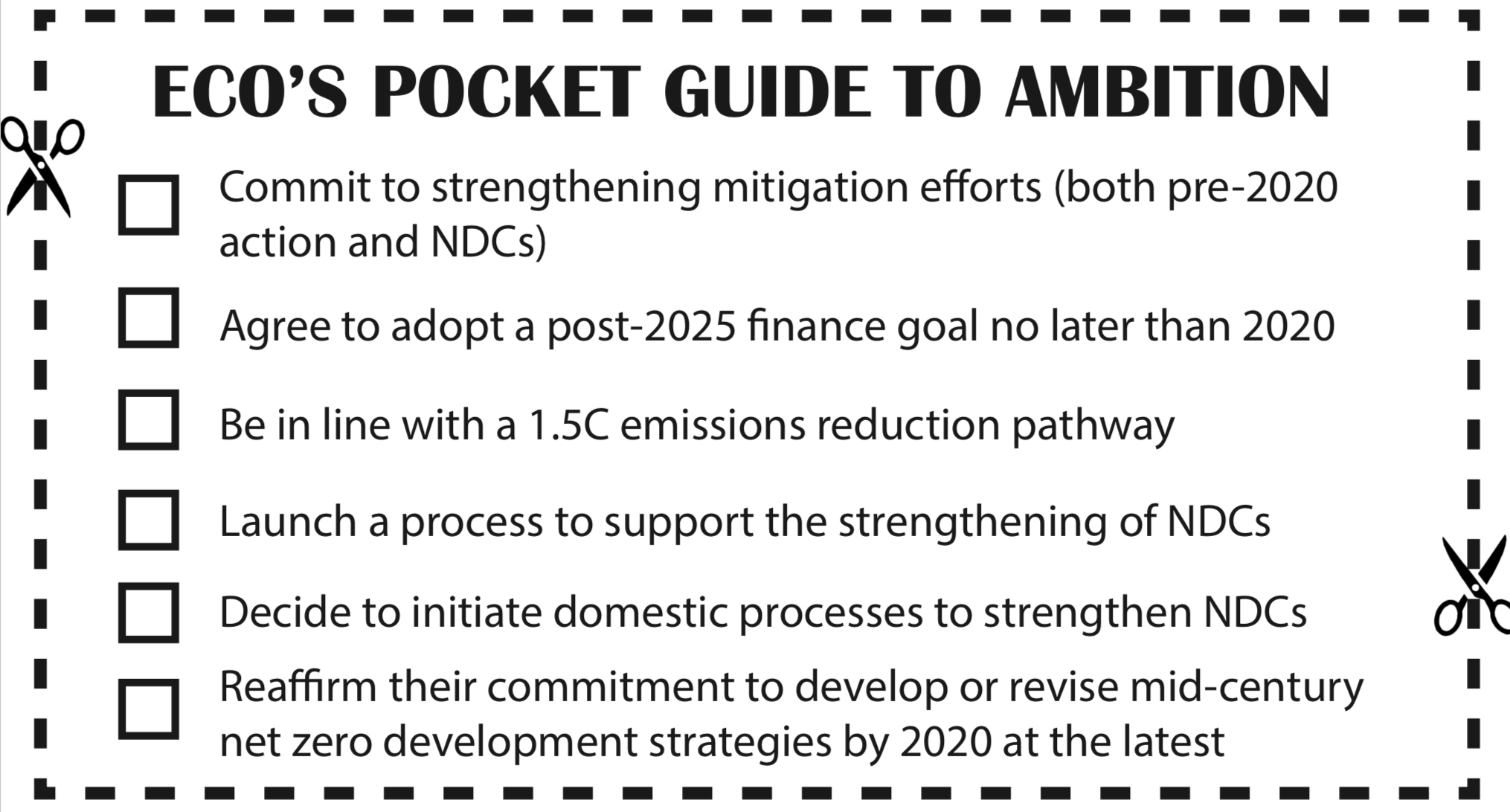
The IPCC SR1.5 makes clear that the world is not on track to limit warming anywhere near 1.5°C. The only conclusion that can be drawn from this exercise is that the current level of ambition is woefully inadequate. In Katowice, Parties must correct course, by agreeing on six key elements of a COP decision on Ambition.

To help negotiators stay on track, ECO has put together a helful pocket checklist:

image-8700

Quedan 12 años: ¿qué habéis hecho para responder al SR1.5?

ECO quedó estupefacto ante la presentación de SBSTA-IPCC de ayer. El IPCC comenzó con una presentación que no solo despertó a los cansados delegados en la sesión plenaria, sino que también los espabiló (si es que se antes no se habían percatado) sobre la urgencia de la necesidad de actuar. El IPCC hizo hincapié en que si las Partes desean mantenerse por debajo de 1,5°C y reducir las emisiones de CO2 a la mitad para 2030, es necesaria una acción inmediata en todos los niveles. No pueden comenzar en 2029. Cada año importa, al igual que lo hace cada décima de grado.

Algunas Partes cuestionaron la viabilidad de estos escenarios. El informe SR1.5 contiene una serie de rutas que podrían seguirse para limitar el calentamiento a 1.5°C, algunas más riesgosas que otras. Sin embargo, a fin de cuentas la viabilidad no es una pregunta que el IPCC pueda responder puesto que se refiere a la voluntad política.

En términos de responder a la SR1.5, ECO espera ver el crecimiento de la voluntad política a lo largo de estas dos semanas, a medida que los negociadores simplifiquen el texto para el libro de reglas y cuando los ministros lleguen a establecer el rumbo para fortalecer las NDC.


... Read more ...

Planificación para una cosecha abundante en Koronivia

Koronivia está muy lejos de Katowice, pero el desarrollo del Trabajo Conjunto sobre Agricultura de Koronivia (KJWA) en la COP24 está a nuestro alcance.

Cada agricultor sabe que el éxito depende de maximizar el tiempo disponible dentro de la temporada de crecimiento. Esto significa conocer el paisaje en el que está trabajando, reunir los recursos que necesita para realizar su trabajo y plantar y cosechar de acuerdo con un plan claramente estructurado.

Lo mismo se aplica a la KJWA.

Para aprovechar al máximo la corta temporada de negociación disponible aquí, ECO sugiere que las Partes consideren las siguientes formas de aclarar el trabajo que les espera:
1- Pedir a la Secretaría que realice un mapeo del trabajo de los Órganos Constituidos, y una revisión de los medios de implementación disponibles, tanto financieros como no financieros. Esto permitirá a las Partes identificar y discutir las brechas existentes relacionadas con cada uno de los temas del taller.

2- Pedir a la Secretaría que realice simultáneamente una revisión de los medios de implementación disponibles, tanto financieros como no financieros.
3- Concuerdan que una entrega clave de KJWA podría ser un criterio u orientación para NDCs, GCF, Fondo de Adaptación y Cuerpos Constituidos, para asegurar que alcancen cinco objetivos generales: seguridad alimentaria, adaptación, reducción de emisiones absoluta y equitativa, ecosistema Integridad y sensibilidad de género.


... Read more ...

3 mil millones de razones de temer acerca de Brasil

Brasil, el lugar de nacimiento de la CMNUCC y hasta ahora un negociador de confianza durante las negociaciones del Acuerdo de París, está a punto de convertirse en pícaro climático. El presidente electo Jair Bolsonaro y su conjunto de ideas muy raras sobre el cambio climático y la selva amazónica se traducen en problemas en el futuro.

Bolsonaro todavía no ha asumido sus funciones, pero ya están avergonzados los delegados brasileños acá en Katowice por su retracción de organizar la COP25 menos de 10 días antes de la COP24. Sin duda, es una vergüenza, pero mantengamos positivos y pensemos en otras cosas: ¡imagínese que el presidente de una COP crea que el calentamiento global es nada más que una trama marxista para transferir poder a China! Sí, Ud. entendió esas palabras correctamente, y son de Ernesto Araujo, el entrante ministro del Exterior en Brasil.

Incluso si Bolsonaro no sigue los pasos de su mejor amigo Donald Trump y Brasil permanece en el Acuerdo de Paris, su gran visión para la selva amazónica es desgarradora: dejar control de desforestación, abrir la tierra indígena a los agronegocios y la minería, desechar las áreas protegidas, y reprimir a los activistas, por añadidura.

El costo para el clima sería nada menos que catastrófico: desforestación ya se ha aumentado por un 32% entre agosto y noviembre.


... Read more ...