ECO Newsletter Blog


It’s About People And Nature, Not Markets And Offsets
As we get into week 2, we continue to hear about the importance of Article 6. But ECO remains concerned that as Parties get bogged down in the technical details (which are important and ECO is happy to discuss them), they are forgetting about what’s really important and ultimately what it’s all about: people, a healthy planet and the ambition needed to keep warming below 1.5°C.
Never fear, ECO is here to remind you. People and nature around the world have been negatively impacted by previous market mechanisms and seen their lands destroyed or taken without consent. Do you really want Paris Agreement implementation associated with human rights violations? Now is the time to take steps to prevent harm: By guaranteeing rights-based safeguards in the article 6 text; through meaningful participation and consultation with those impacted (including women, communities, workers, youth, persons with disabilities, Indigenous Peoples – don’t forget about FPIC … we could go on); and ensure there is an independent mechanism to redress potential harms. Rights-based and inclusive climate action is better climate action. And that includes at this COP. ECO has seen it work.
ECO hears you say that this COP is about enabling us to stay on a path to 1.5°C.
... Read more ...
Human Rights On The Chopping Block: What Does It Mean For Disabled People?
During the Covid-19 pandemic, we have seen the disastrous effects of systemic neglect of disabled people.
We are overwhelmingly overrepresented in Covid-19 deaths, yet many countries have engaged in discriminatory medical triage protocols that treat disabled lives as acceptable losses. This clearly devalues our lives, as does many countries’ premature return to «normal» (including the hosting of this COP), well before it was safe for disabled and immuno-compromised people.
Climate breakdown, like Covid-19, compounds existing inequities, disproportionately harming the one billion disabled people on the planet. This is especially true for our disabled communities who are multiply marginalised, and live on the frontlines of both climate change and eco-ableism.
Many disabled people are still imprisoned in institutions, including the 12 residents of an assisted living facility, who were among the victims of the flash flooding in the Ahrweiler district of Western Germany as recently as July 2021. This is one of many instances demonstrating that when disasters hit, disabled people are literally left behind.
Those of us who are also Indigenous understand first-hand how the colonial and extractive drivers of climate breakdown have stolen and damaged our lands, undermined our cultural practices, and left our communities behind across almost every societal development indicator.
... Read more ...
The Disappearing And Reappearing Rights Of Indigenous Peoples In Article 6
Over the past week and half, Parties have been negotiating the terms of Article 6 and still struggle to agree on human rights language. In our opening statement, the IIPFCC, represented by Taily Terena, called on Parties to ensure that “Article 6 upholds human rights, and specifically, Indigenous Peoples’ Rights, and leads to real emissions reductions.”
However, as we enter into week two, the hangover from COP25 still plagues Article 6, as our rights pop up and disappear on the whim of Parties in a political game of Whack-a-Mole.
Article 6 has direct implications on communities – from land grabs to our rights to consultation and participation. There are growing concerns that without rights safeguards Article 6 would do little to substantially reduce emissions – something that many of our communities simply cannot afford to wait for. We need to ensure that we not only find ways to agree on mechanisms for reducing emissions, but that this happens swiftly and with the guidance of Indigenous Peoples who are already safeguarding 80% of the world’s biodiversity.
As we enter this final leg of COP26 the IIPFCC calls Parties to uphold their existing commitments under the UN Declaration on the Rights of Indigenous Peoples (2007).
... Read more ...
Fossil of the Day
First Fossil of the Day Award goes to the United Kingdom and the Kingdom of
Saudi Arabia
For the first Fossil of the Day in this second week of COP, we have a tie between Saudi Arabia and the UK for their sterling efforts in securing a weak new Work Programme on Action for Climate Empowerment (ACE) which we’re now going to be lumbered with for the next decade!
First of all the UK Presidency appears to have been eager to finish work early on Friday. They dispensed with making the shaping of the text inclusive, instead pushing all parties to come to an agreement that evening, dashing the hopes of civil society organisations and youth groups, who had worked so hard, of having more time to help shape the text.
Not that it may have made any difference anyway – Saudi Arabia gets their first Fossil for manipulating the rushed and restrictive decision making process, to keep the words “human” and “rights” out of the final text. ACE!
As if by magic, or maybe by maintaining a hardline position, “Human rights-based approach” disappeared from the guiding principles. We think we can guess why those oil kings think the next generation doesn’t need a robust climate education….
... Read more ...
CAN INTERVENTION: INFORMAL STOCKTAKING PLENARY, COP26
November 2021
Today is Loss and Damage day. It is a day of grief for all of us. We are reminded of the painful, unjust and unequally distributed losses and damages we all face, but in particular the most vulnerable countries and peoples. This is a matter of Climate Justice. It is a matter of Human Rights. We are extremely outraged that the issue of Human Rights and Indigenous Rights continue to be attacked in this COP. The outrageous deletion of the references to these in the Glasgow Work Program on ACE is shocking. It must be redressed. As civil society, we have been locked out of this COP. It has proven to be the most exclusionary COP ever. If we were in the rooms we would not have allowed the deletion of Human Rights and Indigenous Rights and the pressure on Finance for Loss & Damage would be felt.
We want to remind you that success or failure on loss and damage finance will be the litmus test for this COP. We need to leave Glasgow with an explicit decision that results in delivering Loss and Damage finance. The complete absence of support for Loss & Damage has a direct impact on the millions of people already suffering the impacts of climate change.
... Read more ...
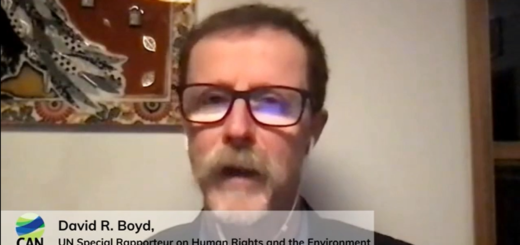
David Boyd on #LossandDamage | COP26
ECO 7, COP26, Glasgow, November 2021 – THE LOSS AND DAMAGE ISSUE
Will Finance Flow?
Would you come to COP without your badge? Would you leave your house without your keys? Or your mask? These are things that you do automatically, because they are required and necessary, and doing them should be part of your muscle memory, without thinking too much. The same applies for keeping 1.5°C within reach. You can’t do it without adequate resources, without it, you will fail. Logical, isn’t it? But so far, ECO is not convinced that this has been understood. Will we leave Glasgow without a clear sign that finance will flow?
You don’t really need to think much to understand finance is the key, and without a Glasgow package that puts solidarity and prosperity — and the necessary resources — at its heart, we won’t be able to have a successful outcome.
So, ECO wants to be clear. For this COP to have any kind of political relevance, the only way forward is a cover decision that recognizes and pushes to overcome, with firm commitments, the inadequacies of current finance provision, so as to adequately support adaptation finance, mitigation finance and loss and damage finance. Too much money is being wasted on subsidizing the dirty fossil fuels industry. Too little is being mobilized for delivery to where it matters most.
... Read more ...
Cover(up) Decisions Or Breakthroughs?
On Sunday, the Presidency released a first draft of the proposed elements for the Cover Decision to be adopted at the end of the week. These decisions will provide the main political signal coming out of Glasgow and will therefore be essential in assessing whether the COP ends with a vision or a cover-up. This COP had a very clear mandate to take stock of the ambition gaps and deliver a credible pathway to address them. Ahead of the intensive consultations scheduled this week; ECO is pleased to share the following checklist of critical elements for these decisions:
Science as the starting point: A credible COP outcome requires taking the science seriously, particularly as the IPCC is delivering its Sixth Assessment Report.
- Deletion of the reckless, scientifically discredited and outdated reference to 2ºC
- Reference to the importance of cumulative emissions are what counts to keeping warming below 1.5ºC
- Recognition of the essential role of ecosystem protection and restoration in achieving a 1.5ºC pathway alongside, not instead of, rapid fossil fuel phase-out.
Most striking missing element: Fossil Fuels – Coal, gas and oil are the elephant in the room, and must finally be acknowledged; Parties cannot deliver the requisite ambition without ending production and support for fossil fuels.
... Read more ...