Catégorie : Previous Issues Articles

Roll up your sleeves

ECO wants all negotiators to understand that what they are doing here really does matter to the lives and futures of billions of people and ecosystems around the world. In a little over a years time, the world needs to see an ambitious and equitable agreement which does not condemn the poorest and most vulnerable to a future of disasters and permanent state of emergency. Negotiators need to make progress this week on four items related to adaptation and loss and damage in the 2015 agreement.

First, the 2015 agreement must highlight the requirement for all climate action to be guided by certain principles; in particular recognising the  needs of vulnerable people, communities and  ecosystems as well as  rights-based approaches, gender-equity and broad participation. Though the 2010 Cancun Adaptation Framework contains some ‘guiding principles’, these aren’t even referenced in the current draft ADP text. This puts the UNFCCC 2015 agreement at risk of being the least people-centred and rights-based of the three international frameworks currently under discussion. Drafts for the Sustainable Development Goals (SDGs) and the post-2015 Disaster Risk Reduction Framework contain much stronger wording on people’s needs and human rights.

Second, it is clear that emission reduction efforts must be at the core of INDCs.
... Read more ...

Five is the magic number

A decision in Lima that commitment periods will operate in 5-year cycles is vital to the integrity of the Paris agreement. ECO wants to remind all delegates in Bonn that a 5-year commitment period:

Avoids lock in: current pledges are far from being consistent with the below 2°C goal, much less the 1.5°C required by the most vulnerable countries. Five-year commitment periods allow for greater dynamism and ratcheting up of global ambition.

Incentivises early action: setting a target that has to be met 10 years from now, rather than 15, compels government to reduce emissions quickly, rather than delaying action.

Maintains better synchronicity with the cycles of IPCC reports: a more dynamic system is more responsive to the best and latest available science.

Creates stronger national political accountability: many governments operate on 5-year electoral or planning cycles. A 5-year commitment period requires a government to act within its elected or planning term rather than leaving action to its successors.

ECO welcomes the support for 2025 targets from the United States, AOSIS and the Africa Group. We hope to see others joining them this week. We believe that the 5-year national planning cycles in countries such as China and Saudi Arabia synchronise naturally with an international 5-year cycle.
... Read more ...

ECO Lonely Hearts Corner

Dear ECO,

I’m a 6,000-year-old woman (but a lady never reveals her true age) looking for suitors who are prepared to send me ambitious INDCs. I enjoy slow change, spinning around, long orbits around the sun, regular seasons, and cute and fluffy animals. My dislikes include comets, mass extinctions, ice ages, solar flares and fossil fuels. I’ve had a rough relationship history and my sudden break up with the dinosaurs wasn’t easy either. Currently, I’m in an extremely abusive relationship with Homo Sapiens, they’re keeping me sweating.

I must admit that I have volatile tipping points and I have become icy cold and uncomfortably hot in the past. I’m afraid that if I have to deal with further weak promises and  empty “commitments”, I may do something rash and enter a state of anger that will make the hurricanes, droughts and storms that you’ve seen before look mild.

I’m hoping to retain my stability by receiving lots of INDCs from suitors who are:

  • Interested in 5 year commitments periods (I need some long term security and not another decade in a destructive relationship)
  • Transparent about the level of effort that they will invest in my wellbeing
  • Willing to indicate how much money and other support they will provide to keep me happy
  • Upfront about how much external support they will need to make the relationship work if the INDC is from someone with less capability
  • Adaptable: I have some historical scarring that is likely to make any future relationships difficult and I will need all the INDCs to indicate adaptation plans as I blow off steam
  • Passionate about equitable relationships and my long-term prosperity
  • Willing to review, and if necessary improve, their contribution to making our relationship work
  • Willing to submit to expert counselling to ensure that they are doing enough to make a long-term relationship work
  • Willing to start work immediately to prevent any further damage to my person

Suitors that have caused harm in the past and that have lots of resources, send me your ambitious proposals by March 2015.
... Read more ...

Adaptation Fund overlooked because there’s a new kid in town?

While we all breathlessly wait for big money to hit the GCF (US$15 billion in pledges is expected by the end of this year), ECO would like to remind everyone that there are other funds in dire need of money too. One of them, the Adaptation Fund, which has projects ready to be implemented in vulnerable countries such as Ghana, Mali or Nepal, is now just waiting for the resources to get those projects started.

Pledges to the Adaptation Fund were among the very few positive outcomes from Warsaw. ECO is shocked that some countries have not yet paid up. Given the urgency of climate change, ECO would love to see the October session kicking off with the transfers of pledged funds from both Belgium and France, who, as the host of the 2015 COP, may want to uphold its commitments.

Honouring pledges made in the past is obviously critical, but so is putting the Adaptation Fund permanently on a more sustainable funding base. This could be done by, for instance, tapping into alternative sources that auto-generate revenues. Until then, the Fund’s board will have to continue to announce fundraising goals as it had to do for 2014 and 2015 ($80m each).
... Read more ...

Assessing the assessment phase discussion: part II

ECO thinks that the ADP has a pretty simple job in designing the next phases of the INDCs process. After completing the information requirements, we simply need an  INDCs assessment phase, as pointed out by AILAC and Palau. The first step of the assessment phase is – you guessed it- all parties submitting INDCs by March 2015. This could not be simpler, really.

March 2015 is only around the corner. Parties need to start preparing their INDCs from the moment they get home. While they make their preparations, Parties should remember that mitigation contributions alone will not pass the assessment test. Both mitigation and finance contributions are necessary to shape an acceptable INDC for a wealthy country. ECO welcomes Mexico’s clear statement in this regard and reminds developed countries about their responsibility to play a leading role on finance.

Scaling up INDCs during the assessment phase may be a frightening idea for some Parties. ECO has just the thing to cure that phobia: produce ambitious INDCs in the first place and, if these still fall short of the level of action required, complement increased emission reduction targets with other types of contributions. For example, in the assessment phase, an absolute emissions reduction target as an initial NDC can be strengthened by additional efforts to scale up renewable energy and/or energy efficiency.
... Read more ...

Tony Abbott’s plan: surreal and catastrophic

Australian Prime Minister Abbott’s fossil fuel celebration tour got even more surreal yesterday when he donned a cowboy hat in Texas. Abbott also offered up his long term view on the prospects for coal —he believes that it will fuel human progress for many decades to come. Meanwhile, here in Bonn, delegates were treated to a glimpse of what the world would look like if Abbott’s dystopia came to pass.

The topic was the melting of Antarctic ice sheets and the latest scientific findings that melting in massive areas of the polar region has recently passed a tipping point. Much of the Western Antarctic ice sheet is now melting and likely to contribute to devastating sea-level rise, a catastrophic consequence.

Abbott had better hold onto his hat tightly while riding the coal-power bull. He may be shouting “Yee-haw”in Texas at the moment but this crazy ride can only end with floods of tears.

Well done Germany, what about coal?

ECO was delighted to hear that Germany has decided to stop export credit guarantees for nuclear installations abroad. Well done to our hosts – but here’s our first question: why did it take 13 years to draw the logical consequence from the 2001 decision to phase-out nuclear power? Only three years ago, the conservative-liberal government tried to mobilise another €1.3 billion export guarantee for Areva to build the Angra-3 nuclear reactor in Brazil. Only a strong refusal by Parliament and civil society stopped this crazy plan.

Today, Germany has become the country of the Energiewende, and wants to be seen as the front-runner in clean energy. Renewable energy is speeding up and it has already reached a 27% share of electricity. Renewable energy is seen as the backbone of Germany’s efforts to reach its national GHG reduction targets of 40% by 2020 and 55% by 2030.  Energy efficiency also needs a similar emphasis.

So, dear German government, if you have decided that renewables are the way to go, here is ECO’s second question: Why are you stopping export guarantees for nuclear, but still giving export credits to coal power plants all over the planet?

Between 2007 and 2013, developed countries collectively provided US$36 billion to coal through their national export credit agencies.
... Read more ...

ECO’s Climate Summit expectations

As the UN Secretary General’s Climate Summit approaches, we are sure Parties, investors and businesses are wondering how to pack their bags and appropriately prepare for New York this September.

ECO would like to help. We know that Parties sometimes struggle with long lists of things they need to prepare. There is a regrettable tendency for some Parties to forget what they have already packed interventions in their bags already, or to wear old items of clothing in the hope that we don’t notice that it’s just the same old thing refashioned.

However, without any kind of a list to work from, ECO is concerned that Parties will arrive in New York completely not dressed appropriately for the occasion. Hot air and vague promises are not going to provide the cover needed at the summit. So here is what ECO recommends that Parties should pack for the Climate Summit:

1) New measures to scale up investment in, and deployment of, renewable energy and energy efficiency. This will to help fill the pre-2020 mitigation gap, but will also help you to pledge your support for a just transition to a fossil-free and 100% renewable future by 2050.

2) Then, if you are committed to a just transition, you will want to come to New York with substantial pledges for the Green Climate Fund and a commitment to increase the overall scale of climate finance.
... Read more ...

Happy Global Wind Day

  • Global wind power has already crossed the 300 GW mark. Installed capacity now equals the capacity of all power plants in South and Central America!
  • The wind industry provides 650,000 jobs worldwide.
  • Wind power is cheap and ready to go. In Australia, power can be supplied from a new wind farm at a cost of AU$80/MWh, compared to $143/MWh from a new coal plant.
  • EU citizens pay €2 every day for the EU’s fossil fuel imports.

Wind power

Renewables save money, lives and jobs

ECO is excited about the many voices in favour of a future powered by renewable energy. On Thursday, it was UNEP’s turn to explore the role of renewables and energy efficiency (RE & EE) in achieving Sustainable Energy for All. Their side event presented, among other things, findings from the International Renewable Energy Agency’s (IRENA) REMAP 2030 study.

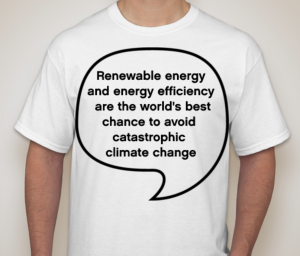
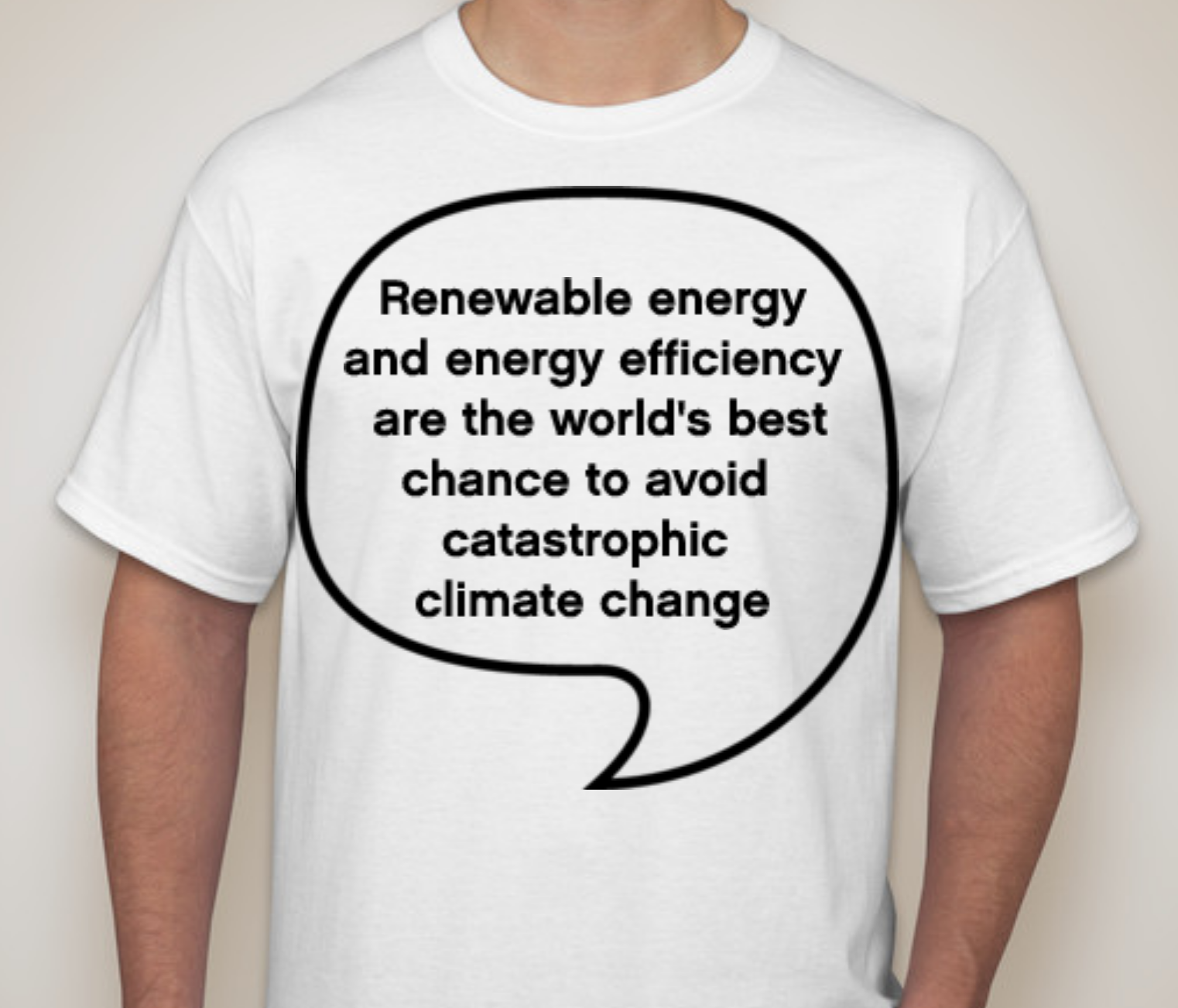
ECO finds some of the findings so cool that they should be printed on T-shirts, so we did:

RE-Shirt
image-3657

Or how would “If we use more renewable energy, we save money” work on a poster hanging in a minister’s wall?

Renewables are crucial in achieving modern energy access for all. According to IRENA, renewables are now the lowest-cost solution for new capacity in an increasing number of countries and regions. Many RE technologies are significantly cheaper than diesel- or kerosene-based systems, and cheaper than extending the grid into rural areas with low per capita energy demand. In addition, renewables offer more security and greater reliability than fossil fuels.

There are other benefits too. Doubling the share of RE in the global energy mix to 36% by 2030 could result in 900,000 additional direct jobs in the energy sector, and reduce health-related costs by up to US$200 billion annually.
... Read more ...