Categoría: Previous Issues Articles

We want you to panic – this is a climate emergency

Dear Delegates,

Some of you might have read the famous Harry Potter books and may remember thinking: ‘How implausible to create a story where a bunch of children have to show up at the government ministry to warn adults about the dangers threatening the very existence of their world!’

Well… it’s 2019 and much has happened since 16-year-old Greta Thunberg spoke at COP24. Last month, 1.5 million young people took to the streets of 120 countries, refusing to accept inaction on climate change. The climate emergency is here – and young people are telling us it’s time to act!

ECO is glad many of you want to contribute to climate action at SB50 and – you would have never guessed – we have some great advice for you. From now on, no meeting of governments on climate can be business as usual. SB50 takes place just before a series of international meetings –  MoCA, G20 Summit, the Abu Dhabi meeting, and the G7. Keeping these events in mind and working towards the UNSG Summit, the GCF replenishment meeting and COP25, ECO wishes to see many informal and formal conversations on expectations and plans to deliver political progress in three key areas: Support, Climate Impacts, and Ambition.
... Read more ...


Loss and Damage is a Core Cure for the Climate Emergency

Just recently, Cyclones Idai and Kenneth killed more than 1,000 people in Mozambique and neighbouring countries, forcing the sixth poorest country in the world to take on an extra US$118 million in debt. The climate crisis’ impacts are increasing, and it is imperative that the international community start addressing them adequately.

Six years after its establishment, it is high time to fully operationalize the Warsaw International Mechanism for Loss and Damage (WIM), by putting in place a finance arm and by agreeing on new scalable sources of finance. The review of the WIM that Parties will perform at COP25 needs to fulfill its promise to enhance action and support.  For that, Parties need to engage in a full-fledged discussion on the availability of finance to address loss and damage (L&D) beyond adaptation and similar finance provided, the needs of vulnerable countries, and potential sources to reduce the gap between the two. 

At SB50, ECO would like to see Parties agree on the terms of reference for this review, ensuring it is fit for purpose and enables the WIM to meet its objectives and fulfill its functions. This needs to include whether (i) the mechanism is meeting the challenge of loss and damage currently faced by vulnerable developing countries, and (ii) if it is capable of meeting future loss and damage needs.
... Read more ...

You had one job!!

For nearly 30 years climate negotiators have been focused on building a global climate regime that can leverage the ambitious action we need to limit emissions, the resulting climatic disruptions, and to respond to unavoidable impacts. Although there is still some work to be done, the rules are now largely in place. 
The time has now come for climate negotiators and their governments to direct a laser focus on the primary reason the UN Climate Convention and the Paris Agreement were created – limiting warming and facilitating fair and ambitious climate action to reduce emissions and protect and enhance sinks. After all, everything that has been done for the past three decades has been either to lay the groundwork for this effort, or to deal with the impacts and consequences of our failure to act fast enough. 
So let’s get on with it!
This means, first and foremost, taking every opportunity to ensure that the central instrument of the Paris Agreement – Nationally Determined Contributions – live up to their world-changing potential. NDCs 1.0 clearly have a lot of bugs and are not up to the task. It’s a no brainer that every country must revisit their plan and prepare to submit a revised version by 1 September 2020 at the latest, in line with their fair contribution to putting the world on a 1.5°C  path.
... Read more ...

Switzerland Astray: Parliament Decides to Kill the Domestic Reduction Target

ECO still cannot believe what happened in Switzerland earlier this week! While we all listened carefully to President Alain Berset’s opening speech on Monday, reminding everyone (in particular his MPs it seems) that“we can only succeed […] if all states – really all – reduce their emissions”,his Parliament back home almost simultaneously decided to abolish the domestic emission reduction target for the period 2020-2030!

Yes, you read correctly: Switzerland may have no target for domestic CO2- emissions reduction past 2020! ECO wonders what’s happening in the small but pristine and wealthy land of milk and honey (ahem.. chocolate) behind the Alps!

Wasn’t Switzerland the first country in the world to announce an ambitious INDC well ahead of Paris? And isn’t the Swiss delegation known for their persistent push on a robust transparency framework, strict criteria (“same for all!”) and a mechanism to continuously increase mitigation ambition?

Perhaps ECO isn’t alone having fallen for a slightly distorted picture of a seemingly progressive, clean and (self- proclaimed “recycling champion”) country. Time to lift the curtain of cheese and fondue:

Indeed, Switzerland announced in early 2015 its INDC of a reduction by 50% of CO2 emissions by 2030 (compared to 1990). But what the Swiss government did not mention back then is the intention to achieve almost half of it abroad.


... Read more ...

Top Tips For Delicious Climate Accounting Finance

How would you like your accounting, readers? Consistent, well done, and accurate? (In that case I’d recommend our MDB special.)

Or maybe you’d like a loan soufflé? Or perhaps lots of different methods all mixed together – with sprinkles of figures plucked from the air (for the climate component of aid programmes)?

Seriously though, accounting rules are important, as this is what will incentivise good quality climate finance.

The SCF and the OECD both delivered reports this week. They gave us some figures, which sound very nice, but when we looked a bit closer they seem inflated. And there are worrying trends on adaptation, and on flows to LDCs.

We have some top tips:

  • Measure what matters: We need to encourage more spending on adaptation. Both the OECD and the SCF show that this is still underfunded. No more than one quarter of climate finance, which is far from the Paris Agreement’s stating that “provision of resources should also aim to achieve a balance between adaptation and mitigation”.
  • Furthermore, the need to keep track of how much goes to LDCs. The OECD forgot. Standing Committee on Finance said this was only 24%, and 2% to SIDS. Grant-equivalent accounting: We’d also recommend you account for the climate finance that developing countries pay back to donor countries – those South-North flows – because loan repayments are not captured at the moment.

... Read more ...

Make Human Rights and the Rulebook a Happy Family for Christmas

As the weather gets colder and Parties work to make a complete rulebook, the spirit of the Paris Agreement — the eight rights based principles included in the Paris preamble are looking forward to being part of that happy family.

How do their chances look? Advocates argue that effective implementation of the Paris Agreement requires people to be at the centre of all climate decisions-making processes and actions. Parties must include the following fundamental elements throughout their implementation guidelines: human rights, indigenous peoples’ rights, public participation, gender equality, just transition, food security, ecosystem integrity, protection of biodiversity, and intergenerational equity.

But some feel their presence in the Paris preamble is enough to allow them to thrive in climate action around the world, or that mere reference to the preamble in the Rulebook would be enough or that maybe just one or two of the principles need to be included.

Including human rights language within the Rulebook itself will help Parties develop and implement the effective climate action needed to stay below 1.5oC. Ultimately, this is what the Rulebook is about: giving guidelines to Parties, to help them to put general principles into concrete steps for necessary climate actions.

We were pleased to see many of the rights have a home in the current text in APA agenda item 3 on the planning processes of NDCs, but we are wondering why some elements are still left behind.


... Read more ...

Takeaways for a Successful Talanoa

The purpose of the Talanoa Dialogue is to take stock of the collective efforts of Parties in relation to progress towards the long-term goal of peaking GHG emissions as soon as possible and achieve net zero emissions by mid-century, in order to limit global warming to 1.5°C. The outcome of the Dialogue shall also “inform” the preparation of countries’ nationally determined contributions.

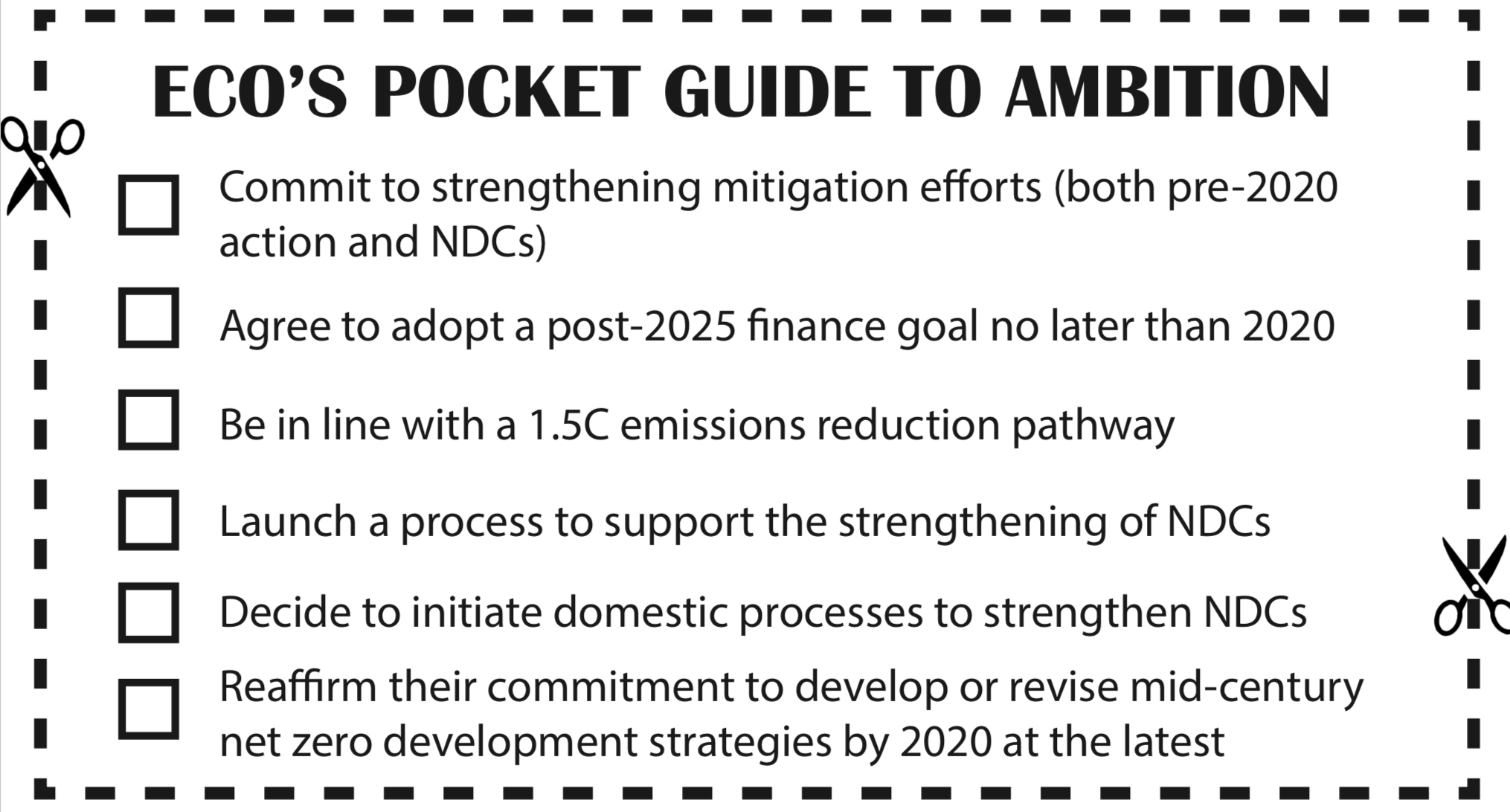
The IPCC SR1.5 makes clear that the world is not on track to limit warming anywhere near 1.5°C. The only conclusion that can be drawn from this exercise is that the current level of ambition is woefully inadequate. In Katowice, Parties must correct course, by agreeing on six key elements of a COP decision on Ambition.

To help negotiators stay on track, ECO has put together a helful pocket checklist:

image-8700

12 Years Left

Today, Parties will get to hear both the urgency of the crisis as well as the feasibility of achieving a 1.5°C pathway straight from the horse’s (or in this case scientist’s) mouth at the SBSTA-IPCC special event on the SR1.5. While ECO does not want to steal the IPCC’s thunder, ECO did want to highlight a few key points from the report.

The scale of the task is clear: the world needs to halve CO2 emissions in little more than a decade and achieve net-zero emissions by mid-century. This will mean a rapid phasing out of fossil fuels and a transition to a 100% renewable energy future. If the world were to follow the P1 pathway it would mean close to an 80% reduction in coal use below 2010 levels by 2030, with significant cuts in oil and gas are well. Time is of the essence for Parties to strengthen their NDCs and mid-century emission reduction development strategies, accordingly!

In terms of ECO’s question on how to respond to the SR1.5, ECO hopes that the SBSTA chair listens closely to the present by the IPCC and delivers as thorough a summary report as the Chair developed for the last SBSTA-IPCC special event held in May 2016. This report should feed into the Talanoa Dialogue and its outcome.

A Step in the Right Direction

On Monday, the World Bank released news of its post-2020 climate action, to cover 2021-2025.

The announced USD$200 billion is good news. Quite a lot of zero-carbon resilient-infrastructure building good news, in fact, and the Bank has doubled its existing climate finance commitment. The World Bank (minus the IFC) has also committed to 50% for adaptation. Did other MDBs hear that?

Who could complain about the newly-pledged efforts to support 36GW of renewables and 1.5GW of energy efficiency savings? Or helping 100 cities decarbonize?

It’s just that the Bank has failed to actually state a climate target, or even how much carbon savings all that money will aim to achieve. It has not promised to end funding fossil fuel infrastructure completely, either directly or through intermediaries, although its prior announcement to stop funding upstream gas and oil remains a very positive step. This remains a gaping hole in the Bank’s stated climate ambition.

Perhaps the simplest way to set a climate-ambitious target would be to pledge, as civil society called on them to do at their October annual meeting, that the World Bank will make ALL of its portfolio lending compatible with 1.5°C.

And please remember in the midst of all the joy surrounding the new announcement, that most of the money from the banks are loans that must be paid back — by the world’s poorest countries.