
Categoría: Previous Issues Articles

Adaptation Fund: The Litmus Test
AF chart
image-2604

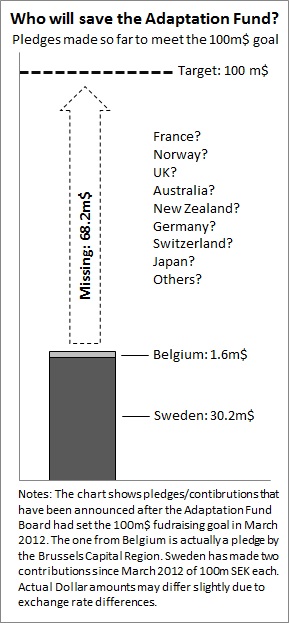
As delegates are reorganizing their first week notes for ministers back home, ECO offers the chart below for inclusion in their briefings. It shows the gap that developed countries should fill next week to meet the US $100 million fundraising goal for the Adaptation Fund.

We are confident that the goal can be met – how can we believe the claims that the long-term goal of mobilising $100 billion a year is within reach if they can’t provide even this much.We will keep track of forthcoming announcements and update the chart as needed.

Developed countries eager to be included in the chart with their contributions are invited to contact the ECO email.


Bunkers: No More Evasive Maneuvers

The way things are going, ships and airplanes will be able to cruise the seas and skies without serious emissions control measures for some years to come. Earlier this year the International Maritime Organization (IMO) indefinitely suspended its consideration of market based measures (MBMs) that can put a cap and a price on emissions in line with the polluter-pays principle.

In early October, the International Civil Aviation Organization (ICAO) decided to ‘develop’ (the text neglected to commit to actually ‘adopt’ or ‘implement’) an MBM by 2016 – not a particularly noteworthy achievement after well over a decade discussing these very measures. And the only emissions target mentioned in the agreement (but still in essence bracketed by party reservations) is carbon neutral growth after 2020. Meanwhile, under intense pressure from airlines and many governments, the EU is severely scaling back its ETS coverage of international air traffic, the only measure in the world that regulates aviation emissions.

The shipping and aviation industries must be very pleased with themselves. Thanks to their intensive lobbying of transport ministries and the tendency by governments to treat these sectors as a proxy for the broader negotiations, countries seeking action on emissions from these sectors have practically thrown in the towel.
... Read more ...

Brazil Goes in Reverse

There was rather astonishing news from Brazil this week. A report by the National Institute for Spatial Research (Instituto Nacional de Pesquisas Espaciais – INPE) reveals that deforestation in the Amazon region has increased by 28% from August 2012 to July 2013. This is the third largest rate of deforestation ever registered.

The real number is surely larger if you take into consideration cloud cover — and that the bad guys on the ground are getting smarter and cutting the forest in a greater number of ever smaller areas.

Although the Minister for the Environment is trying to put the blame on the States that make up the Amazon region, we are hearing that it’s really the Federal government that  bears the major responsibility.

For years, Brazil has showcased deforestation in these meetings as the main component of its voluntary mitigation commitment/promise. But the new forest law the government pushed through Congress last year included major concessions to the agro-business lobby.

And to be clear, no other sector of the Brazilian economy has contributed to emissions reductions – ever. So greenhouse emissions are on the rise everywhere. The momentum from the very substantial reductions of forest emissions in recent years is being reversed by

Brazil’s accelerated economic growth plan and the return of increased deforestation.
... Read more ...

EU: When 40 Is Only 33

Coming to Warsaw, ECO was feeling somewhat optimistic. Fresh statistics suggested that global CO2 emissions growth has slowed a bit, which could be the first sign of an approaching emissions peak. In September, China announced took a major positive step — a direction change in its coal policy. Three key industrial provinces must peak and decline coal consumption by 2017 and ban new dirty coal plants.
But then came the damaging announcements by Australia and Japan, whose shifts are in the negative direction.

After a week like this, we certainly don’t need more bad news.  But according to rumours, the European Commission is preparing a proposal for a 2030 climate target of a meagre 40% reduction against 1990 levels.
The EU has long been seen as setting a global high water mark on ambition.  Yet now it is undermining its own objective to keep global temperature below 2°C.

Yes, 40% seems like a lot – so let’s explain what this means.  A 40% target for 2030 would in practice bring the EU on a pathway towards real emission cuts of merely 33% by 2030 due to the amount of surplus emission allowances in the system.  Indeed, in order to accommodate the huge oversupply of surplus pollution permits in the EU’s carbon market, any 2030 target would need to be 7% stricter.
... Read more ...

A Tale of Two Transparencies

There is much on the Warsaw agenda for enhancing the current MRV system from Cancun as well as enabling the ex ante equity and adequacy review of post-2020 targets.

But the lack of progress regarding the review guidelines for developed country biennial reports and developing country International Consultation and Analysis (ICA) reports is disheartening. In both cases, the importance of a strong technical assessment is crucial, though the purposes are different.

For developed countries, expert review should be able to assess progress on fulfilling commitments as well as identifying potential problems.

At the same time, for many developing countries, the new biennial update reports and the process to analyse them were significant improvements on previous reporting efforts, especially since it was the first time they agreed to be subject to some sort of scrutiny.

However no one expects these reports will be perfect from the beginning. It would be very beneficial for the technical expert teams to recommend further improvement in these reports – after all, they are called ‘experts’.

Looking forward to the post-2020 tabling and assessment of commitments, Warsaw needs to set up a clear process to generate the most ambitious and fair offers by the time we reach our final destination in Paris.
... Read more ...

Close the Gap!

On Wednesday the second Structured Expert Dialogue of the 2013-2015 review began to assess overall progress towards achieving the long-term global goal, including the implementation of commitments under the Convention.

The IPCC authors conclude that there is a 1000 Gt carbon budget for humankind from the starting point of the fossil fuel era. Within that budget there is a 66% likelihood of staying below 2 degrees.

We have already used half of that budget and, taking into account other greenhouse gases, only 270 Gt can still be emitted to remain within the safe lines.  That’s a shockingly small carbon budget to stay with a climate that is relatively safe – and even then substantial impacts will still occur.

Most numbers from the IPCC are associated with uncertainties. From a risk assessment perspective (or common sense, depending on how formal you want to be), higher uncertainty requires a lower carbon budget. So remember, even a 66% likelihood means a one-third chance of going beyond 2 degrees.

Furthermore, action on short-lived forcers like methane cannot replace or ‘buy time’  on long-lived greenhouse gases, especially CO2.  We need substantial reductions of them all.

However, while the Structured Expert Dialogue did not formally draw conclusions, it is clear that the overall progress made so far towards achieving the long-term global goal is small and far less than what is necessary.
... Read more ...

Gender Equality: Making Progress

The time is now for gender equality in the climate change negotiations.  And you ask why? — doesn’t climate change affect us all?

A common sense human perspective on climate change and its solutions needs to uphold the rights and respond to the diverse needs of the entire population. Gender is one of the foremost social categories in determining roles, experiences and perspectives in human society. If climate policies and solutions are to meet the needs of women and men, girls and boys, equally – and be effective – policy makers must understand these gendered dynamics.

It took 19 years for common sense to land on the agenda of the UNFCCC, but here it is.  The dynamic discussions on gender equality and climate change in the SBI, during both Tuesday’s workshop and Wednesday’s SBI contact group on the draft conclusions, highlighted great strides in recognizing the human face of climate change in this process.  Yes, there is progress in a sea of stagnation.

Now, Parties have an opportunity to take robust and innovative action towards the goal of gender-responsive climate policy, or to put it another way, policy that meets the needs of all individuals equally.

Recommendations are being tabled to incorporate gender guidelines into ongoing and existing initiatives, programmes and processes under the UNFCCC; tools for accountability to and reporting on gender responsive climate actions; calls for innovative funding, capacity building and networking to strengthen women as decision-makers in this process; and recommendations to further education and training on how to understand climate policy through a gender lens.

The CDM Must Protect Human Rights

During the CDM workshop held this past June, Parties heard firsthand testimony from Weni Bagama, who spoke out passionately about the impacts of the Barro Blanco CDM project — a 29 MW hydroelectric dam currently under construction on the Ngäbe indigenous territories in Panama.

Weni described how the company failed to adequately consult the affected communities, a clear violation of CDM rules and international human rights standards. Despite concerns raised regarding consultation and other human rights abuses during the validation process, the CDM executive board approved the project in January 2011.

Since then, James Anaya, the UN Special Rapporteur on the rights of indigenous peoples, visited the affected communities to investigate the human rights abuses associated with the hydro project. In his concluding statement, the Special Rapporteur highlighted the Barro Blanco case, and clearly articulated the international human rights obligations that should apply. He further stated that this case is emblematic of the many development projects that are threatening the lives and livelihoods of indigenous peoples in Panama.

Barro Blanco does not stand alone.  It is one of many projects that illustrate how the CDM has failed to ensure that projects are designed, implemented and monitored in a manner that protects human rights.
... Read more ...