ECO Newsletter Site

Team Koronivia: Do you think the rulebook is going in the RIGHTS direction?

Once upon a time, 197 parties signed an agreement somewhere near the Eiffel Tower, to address our climate. They called it the Paris Agreement.

In the city of lights and with a light of hope, those 197 parties agreed, among others, to safeguard principles of human rights, including the rights of indigenous peoples, food security, just transition, ecosystem integrity and protection of biodiversity, intergenerational equity, gender equality and public participation.

But ECO is starting to feel a bit puzzled … we’ve heard that a Rulebook is being written to implement this Paris Agreement, but that the great eight principles are incomplete, and scarcely and shyly mentioned.

A few of those principles are mentioned (although heavily bracketed). But we’re sad to see food security has been left out.

Negotiators who have worked hard in the discussions under the Koronivia Joint Work on Agriculture to safeguard food security in a changing climate might feel that their efforts are being undermined by this APA oversight. After all, they might agree with ECO that there is a risk that Team Koronivia could end up developing excellent guidelines or outcomes on food security — only to see farms, lands and livelihoods threatened by misguided climate action.


... Read more ...
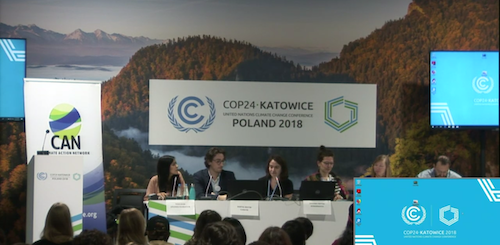
ECO 4, UN Climate Conference, Katowice, December 2018 – The Big ECO For Big Ambition Issue

Eco banner, 1024x357

Content:

  1. 12 Years Left
  2. Have You Done Your Stretches?
  3. Voices From the Front Lines
  4. Eating Away at the Paris Agreement
  5. Equity in the Global Stocktake – Good Text. Let’s Improve It, Not Lose It
  6. It’s Not Sufficient to Avert and Minimise if We Forget to Address
  7. Fossil of the Day
  8. Switzerland Astray: Parliament Decides to Kill the Domestic Reduction Target
  9. Top Tips For Delicious Climate Accounting Finance
  10. Make Human Rights and the Rulebook a Happy Family for Christmas
  11. Takeaways for a Successful Talanoa
 … or read this ECO as a pdf

12 Years Left

ECO was deeply impressed by yesterday’s SBSTA Special Event on the IPCC Special Report on 1.5 degrees. The world’s best climate scientists have compiled an avalanche of new information on the advantages of restricting warming to 1.5 degrees . Up to several hundred million fewer people would be exposed to climate related risks and susceptible to poverty by 2050 if warming is limited at 1.5 instead of 2 degrees. The area of risk of undergoing a transformation of ecosystems from one type to another is 50 % lower with 1.5 degrees that with 2 degrees of warming. Every tenth of a degree of warming really matters.

But ECO also felt a bit overwhelmed by all of this – a three hour Special Event one afternoon is just not enough to do justice to the Special Report and all the information contained in it. Therefore, ECO was happy to hear Grenada’s proposal to have a deeper analysis of IPCC SR1.5 as an agenda item for the next SBSTA session(s).

There is just one problem with that: We have only 12 years left to reduce global CO2 emissions by almost half if we want to keep the Paris 1.5 degree warming limit in reach without counting on vast amounts of negative emissions.
... Read more ...

Have You Done Your Stretches?

ECO has been running back-and-forth from the negotiations in areas B and D to side events in area G. ECO is getting quite the exercise! However, ECO forgot to stretch before exercising – and now, ECO feels sore. ECO hopes that Parties in the transparency negotiations don’t make the same mistake. We all know that stretching is vital to maintaining individual flexibility and improving balance so you don’t slide off slippery sidewalks.

Speaking of (back-)sliding, ECO would like to remind Parties that they decided in Paris that they would maintain at least the frequency and quality of reporting as under the Convention.ECO thinks this applies to reviews as well…there’s no avoiding a true technical expert review.

Flexibility and support are crucial, so reporting and transparency can improve over time. Luckily, the Paris Agreement clearly provides flexibility for those developing country Parties that need it in light of their capacities. Flexibility and support have to be provided to develop the capacities of those Parties who need it. But you can’t keep stretching forever, at some point you need to begin exercising. Flexibility should no longer be provided to Parties once they have the capacity. Improvement plans are a great tool to help Parties to build their capacity over time as well as to track their progress.


... Read more ...

Voices From the Front Lines

Hajji Mohamed used to make a living as a rice farmer on the fertile soil of Bhola Island in Southern Bangladesh. He’d saved enough in the 1980s to get to Mecca for the pilgrimage and looked forward to providing for his family in the years to come. But disaster struck in May 1997 when Mohamed and his family were caught in a devastating cyclone. They survived but their home and farm had been swept away.

For Mohamed, cyclones had become part of his life, and he was able to rebuild and start over. But from 2000 onwards, high tides and cyclones became more frequent around the island. Nearly every year, Mohamed’s family was forced to relocate as the soil became too salty for growing his crops. Floodwater rushing down from the distant glaciers melting in the Himalayas posed yet another peril. Great swathes of land fell into the river and time and time again Mohamed was forced to move inland. When I met him early last year he was destitute. His community uprooted, his family dispersed to the slums of Dhaka and Chittagong with their own troubles, Mohamed was alone and begging for food from people hardly better off than himself.


... Read more ...

Eating Away at the Paris Agreement

“I am so hungry”, ECO told itself as it went out of Mazowsze Plenary room. All that talk about transparency reminded ECO of the hole in its stomach. ECO had reached its common time frame for nourishment, having not eaten for more than four hours. ECO was craving some plant-based locally sourced food to silence the growling belly.

ECO spotted the Grab and Go right across the hall. It was salivating for a salad with Polish cabbage, tomatoes and potatoes, and a freshly pressed carrot juice to go with it. And for dessert a banana and an almond milk cappuccino. ECO was happy to know that those plant-based food choices would help mitigate the growing emissions from the agriculture sector, which are projected to reach 52% of global emissions by 2050.

ECO joyfully set itself in the queue to order, but as it arrived to the front, a full platter of baguettes filled with sausage slices occupied half of the shelf. The rest of the menu was overwhelmingly meat based. The cafeteria cuisine wasn’t any better. “Vegetable broth with bulgur groats it is!”.

Later that evening, as ECO entered the Spodek arena for the much anticipated COP24 Welcome Party, it noted the same meat-loving theme: Sausages with ribs and sausages with a side of sausage.


... Read more ...

Equity in the Global Stocktake – Good Text. Let’s Improve It, Not Lose It

Fortunately, the Saudis aren’t in charge of the Global Stocktake. ECO notes this because yesterday Saudi Arabia, speaking for the Arab Group, called for the term “ambition mechanism” to be deleted from the GST text. Why? Because apparently this would pre-judge the outcome of the GST (see also, Fossil of the Day). As if the whole point of the GST wasn’t to drive the ambition mechanism.

In any case, this view clearly isn’t shared by all developing countries, many of whom are submitting good and useful text. Here are some nice examples:

  • “Equity will inform how Parties will consider fairness and ambition,”The explicit statement makes it clear that equity isn’t just a matter of process, but rather comes down to how parties perceive that they are making appropriately ambitious contributions to the global transition to climate resilient, low carbon societies.
  • The GST will “identify gaps in collective progress and how they could be addressed in the light of equity and the best available science, as well as lessons learned and good practices.”This one makes it crystal clear that we’re talking operational text here, and that the GST would result in concrete outputs that Parties take home and apply to increase their ambition over time – the core point of the ambition mechanism.

... Read more ...

It’s Not Sufficient to Avert and Minimise if We Forget to Address

Yesterday we were treated to the draft decision text of the report of the Executive Committee (Ex-Com) of the Warsaw International Mechanism (WIM) for Loss and Damage associated with Climate Change Impacts. The report starts off well, highlighting the forthcoming review of the WIM, seeking inputs to the terms of reference for the review, and reminding everyone of the importance of the IPCC special report on 1.5oC. Sadly, that’s where the positives cease. But ECO thinks it might have a suggestion on how to improve the text.

But first, a slight detour: At many previous COPs, negotiators have struggled to come to terms with the fact that Loss and Damage is separate from adaptation. Amazingly some WIM Ex Com members attempted to subsume Loss and Damage under Adaptation, despite the fact that it is a separate article in the Paris Agreement. This would ignore the plight of the millions of people already facing the irreversible consequences of climate change; for many of them it is already too late for adaptation. The IPCC 1.5 report has confirmed that loss and damage is a real problem, with substantial evidence of the impacts, causalities and attributions.

Maybe the problem with loss and damage is that negotiators are too focussed on two of the three tasks from the Paris Agreement, namely to avert and to minimize – but somehow forgot the third one, to address?


... Read more ...