
Eco 3, COP18 Doha 2012 – Bubbling Issue
 |
Content:
What a difference a year makes? 2012 has been all about tying up the loose ends of the Durban package, which by the end of Doha should form a nice bow of an amended Kyoto, concluded LCA, and work plans for both ADP tracks. (And ECO won’t object if any Party would like to throw ambition into that mix!!) Today’s ADP roundtable will begin to flesh out what the work programme to reach a 2015 Protocol should cover. ECO has a few initial thoughts. First, what to do about those remaining LCA issues? Many of these are clearly relevant to the 2015 discussion. Take equity for instance. ECO is overjoyed that the LCA chair’s text included a work programme on equitable access to sustainable development, as this provides a good platform for discussions on equity principles and indicators, a key element for successful ADP outcome in 2015. We’ve had one productive workshop on the subject, but there is much more to say about what EASD looks like exactly. What are the principles that should guide this issue? And what does that mean for IPR, trade matters, human rights and any number of other issues in practice? This is a crucial discussion and one that clearly must inform the work of the ADP.
Will Doha Burst the Hot Air Bubble?A staggering 13 billion emissions permits are left over from the first Kyoto commitment period. Hot air is looming large – and threatens the viability of CP2 and any future climate deal. ECO would like to remind delegates that the problem is the result of extremely weak CP1 emissions targets well above what countries were projected to emit. Poland, for example committed to a 6% reduction from their 1988 emission levels, despite the fact that in 1997, when the Kyoto targets were set, Poland’s emissions were already about 20% below 1988 levels. ECO warns the distinguished delegates not to fall for the bogus claim that the existence of hot air is the result of dedicated action. It’s not – and the economic downfall of the nineties cannot lead to inherited rights in the climate change process. But memories are short. ECO can’t help but notice that Parties are about to make the same mistake again: Low pledges for CP2 mean that another surplus of 3 to 10 billion tonnes will accumulate by 2020. Add to that the 13 Gt surplus from the first phase and you have rendered any Kyoto targets quite meaningless. Yet Russia, Ukraine and Poland, the largest surplus holders, insist on keeping the right to sell their hot air.
REDD+ At Bali+5Five years after Parties endorsed the Bali Roadmap, we are far down the road on several REDD+ issues, but all over the map on others. It’s now time for SBSTA to complete recommendations on Monitoring and MRV and to move forward on safeguards, reference levels and drivers of deforestation. Though tracking emissions, removals and changes in carbon stocks are necessary, counting carbon tonnes alone is not sufficient for successful Monitoring and MRV. To ensure REDD delivers benefits for the climate, forests and peoples, Monitoring and MRV must contribute to the sustainability and permanence of pollution reductions. To contribute to this, Parties should build further consensus on the technical review of reference levels, on comparability and consistency of units of measurement in pilot testing and implementation, and on information systems for safeguards. SBSTA’s decisions must also be applied consistently throughout REDD+ readiness activities, pilot programs and implementation with results-based incentives. Further, REDD+ policies will not significantly reduce deforestation and forest degradation unless they also minimize the internationally-driven, demand-side drivers on the world’s forests. Compared to other mitigation strategies with long lead times, REDD+ activities make unique contributions to enhanced mitigation action, as well as deliver non-carbon benefits, before 2020 and after 2020.
What’s Wrong With Poland?The Polish government lives in the past. Because of that it believes Poland should be treated as a special case forever. It fails to acknowledge that a lot has changed in the country since the 1990s. Poland is a developed country now. But instead of strengthening Poland’s climate policies to further enhance competitiveness, its government blocks any action on climate change and threatens the country’s future. So far, Poland has done everything it can to be the lone bad guy in the EU. Poland already stood alone thrice in opposing European efforts to take more ambitious climate action for 2020 and beyond. ECO understands that Poland wants to be seen as a strong EU country. But domestically, the Polish authorities have done everything but be an equal partner, such as failing to fully enforce important EU laws. And to top its opposition to stronger action by the EU, it plans to build new coal and nuclear power plants, open new lignite mines and extract shale gas. This when most European countries are transitioning to a low-carbon economy based on renewables and energy efficiency. At the UNFCCC negotiations the Polish government has been blocking the EU from finding a constructive, unified position to address the 13 billion AAU surplus.
Arabs: It’s Time To Lead!For the first time in the history of UNFCCC negotiations an Arab COP has officially begun. Qatar, of the rich Persian Gulf, is hosting the 18th Conference of Parties. A lot is at stake in these 2 weeks and we are all expecting the Presidency and the Parties to deliver a successful, balanced outcome that will ensure climate action pre and post 2020. Our eyes are on Qatar and all the other Arab countries as negotiating Parties. The COP not only brought the climate debate into this climate vulnerable Arab peninsula, but also stimulated the newly established Arab Youth Climate Movement (AYCM). ECO easily spotted many of them in the hallways, and they had a message for their countries; “Arabs: It’s time to lead!” The Arab world is feeling the grave impacts of climate change with droughts, decreased precipitation and floods. They have, however, not planned major shifts away from business as usual, let alone put climate change on their political agenda nor do they demonstrate willingness to take action internationally. The Arab spring has created a platform for social change, youth engagement and social change. It has in turn brought a climate spring and many young activists who will be strongly calling on their governments to provide mitigation/adaptation strategies to combat and reduce climate change impacts.
Australia To Join Carbon Diet ClubNow you all know that ECO doesn’t like to be rude to Parties, but surely all would admit that Australia is carrying excess carbon weight and needs to lose some carbon flab. So ECO was delighted to hear a few weeks back that Australia was signing up as a member of the KP2 carbon weight loss club. ECO had visions of a trim physique of a zero-carbon economy. But oh dear Australia – what happened with your target? 99.5% of carbon emissions – really? That’s a carbon loss goal so small that a bit of rounding and pffft it’s gone. Haven’t you heard that carbon flab is bad for your health? The UNEP doctor has said you need to trim down by 25-40% for all our sakes. Surely a sporty nation like yours knows about “no pain no gain”? Especially as your own economy doctor Garnaut has said the sooner you start the easier it will be. Could your fossil fuel addiction be swaying your resolve? ECO knows you have all those stashes – but you’ve got amazing clean energy resources as well to help wean you off. So where do we go from here? Well you do have a reasonable weight loss goal in column 6 and there’s plenty of support meetings over the next two weeks.
Fossil of the Day
The First Place Fossil is awarded to Turkey. Although Turkey is the world’s fourth largest investor in coal, recording the largest relative increase in annual GHG emissions between 1990–2010 with Ankara declaring 2012 the year of coal, Turkey is asking for more funds in the climate negotiations. This is even though Ankara did not post any QUELROs for the first commitment period. To make matters even more fossilised, Turkey has already declared they wont make a pledge for the second commitment period of the Kyoto Protocol. Although, they work almost invisibly during the negotiations, so as not to receive too much attention, it’s clearly their time to step onto the fossil stage! It’s your turn Turkey for a Fossil! The second place Fossil of the Day goes to the EU for having already reached their pledged 2020 target of 20% but having so far failed to increase even though there is still almost 10 years to go. How outrageous! Is the EU really planning to go for the next 10 years without doing ANY further emissions reductions? EU you will need to quickly increase your target or the clouds will appear and it will start raining even more fossils on your negotiating table.
Adaptation Committee: Kick off To Adaptation Leadership?The Adaptation Committee has worked hard to prepare its ambitious three-year work plan, with only one meeting held in 2012. In order to be able to perform this necessary leadership role, ECO urges in particular developed country Parties to provide the necessary means for the work of the Adaptation Committee. ECO welcomes that the Adaptation Committee plans to address the importance of understanding adaptation best practices and needs of local and indigenous communities. But there is one piece missing in the overall picture: The COP should recognise the value that the Adaptation Committee work may have for the ADP negotiations towards a 2015 legally-binding instrument. It can substantially inform the work of the ADP, so that the future agreement can help scale-up adaptation based on the needs identified. ECO knows that civil society is willing to contribute to the Adaptation Committee’s work, and encourages committee members to facilitate these inputs. A gap in the rules of procedure should be closed, namely webcasting meetings where possible. The Adaptation Fund is a good precedent in this regard. Last but not least, ECO is pressing the Adaptation Committee to act in a proactive manner by holding events, workshops, etc. on specific adaptation needs and responses.
Seeing Signs…?While waiting in traffic on the bus to the Qatar National Convention Centre, ECO had time to admire the local COP18 advertisements, in cluding this one that seemed opposite of the less then 2 degrees messages ECO has so often discussed. Typo? Subtle message about the future of the planet? Something more sinister? You decide. 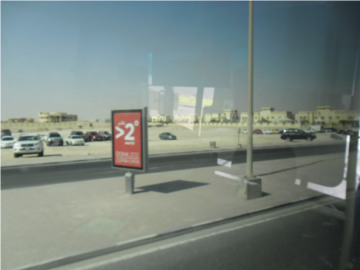
Photo Credit: Ian McGregor 
|