
ECO Newsletter Blog
LCA Gaps: From Text to Tonnes
In Durban, Parties agreed to conclude the LCA here in Doha. A successful closure necessitates that the critical issues are resolved or find homes in which further work can be done. In the LCA text tabled Monday, there were some gaping gaps, from text to tonnes.
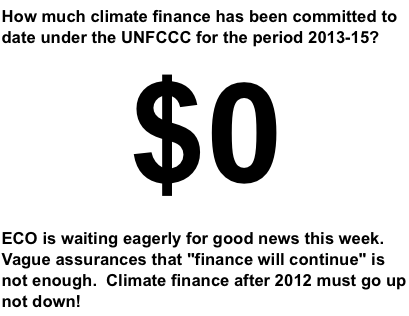
ECO was shocked that text on 2013-2015 financial support turned up missing. There needs to be at least a doubling of fast-start financing, and a mandate for a political process to scale up financing to reach the 2020 $100 billion per annum target.
Adding insult to injury these two issues are also missing from the financing text advancing under the COP. No wonder there are strong calls for the MRV of finance if this is the state of play!
The 2-year Doha Capacity Action Plan and decisions on enabling environments including IPR and on the interlinkages between the different bodies under the Convention, including the CTCN and TEC, also seem to be missing in the the text.
Where there is text, ECO is concerned that it lacks ambition and environmental integrity. The work programmes under the SBs for clarifying commitments and actions inspire little confidence that such processes will lead to the increase in mitigation ambition so sorely needed up to 2020 and beyond.
... Read more ...
Closing the Loose Ends for Adaptation
As COP 18 welcomes Ministers from around the world, ECO would like to focus their attention on significant matters related to adaptation. May we have your attention, Ministers: adaptation needs are closing in fast!
National Adaptation Plans. These are intended to address medium and long term adaptation needs. Let’s keep this short and sweet:
First, guidance to the Global Environment Facility is needed now. LDCs are committed, the technical guidelines are out, and there is clear willingness among other developing country Parties. So really, there’s no excuse for delays.
Second, use those funding bodies. The LDCF and SCCF are ready, willing and able to be capitalized. There’s no denying that more funding is needed and this must be additional to that of NAPAs. Otherwise, all the good and benevolent intentions of NAPs are completely without effect.
Loss and Damage. Political opportunity cannot be lost here:
As negotiators are running out of steam from all their work on the L&D text, ECO will pitch in to make sure that this reaches success. These points should steer you in the right direction:
- Loss and damage needs to be given the political space that it deserves; negotiators must keep the political will to keep loss and damage high on the agenda.
... Read more ...
Note to Self: This Week, Agree a Strong CP2
Today’s Thought for the Unwilling: why a strong CP2 is better for you…
ECO would like to remind Parties that hold large amounts of Kyoto surplus units: Insisting on lenient use rules and refusing to agree to cancellation at the end of 2020 may get you the opposite of what you want.
Why would developing countries agree to a CP2 with no ambition, no provisional application, no 5 year period, no finance . . . Why should these countries agree to such a miserable CP2 deal?
If the KP negotiations fail in Doha, it would mean your AAU surplus will vanish overnight, because it is only under a working KP that your AAUs have any meaning or value. So simply blocking progress on this issue may well turn against what you are hoping to achieve. ECO believes that there much more constructive ways out of this mess. Please take notes!
Ukraine – it is time to end your timid silence! How about joining the Kyoto family with an ambitious target and not selling any of your surplus? Such bold action may even be your ticket into the EU-ETS.
Belarus and Kazakhstan – don’t get off to a bad start by supporting carryover of hot air owned by others!
... Read more ...
Fast Start Finance: Mixed Results
Climate finance is not generosity or voluntary aid – it is a moral and legal obligation of developed countries, and an essential element of a solution to the climate crisis. But concrete commitments to financing are absent here so far.
Now ECO has heard some grumpy noises from developed countries that their fast start financing and transparency efforts are not sufficiently appreciated.
While not very sympathetic to the rich countries’ plight, ECO under stands how hard it is pry any amount of money out of the hands of finance ministries, especially in difficult economic times.
Treasuries could well be lacking commitment to resolving the climate crisis, and don’t understand why it is absolutely essential to quickly scale up climate finance and meet all commitments transparently and responsibly.
That’s why ECO is taking this opportunity to recognize the fact that developed countries did in fact deliver some climate finance in the Fast Start Finance period, and that climate negotiators and ministers participating in these negotiations had to work long and hard to steer that financing through government budgeting processes and get it delivered.
Even Japan, faced with a devastating tsunami and a nuclear disaster, followed through on its plans, such as they were, which accounted for nearly half the FSF commitments.
... Read more ...
Tarnished: Dirty Oil Smears Canada’s Reputation
Canada’s environment minister, Peter Kent, arrived in Doha yesterday under the long shadow of the tar sands.
Since Durban, his government has been working hard to dismantle Canada’s environmental protection laws to speed up resource extraction, an initiative that government has been promoting under the Orwellian slogan of “responsible resource development.”
ECO has warned over and over again about the creeping influence of Canada’s massive deposit of carbon intensive “unconventional oil”. Larger in geographic extent than the entire nation of Qatar, and generating more emissions than all of New Zealand, the tar sands have been called the planet’s largest “carbon bomb”.
Projections from Minister Kent’s own department show that the growth in tar sands emissions by 2020 (73 Mt) will virtually cancel out all other emission reductions in Canada’s economy (75 Mt). And yet Ottawa has done nothing to curb the sector’s exploding GHG pollution.
Quite the opposite – government documents suggest that Canada has taken international climate policies to some of the largest tar sands corporations in Canada for vetting.
Great news for Canada’s Fossil trophy case: the CEOs love what they called Canada’s “elegant” approach. So now, a new report by the Canadian Youth Delegation, Commitment Issues, digs into the tar sands’ expansion blueprint, documenting the sector’s plans to blow past the production levels outlined in the IEA’s 450 scenario.
... Read more ...
Hope for Change…or?
“We want our children to live in an America that is not burdened by debt, that is not weakened by inequality, that is not threatened by the destructive power of a warming planet.”
– President Barack Obama, Chicago, 7th November
“On the international side, you know, I think that the United States has had a very strong and solid and consistent position since the beginning of the Obama administration and I would expect that to continue.”
– Special Envoy for Climate Change Todd Stern, Doha, 3rd December
Fossil of the Day

The First Place Fossil goes to New Zealand because the NZ Environment Minister thinks NZ is ‘ahead of the curve’ in not signing up to a second commitment period of the Kyoto Protocol. CAN knows the opposite is true. What the Minister fails to realize is that by refusing to sign up to the only international legally binding deal to reduce carbon pollution, New Zealand will become more and more irrelevant in shaping a post2020 regime.
The Second Place Fossil of the Day goes to Canada for serious ‘climate amnesia.’ Today Canada published a timeline of the past 3 years of their climate (in)action in an attempt to “clear the air” as it were, about whether or not Canada is committed to capping warming at 2 degrees.
And the Ray of the Day goes to Monaco for their outstanding unconditional pledge of 30% emissions reductions by 2020. They are also fully committed and on track to complete their commitments from the first commitment period, and are urging others to make pledges as well. Monaco serves as a shining example that this COP needs, and this Ray is to encourage others to follow.
Complete info: www.climatenetwork.org/fossil-of-the-day
Heros and Zeros: Adaptation Fund Facts & Figures
More and more countries seem to recognise the progress and achievements of the Adaptation Fund in recent years. Progress so far was featured at a side event last Friday, held jointly by the Adaptation Fund Board.
First the good news. Only two years after the first call for proposals, 25 concrete adaptation projects have been approved so far and USD 160 million has been allocated. Direct access is now approved for 14 countries, and many more have expressed interest.
The bad news is that the key funding source, the share of proceeds of CERs from the Clean Development Mechanism, has now almost totally dried up. At the end of 2010, it was estimated that revenues would come in as much as USD 400 million by the end of 2012, but only USD 180 million can actually be realised with the current all-time low CER price.
Some developed countries have made contributions to the AF to the tune of USD 120 million, and this is a very good thing. Spain and Sweden have been the heros in this, while UK and Germany have contributed only a tenth as much relative to their GDP than Spain or Sweden (roughly a tenth).
But lots of other developed countries have closed their pocketbooks despite the benefits for vulnerable communities addressed by the AF projects.
... Read more ...
Time to #endfossilfuelsubsidies
Roaming in the halls of the QNCC, it’s not hard to hear the frustration from poorer countries lamenting the lack of climate finance. The only thing louder is the excuses from the richer ones, saying the money is nowhere to be found.
Well, ECO has a solution! A new analysis from Oil Change International shows that rich countries are spending more than 5 times as much on subsidizing fossil fuel companies than their climate finance pledges.
Just a quick perusal of the figures provides some shocking details. Australia, for instance, has subsidized fossil fuels at a rate of 40 times more than their climate finance pledge. The United States? Their climate finance pledge is mere 20% of what they spend subsidizing the richest corporations in the world. That favorite Fossil country, Canada, spends nearly eight times as much subsidizing their beloved fossil fuel industry than they do supporting the most vulnerable.
So, when you hear that there’s no money to be found, now you, dear ECO reader, know exactly where to look! Time to stop subsidizing the industry that is fueling the climate crisis and put that money to use fueling a safe future! (And one place to start would be including fossil fuel subsidy phase out in the pre2020 mitigation work programme…)