ECO Newsletter Blog

Market Mania

Carbon markets are in the dumps and policy makers and market participants alike are scrambling to come to their rescue. This weekend, ECO spent two days with delegates to discuss the future of the Clean Development Mechanism (CDM) and what changes to its underlying modalities and procedures are needed to make the CDM fit for the future. The number of delegates that showed up on Sunday at 9 AM showed us that there is hope.

Let’s start with the good news. For the first time, human rights impacts of CDM projects and harmful impacts of large power supply projects in the CDM were discussed openly! Now dear delegates, it’s time to move into action mode: start by kicking coal out of the CDM, find a way to phase out large scale power projects, improve the stakeholder consultation process, establish a grievance mechanism and move the whole CDM far beyond offsetting!

But ECO is worried that certain Parties that host many CDM projects did not seem to like the proposed changes. Some of them posited that everything was all right with the mechanism and that people who raised doubts about additionality were only showing their ignorance. ECO suggests that a little less self-congratulation would be in order given the number of academic studies that have concluded that there are in fact substantial problems.
... Read more ...
Don’t Be a Quitter, Be a Committer!

In yesterday’s issue, ECO outlined the process for tabling, reviewing and adopting ambitious commitments for the 2015 agreement, including setting a deadline for tabling initial commitments in 2014. ECO thinks it goes without saying that such commitments – in their various shapes and sizes – should be framed in terms of a five year commitment period. But since SBI is still stalled and everyone has some free time, we figured we’d lay out the full case for why that’s true.

First, shorter commitment periods encourage early action. As we all know too well, it is easier to put off action when the deadline is far away – and ECO is all about getting action. Second, your political masters are accountable on 4-6 year cycles, so 2030 targets set in 2015 would be too many election periods away, and hence candidates for “someone else’s problem”. Third, a shorter commitment period reduces concerns about locking in low levels of ambition (wonder why ECO would be worried about low levels of ambition…). Fourth, single year targets don’t give ECO or Parties any certainty over emission pathways (just see the discussions in the SBSTA work programme on developed country targets). Better to have things defined in advance.
... Read more ...

Fossil of the Week – Russia

Climate Action Network (CAN) has slammed blocking moves by Russia which have stalled progress during the first week of the UN climate negotiations in Bonn, Germany.

CAN – a network of over 850 NGOs all working together to combat climate change –  voted to give Russia the nation the weekly fossil award for the country which does the most to block progress in the talks a day early.

Kaisa Kosonen, senior political adviser from Greenpeace International, said so far five days have been wasted as Moscow insisted the rules on agreeing laws in the UN climate process be discussed  – meaning many negotiation sessions could not begin –  and all efforts at compromise so far have been blocked.

“It’s in everybody’s interest that the rules of the game are respected, but frankly, the Russians broke the rules first by pulling out of the Kyoto Protocol and by not taking any climate action even though they are a major emitter,” Kosonen said.

Moscow’s actions seem to stem from their anger over the way their objections to the Doha Decision – which quite rightly removed tons of poor quality emissions permits from the system –  at last year’s major climate talks was ignored.   
... Read more ...

An Invitation….

Distinguished Delegate,

The ECO Presidency is pleased to invite you to a special High-Level Observer Reception in the presence of ADP Chairs Dovland and Mauskar.

The ECO Presidency and ADP Chairs will have the pleasure of presenting you with views, creative ideas and concerns by non-governmental experts closely following negotiations here in Bonn.

The event will begin at 1.15 on Saturday the 8th of June 2013 at the Twilight Ballroom of the Maritim Grand Hotel in Bonn.

* This special event was organised in response to the numerous complaints received from delegates frustrated with the fact that NGOs are not allowed in closed meetings AND limited to short or no interventions in open meetings, due to time constraints. While we love to see delegates reading and quoting ECO, we don’t believe it makes up for these shortcomings in NGO participation under the ADP
* Cocktails will be served to delegates who write down and report on NGO views. Fossils will be distributed to delegates who do not show up to this event (courtesy of ECO).
* Dress code: black tie

ADP – Set a 2014 Deadline for New Targets

One of the reasons Copenhagen was such a mess was that countries’ commitments came at the last minute and weren’t available for any scrutiny beforehand. Some of these pledges are still unclear. Hence estimating the actual reductions that Copenhagen pledges have delivered has been a nasty and complicated chore.

Therefore, ECO has been pleased to hear about Parties’ proposals to set a 2014 deadline for targets and commitments for the 2015 agreement. We think this is important in order for us to be able to assess well before Paris whether targets and commitments represent countries’ fair shares and will deliver a pathway for staying below 2°C, let alone 1.5°C. It would also increase confidence and trust in the process leading up to Paris.

Parties take note! These initial commitments cannot be just whatever – they must be credible and fair. In order for us to ensure the 2015 agreement is equitable, covers all emissions and keeps us on a safe pathway, some basic rules need to be set before Warsaw to guide the national target-setting processes.

In Warsaw you need to spell out some rules for what kind of commitments are acceptable and unacceptable, including ways of ensuring transparency, quantification and comparability.
... Read more ...

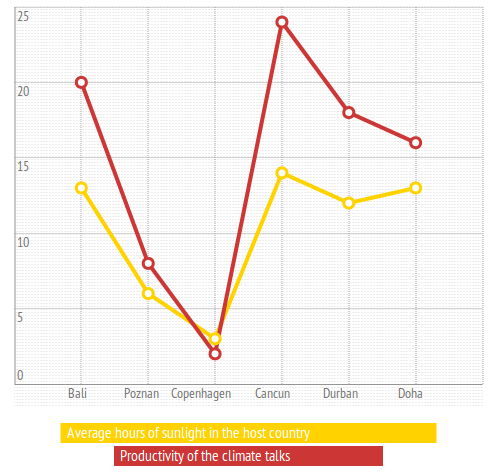
Does Climate Affect the Climate Talks?

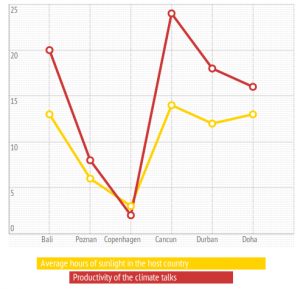
This chart shows the average hours of sunlight in COP host countries in comparison to the productivity of the COP hosted there. Given this, ECO is excited for next year’s negotiations, especially considering the response to its job application yesterday, and hopes to give some Rays of the Day at future negotiating sessions to brighten up even cloudy days (but only if Parties earn them). More northern hosts should not despair, however – what matters most is the sunny disposition you can foster in the negotiating rooms, since none of us ever have time go outside during COP, anyway. And if Parties object to our less-than-scientific calculations, might we remind you that some of you often make policy in this process with less than the best available science in mind.


sunlight
image-2093


Infographic Credit: Sébastien Duyck