ECO Newsletter Blog

The right stuff

When ECO learnt that February’s ADP session would be held in Geneva, home of the Human Rights Council, we started dreaming of how the UNFCCC could use a change of scenery (from Bonn) to agree, respect, protect, promote and fulfil human rights for all, in all climate change related actions.

Little did we know that nations of the world would actually come one step closer to fulfilling this dream, and in the very first few hours of the session too! Well done. A significant number of groups and countries; including Mexico, Uganda, Chile, the EU, Bolivia, and Tuvalu, supported the inclusion of strong language of human rights, the rights of indigenous peoples, and gender equality. This was done throughout different sections of the text including Section C which will help ensure that these principles apply to all aspects of the agreement.

Even though the engagement levels have been great from a wide array of Parties, the road to Paris is short and winding. As Parties are about to engage in the so-called streamlining exercise, remember that beyond all the legalese, climate change has profound human consequences. The lives and livelihoods of literally billions of people are riding on what comes out of this process.
... Read more ...


Join the movement

Be heartened, delegates! Soon you’ll be back in that other, outside, world, away from all things ADP, streamlining, contact groups and spotty Plug-N-Play Internet.  This wonderful outside world is also home to a global movement of citizens who have taken climate leadership into their own hands.

There’s the 400,000 activists taking to the streets of New York, or millions working on climate solutions every day at a variety of levels – the world is pressing ahead to end the fossil fuel era. Today, Global Divestment Day, will see hundreds of communities in 58 countries sending a clear message to institutions: it’s time to stop funding fossil fuels.

As you move ahead towards Paris, ECO hopes Parties will keep an eye on this exciting outside world, and be encouraged by the progress happening all around us. This week has seen you walking in the right direction, but the sooner you pick up the pace, the sooner you’ll catch up to the rest of us.

All aboard: don’t leave out airplanes and ships

Climate negotiators spend much more of their lives on airplanes than they would no doubt wish for. Perhaps there is some kind of psychological repression that makes them want to forget about airplanes as soon as they arrive at the negotiations. But we can’t meet our climate objectives if we don’t include the large and fast-growing emissions from aircraft and ships travelling between countries, which are not included in national targets.

The negotiating text took an important step forward this week with the inclusion of text calling for setting emission targets for shipping and aviation, in the context of a 2 degrees C objective. The coming months are an opportunity for a dialogue between Parties on why this step is so crucial to an ambitious deal, and addressing any concerns raised.

The importance of this step is clear. Shipping and aviation account for about 6% of global emissions. Indirect impacts of these sectors, like cirrus cloud formation and black carbon, likely add several percent to these impacts. The IMO and ICAO have stated that BAU emissions will increase by up to 250% for shipping and 270% for aviation by 2050. They would account for one-quarter of all allowable emissions under a 2 degree scenario and one-third under a 1.5 degree scenario.
... Read more ...

ECO’s Valentine’s Nest

Love in the time of climate change

Are you in the mood for love? Been eyeing that special someone from across the negotiating hall? Wishing you could have a private bilateral or two? Today’s your lucky day, because ECO is accepting personal ads to match you to that perfect partner. Send us a short description of your best traits at administration@climatenetwork.org, and we’ll find you a compatible cutie to stay up with highlighting your draft text all night long.

“High Energy”

Small in stature and greenie at heart seeks partner equally enamoured by windmills, woollen sweaters and mermaids for long walks on the beach and common efforts to reach 100% renewable energies. While arrival on a white steed is not required, proficiency on an iron horse certainly is.

“Big Deal”

When it comes to carbon, I’m kind of a big deal. Size matters. And if we’re talking cumulative emissions, it’s really no contest at all. I’m not looking for any sort of binding commitment, but if you’ve got something to offer—call me? Maybe we can make it work.

“Fresh Start”

I’m a fun, major emitting country looking to start something new, eh? My previous relationship was 7 years long, and had too many rules and commitments.


... Read more ...

In Defence of an objectives section

Let’s start with the big questions: Why are we here? Is it the beautiful mountain panorama overlooking a magnificent lake, the long working days or the joy of spending more money, than average, for just about everything? No, ECO doesn’t think so either. We’re here to save civilisation, secure our children’s future, keep global warming below 1.5 C; and to pave the path to get there.

The agreement needs to send a signal to the rest of the world that we’re heading in the right direction towards a transition to a carbon-free future. It’s not rocket science that putting the common objectives section at the beginning of the document sends a signal that this is exactly what we will do.

Clarity at the start of the document will give structure to the text and establish the overall goal supported by all of the subsequent elements of the agreement. Ergo, ECO will defend Section C until it runs out of ink to voice our never-ending support. It’s Section C that will provide a clear direction knitting together all the pieces, outline the drivers and our shared aspirations.

Section C on objectives must:

  • Set the direction towards a resilient world in which we phase-out fossil fuel emissions and phase-in renewable energies, as soon as possible, and no later than 2050.

... Read more ...

Differentiation is in the air

The post-Copenhagen vogue has been all about self-differentiation. Everyone wants to talk about it! This is good news, because if we don’t differentiate contributions and rules and get trapped in pure self-differentiation, we’ll lack the overdue ambition needed to tackle climate change .

But we’ll need to become a lot clearer about the differentiation challenge. So what is needed now? Let’s start with top-down elements – e.g. equity based comparative review and ratcheting – integrated in the Paris agreement. To that end, ECO raises the following three questions:

1) How do we differentiate?

The old binary distinction between “developed” and “developing” countries is unacceptable to (ahem) developed countries. Meanwhile, developing countries will not accept a new accord without a distinction between groups of countries.

So, what to do? Ideas are flying! We have Brazil’s “concentric circles” proposal and South’s Africa’s equity reference framework. There’s also America’s rather tongue-in-cheek suggestion for a formulation in which emissions and economic indicators are used to define dynamic groups called “Annex X” and “Annex Y”. Then there’s Ethiopia with their different formulation of dynamic annexes, based on per capita GHG and GDP indicators. And just about everyone’s future features “cycles.”

2) Which rules should apply to which groups?
... Read more ...

A message from outside the UNFCCC Bubble

ECO hears a lot of talk about the ‘real’ world — that thing outside of the UNFCCC negotiations, remember? Don’t worry, it still exists. And to be fair, outside of our bubble, there are others too, like the post-2015 sustainable development goals or development finance ones. All three of these bubbles are in motion this year, and their paths will cross. And we all know what happens when bubbles collide, or worse, burst. And that makes Liechtenstein’s signpost to the sustainable development goals in the preamble of the Geneva text very welcome.

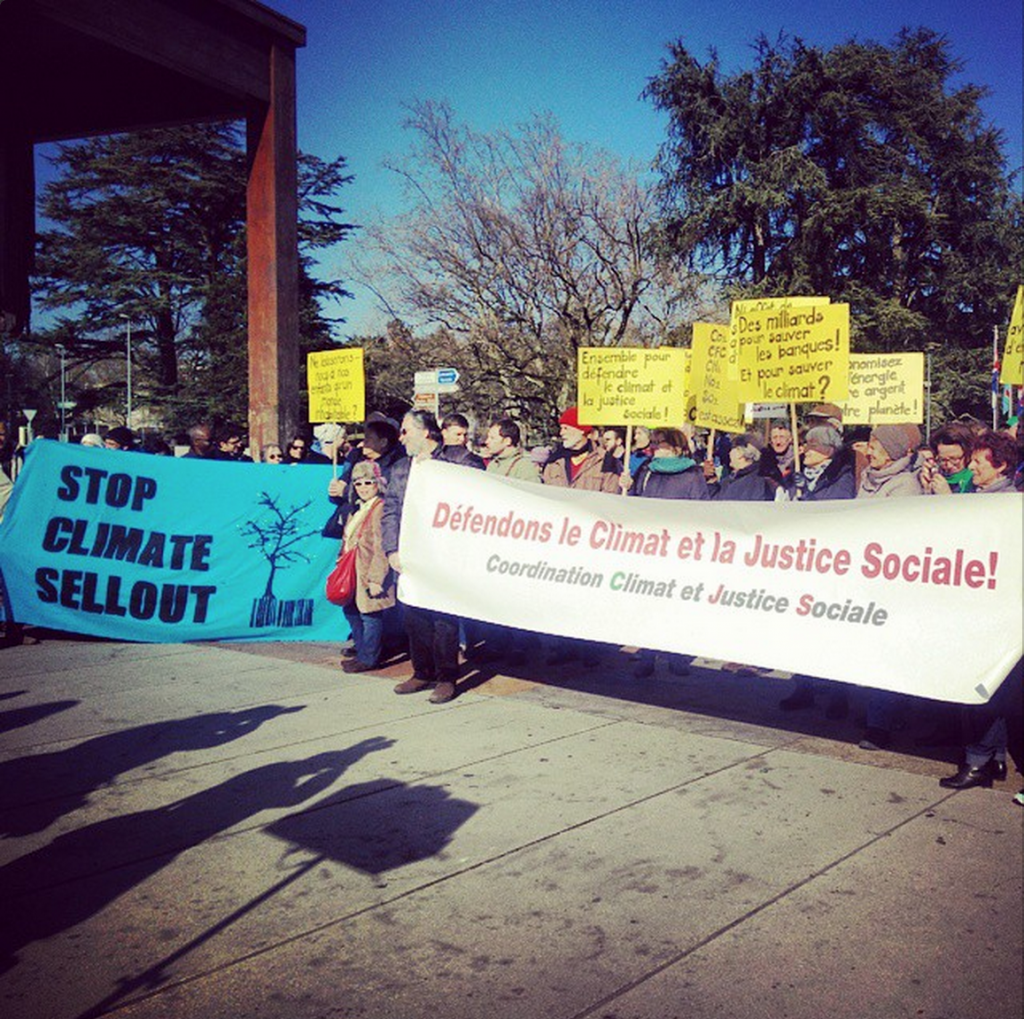
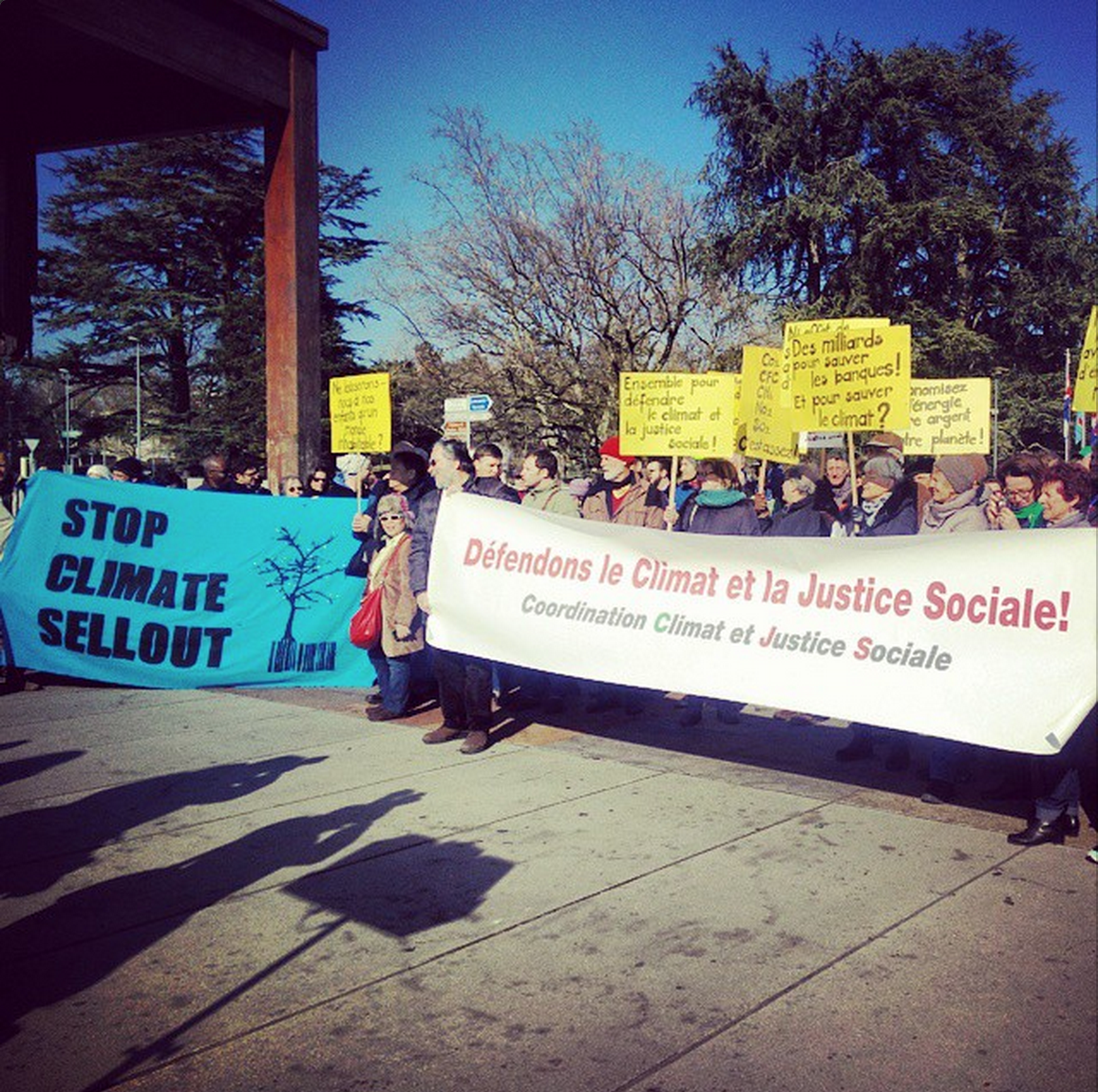
Locals calling for climate action in Geneva, Switzerland
image-5053

Locals calling for climate action in Geneva, Switzerland, Photo: Linh Do

With the post-2015 sustainable development process, the Heads of States Summit at the United Nations General Assembly (UNGA) later this year in September will set the tone for Paris.

So, shouldn’t the development framework for the next 15 years also deliver action on mitigation, adaptation, resilience, etc.? It only makes sense that the millennium declaration illustrates how climate-proof development and sustainable development are interlinked. This kind of support for the UNFCCC would be most welcome, especially in strong statements from world leaders in New York.

But, dear Parties, you don’t have to wait until September. You can start as early as next week, because there’s a UNGA session from 17-20 February.
... Read more ...

The emissions abyss

The main focus here in Geneva is on shaping the Paris agreement for the post-2020 period. Nevertheless, it is critical that we do not lose sight of the need to increase our climate actions from now up to 2020 as well.

Even if a global climate agreement is reached in Paris this December, most of the proposals and targets for cutting emissions won’t kick in until after 2020. But the coming five years are absolutely vital in the battle against climate change.

During these five years global emissions should be peaking and then falling, or at the very least, levelling off. At the moment the pre-2020 period doesn’t seem to have much priority in most countries, despite the fact that emissions must peak within this decade to keep global warming below 2°C. It is no secret that with current emission trends we are heading for a 3.6 to 4°C scenario; just check the IPCC’s work. We can’t allow emission figures to drift ever upwards — otherwise the long-term goals will become even harder to meet.

We know that many countries have already started taking actions on climate change at the national level. But we also know that these have not gone far enough.
... Read more ...

Sendai calling: tackling disasters and climate change

2015 will be a trek. One summit followed by another, ending with a steep climb to Paris. The first peak will be reached next month with delegates meeting at the World Conference on Disaster Risk Reduction (WCDRR) in Sendai, Japan to finalise a new framework for Disaster Risk Reduction (DRR). ECO has some thoughts about outcomes at Sendai:

  1. A strong signal that climate change is already increasing the frequency, intensity and unpredictability of natural disasters. Reducing disaster risks will require emissions to be cut drastically.
  2. Ramp up support for disaster risk reduction action. Disaster preparedness is not a solo undertaking. Often a practitioner gap exists between DRR institutions and those doing adaptation on the ground. This results in bad planning and loss of crucial resources. Sendai should bridge that gap and transform DRR into “strategic DRR”.
  3. Initiate a framework that tracks countries’ progress in advancing DRR both qualitatively and in metrics. This framework could also provide valuable learning and bring coherence in implementation of adaptation actions.
  4. Promote approaches to tackle ‘exceeding national capacities’, which is a gap in the international system. Sometimes countries are overwhelmed by disasters. For many countries, these disasters are a direct result of our changing climate. The DRR needs of affected countries should be matched by reliable support, recognising collective and differentiated responsibilities.

... Read more ...