Category: Previous Issues Articles

Workstream 2: Have you done your homework yet?

In yesterday’s contact group on Workstream 2, Co-Chair Runge-Metzger gave all delegates very specific homework: talk to each other and develop proposals on how to improve the draft decision text until this afternoon. Delegates, you might not get a grade, but ECO is expecting you to take that assignment very seriously – as seriously as the emissions gap needs to be taken. From now until 2020, greater emissions reductions are needed for us to entertain the “fanciful” idea of limiting warming to below 1.5°C. ECO wonders: did you do your homework last night? If you haven’t yet, ECO will happily help you cheat. Here are a few ideas that you can copy, and we won’t tell anyone:

Firstly, tell the Co-Chair which elements you really liked in his text. ECO’s favourites including continuing the Technical Expert Meetings (TEMs) beyond 2015, until the gap is closed. As a result of the technical work, identify a policy menu, and ask each Party to select from it the policies it intends to implement, with targeted support provided by the financial and technology mechanisms of the Convention. Keep the “placeholder for Lima outcome on long-term climate finance, including any potential roadmap” because developed countries need to fulfil their promises on finance, to facilitate the potential for even greater mitigation ambition in developing countries.
... Read more ...
Getting the big bucks from Lima to Paris: finance in the INDCs

In the UNFCCC circus, ECO rarely favours one Party and its views over another. But this week, ECO is tempted to make an exception on finance. ECO secretly hopes that the AILAC submission on INDCs has been every negotiators’ bed-time reading last night in preparation for this morning’s ADP session on finance and the INDCs. AILAC’s submission helpfully suggests that for developed countries, and for countries with comparable levels of responsibility and capability, providing international climate finance (e.g. to support mitigation in other countries) is part of their fair share in the global effort, as much as it is their commitment to cut their own emissions too. Providing climate finance is not charity, nor is there a choice to opt out.

Once this is more widely understood in these halls (and ECO stands ready to help that cause), the next logical step is ensuring that such information on supporting mitigation through finance or means of implementation appears somewhere. That way, it’s easier to assess the adequacy and equity of overall contributions. ECO notes the clever system AILAC has come up with: INDCs to include information on policies and measures taken by countries to contribute to a yet-to-be-defined global target for the means of implementation in the 2015 agreement.
... Read more ...

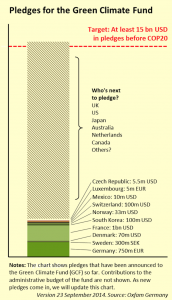
One small step for a Fund, one giant leap for humankind. We hope.

Graph

ECO sat through 4 long days and one very long night in Barbados last week, but it was worth it. The Green Climate Fund Board finally agreed upon arrangements to receive contributions this year, and further prepared the governance system to start disbursing funds next year.

Not all negotiators will know that the issue of whether contributors could include specific “targets” within their contributions was the one issue that kept board members up until 3:30 AM on Saturday. Developing countries firmly rejected this idea, despite the imminent threat that developed country treasuries were sure to contribute less if this extra grip on the GCF’s purse strings was relinquished.

ECO sees hope and feels that this step highlights the GCF as an entity that could herald a new era in international cooperation, where country ownership and direct access to funding replaces the old model of institutions and decisions dominated by developed countries. Developing countries could have an equal say in fund governance.

Some fights have yet to be fought, though, like whether the GCF will fully steer clear of fossil fuels. ECO has learnt that the idea to tie voting to contributions may rise again, but for now, things seem to be moving in the right direction, albeit slowly and unevenly.
... Read more ...

Filthy finance

ECO is confident that delegates will remember President Obama’s famous address to the world just last month: “The climate is changing faster than our efforts to address it. The alarm bells keep ringing. Our citizens keep marching. We cannot pretend we do not hear them.” Despite this appeal to follow the people, industry choose to follow the money. So far, the money–both public and private–has continued to flow overwhelmingly to fossil fuels, entrenching dirty power, locking-in emissions, and inflating the incipient carbon bubble.

Lubricated by a US$1.9 trillion concoction of subsidies, tax breaks, government incentives and the externalisation of the true costs of dirty energy, the fossil fuel industry spent $674 billion in 2012 on exploration and development. With the current rate, fossil fuel companies are slated to spend over $6 trillion in the next decade on further industry developments. ECO can only encourage governments to stand up to the fossil fuel industry’s efforts to protect their profits. Industry spends half a million dollars a day lobbying in Washington and Brussels to prevent, delay or weaken climate regulation. In the US alone, investment in lobbying activities ($160 million a year) is equivalent to what’s needed for Nepal to adapt to climate change–an amount that remains unfunded.
... Read more ...

Can you hear us now?

Peoples' class=
image-4177

People’s Climate March: 400,000 marching for Climate Justice in New York City, September 21, 2014

Political and religious leaders, progressive businesses, and most importantly, people from all walks of life have spoken with one voice: calling for immediate and ambitious climate action. The Peoples’ Climate March in New York, and associated events across the world, sent a clear call to all governments that they need to step up, phase out fossil fuels and massively scale up renewable energy. It’s a huge task, but ECO thinks that negotiators here in Bonn can take concrete steps forward.

First of all, negotiators should start by strengthening their pre-2020 commitments on mitigation and finance. That is unless we want to renegotiate the terms of the 2015 agreement and make it 4°C-compatible? ECO thinks not.

Secondly, they need to create the space for ambitious INDCs in the post-2020 agreement by negotiating the backbone of UFIs, or ‘Upfront Information’, requirements. ECO has long been calling for these UFIs to set meaningful and concrete benchmarks for ambition and equity. It’s now crunch time. The key elements that need to be discussed in Bonn and agreed at the Lima COP are outlined below:

Soon, soon, soon!! While INDCs are going to be nationally determined, they are contributions towards a global effort.
... Read more ...

What’s wrong with you, EU?

At the end of this week, EU leaders will decide on Europe’s climate and energy future. Agreement on the post-2020 Climate and Energy Package make the EU the first to announce an international offer.

Other countries will be intently looking at the ambition and quality of the key elements that form the Package: the emissions reductions target, the renewable energy target and efforts to increase energy efficiency. These elements are likely to be parts of many other countries’ INDCs, the EU should be wary of exposing itself to criticism as an unambitious first mover. Given that the EU is a major proponent of a global carbon market, other parties (including China) will also be looking at the impact of the package on the EU ETS.

Many EU leaders stood up at the New York Climate Summit and talked about the need to agree on an ambitious global climate deal in Paris. Yet, at the same time they announced they would be adopting a 40% emissions reduction target by 2030, which is way below the EU’s equitable share of effort for a below 2°C trajectory (much less a 1.5°C pathway), and not in line with the 2050 target agreed by EU leaders in 2009 of 80-95% emission reductions. 
... Read more ...

Roll up your sleeves

ECO wants all negotiators to understand that what they are doing here really does matter to the lives and futures of billions of people and ecosystems around the world. In a little over a years time, the world needs to see an ambitious and equitable agreement which does not condemn the poorest and most vulnerable to a future of disasters and permanent state of emergency. Negotiators need to make progress this week on four items related to adaptation and loss and damage in the 2015 agreement.

First, the 2015 agreement must highlight the requirement for all climate action to be guided by certain principles; in particular recognising the  needs of vulnerable people, communities and  ecosystems as well as  rights-based approaches, gender-equity and broad participation. Though the 2010 Cancun Adaptation Framework contains some ‘guiding principles’, these aren’t even referenced in the current draft ADP text. This puts the UNFCCC 2015 agreement at risk of being the least people-centred and rights-based of the three international frameworks currently under discussion. Drafts for the Sustainable Development Goals (SDGs) and the post-2015 Disaster Risk Reduction Framework contain much stronger wording on people’s needs and human rights.

Second, it is clear that emission reduction efforts must be at the core of INDCs.
... Read more ...

Five is the magic number

A decision in Lima that commitment periods will operate in 5-year cycles is vital to the integrity of the Paris agreement. ECO wants to remind all delegates in Bonn that a 5-year commitment period:

Avoids lock in: current pledges are far from being consistent with the below 2°C goal, much less the 1.5°C required by the most vulnerable countries. Five-year commitment periods allow for greater dynamism and ratcheting up of global ambition.

Incentivises early action: setting a target that has to be met 10 years from now, rather than 15, compels government to reduce emissions quickly, rather than delaying action.

Maintains better synchronicity with the cycles of IPCC reports: a more dynamic system is more responsive to the best and latest available science.

Creates stronger national political accountability: many governments operate on 5-year electoral or planning cycles. A 5-year commitment period requires a government to act within its elected or planning term rather than leaving action to its successors.

ECO welcomes the support for 2025 targets from the United States, AOSIS and the Africa Group. We hope to see others joining them this week. We believe that the 5-year national planning cycles in countries such as China and Saudi Arabia synchronise naturally with an international 5-year cycle.
... Read more ...

ECO Lonely Hearts Corner

Dear ECO,

I’m a 6,000-year-old woman (but a lady never reveals her true age) looking for suitors who are prepared to send me ambitious INDCs. I enjoy slow change, spinning around, long orbits around the sun, regular seasons, and cute and fluffy animals. My dislikes include comets, mass extinctions, ice ages, solar flares and fossil fuels. I’ve had a rough relationship history and my sudden break up with the dinosaurs wasn’t easy either. Currently, I’m in an extremely abusive relationship with Homo Sapiens, they’re keeping me sweating.

I must admit that I have volatile tipping points and I have become icy cold and uncomfortably hot in the past. I’m afraid that if I have to deal with further weak promises and  empty “commitments”, I may do something rash and enter a state of anger that will make the hurricanes, droughts and storms that you’ve seen before look mild.

I’m hoping to retain my stability by receiving lots of INDCs from suitors who are:

  • Interested in 5 year commitments periods (I need some long term security and not another decade in a destructive relationship)
  • Transparent about the level of effort that they will invest in my wellbeing
  • Willing to indicate how much money and other support they will provide to keep me happy
  • Upfront about how much external support they will need to make the relationship work if the INDC is from someone with less capability
  • Adaptable: I have some historical scarring that is likely to make any future relationships difficult and I will need all the INDCs to indicate adaptation plans as I blow off steam
  • Passionate about equitable relationships and my long-term prosperity
  • Willing to review, and if necessary improve, their contribution to making our relationship work
  • Willing to submit to expert counselling to ensure that they are doing enough to make a long-term relationship work
  • Willing to start work immediately to prevent any further damage to my person

Suitors that have caused harm in the past and that have lots of resources, send me your ambitious proposals by March 2015.
... Read more ...

Adaptation Fund overlooked because there’s a new kid in town?

While we all breathlessly wait for big money to hit the GCF (US$15 billion in pledges is expected by the end of this year), ECO would like to remind everyone that there are other funds in dire need of money too. One of them, the Adaptation Fund, which has projects ready to be implemented in vulnerable countries such as Ghana, Mali or Nepal, is now just waiting for the resources to get those projects started.

Pledges to the Adaptation Fund were among the very few positive outcomes from Warsaw. ECO is shocked that some countries have not yet paid up. Given the urgency of climate change, ECO would love to see the October session kicking off with the transfers of pledged funds from both Belgium and France, who, as the host of the 2015 COP, may want to uphold its commitments.

Honouring pledges made in the past is obviously critical, but so is putting the Adaptation Fund permanently on a more sustainable funding base. This could be done by, for instance, tapping into alternative sources that auto-generate revenues. Until then, the Fund’s board will have to continue to announce fundraising goals as it had to do for 2014 and 2015 ($80m each).
... Read more ...