Category: Previous Issues Articles
Equity: a pathway to ambition and sustainable development
ECO has done some late night soul searching and come to the conclusion that the Paris agreement will have to be fair if it is to achieve the extremely high ambition that the science demands. Equity is not just the pathway to ambition; it is also the pathway to survival. As ECO has concluded, and as you know in your heart of hearts to be true, to be fair the new agreement will have to actively promote sustainable development, facilitate poverty eradication, protect livelihoods, and promote robust adaptation solutions even as it facilitates the rapid and more or less complete elimination of carbon emissions.
It will simply not do to say that equity is a matter of opinion. The pre-Paris assessment of the adequacy and equitability of INDCs needs to be based on the Convention’s equity principles of adequacy, CBDR+RC, and equitable access to sustainable development. In case Parties are wondering how to operationalise these high-level principles, ECO suggests these five core indicators that together can do the job quite nicely: adequacy, responsibility, capability, sustainable development need, and adaptation need.
Equity and adequacy reviews must be an integral part of the new agreement, so that in each commitment period contributions are finalised only after a robust, science-based Equity Review.
... Read more ...
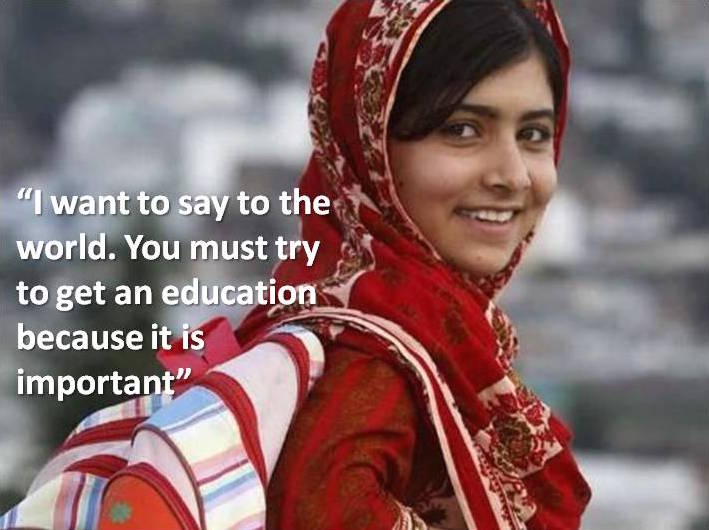
“You must try to get an education!”
Malala Yousafzai is the youngest-ever Nobel Prize recipient (2014). She is known mainly for human rights advocacy for education and for women.
Dear negotiators,
You may have noticed that ECO loves a good homework metaphor, and this should give you insight into how we feel about education: we love it. This makes Article 6 a very close issue to our well-schooled heart. Imagine our delight in scrutinising over the latest batch of submissions to discover those from Dominican Republic and Belize, Benin, Burkina Faso, Chile, Costa Rica, Colombia, Fiji, Guatemala, Haiti, Jamaica, Malawi, Maldives, Marshall Islands, México, Palau, Panamá, Peru, Philippines, Saint Lucia, Trinidad and Tobago, Uganda, and Uruguay highlighting the importance of education, access to information and public participation.
These issues deserve to be in the preamble of the new agreement. A commitment to strengthen climate change education, access to information and public participation at home and internationally is worthy of all of our attention.
ECO also suggests that delegates look further afield to the UNESCO Global Work Programme on Education for Sustainable Development (ESD) for more suggestions.![]()

Will the INDCs add up to a safe climate? The truth is out there.
Many countries are already working hard to prepare their INDCs. ECO has said repeatedly that INDCs need to be assessed for adequacy (do INDCs sum up to <2°C?) and equity (are countries doing their fair share?). The INDCs must include all the elements, and also set out an assessment phase between March 2015 and Paris. This must include:
- all important timelines for INDC communication by March/June 2015;
- requirements for a proper assessment including the equity indicators of adequacy, responsibility, capability, development need and adaptation need; and
- a process for conducting assessments.
Following the first batch of INDCs in March, the Secretariat should prepare a compilation paper and public online database, to be updated as INDCs continue to be submitted or amended. The Secretariat should also arrange for an assessment of the collective adequacy of all received INDCs at a June 2015 workshop series, that is also periodically updated. The series of workshops at the June session should:
- give governments an opportunity to clarify their INDCs by responding to questions from other Parties and observers;
- present the outcome of the assessment of collective adequacy to verify if we are on track towards staying well below 2°C; and
- facilitate equity reviews of received INDCs, including opportunities for observers to present their own equity assessments.
... Read more ...
Gimme Shelter: adaptation and loss and damage in the Paris deal
Monday’s ADP session on adaptation and loss and damage covered a lot of ground. LDCs’ call to base all adaptation actions on certain guiding principles, as agreed upon in the Cancun Adaptation Framework, set off the debate on a positive foot. Promoting a gender-sensitive and participatory approach focused on vulnerable people, communities and ecosystems are principles currently absent from the text. They should be bolstered by Parties to guarantee a people-centred, human rights-based agreement.
Convergence emerged around the need to include a long-lasting vision for adaptation in the Paris agreement. Defining objectives for this goal, related to adaptation finance, institution building and readiness would make it even more concrete.
Parties need to come to grips with the link between mitigation and adaptation. One way to do this would be an assessment of the adequacy of NAPs, once mitigation pledges are on the table, taking into account expected level of warming. Vulnerable countries could then better assess the fundamental threats they face, and Parties might reconsider their mitigation ambition.
ECO further welcomes AILAC‘s proposal to set up an Adaptation Technical and Knowledge Platform, conceived as an enhanced hub to support adaptation design and implementation. Indigenous peoples, acknowledged by Norway as adaptation knowledge holders, could play an important role in this initiative.
... Read more ...
5 is the magic number
A decision in Lima that commitment periods will operate in 5-year cycles is vital to the integrity of the Paris agreement. ECO wants to remind all delegates in Bonn that a 5-year commitment period:
Avoids lock in: current pledges are far from being consistent with the below 2°C goal, much less the 1.5°C required by the most vulnerable countries. Five-year commitment periods allow for greater dynamism and ratcheting up of global ambition.
Incentivises early action: setting a target that has to be met 10 years from now, rather than 15, compels government to reduce emissions quickly, rather than delaying action.
Maintains better synchronicity with the cycles of IPCC reports: a more dynamic system is more responsive to the best and latest available science.
Creates stronger national political accountability: many governments operate on 5-year electoral or planning cycles. A 5-year commitment period requires a government to act within its elected or planning term rather than leaving action to its successors
ECO welcomes the support for 2025 targets from the United States, AOSIS and the Africa Group. We hope to see others joining them this week. We believe that the 5-year national planning cycles in countries such as China and Saudi Arabia synchronise naturally with an international 5-year cycle.
... Read more ...
Opportunity alert: EU, the road to Lima and ambition
ECO is hearing rumours of a battle over the EU’s direction for a long-term goal towards a carbon-free future, and its position on INDCs. European environment ministers will meet in Brussels early next week to adopt the EU’s position towards Lima. This is an opportunity to show they are serious about building a truly fair and ambitious global climate regime. And ECO has a few tips for the EU:
Tip 1. Apply the science to enhance the action.
ECO hopes that all EU member states, particularly Poland, understand the importance of adopting a long-term mitigation target that reflects the urgency of the scientific advice of the IPCC, and the need to signal an irreversible transformation towards a carbon-free global economy. To stay below 2°C, emissions need to peak by 2020 and drastically reduce by 2050. That’s why ECO has been making the case for a total phase out of fossil fuel emissions by 2050, to be replaced by a 100% renewables future. ECO knows that the EU has committed to reduce its own emissions by 80-95% by 2050 as part of the global long-term efforts, and would like to advise that Parties respect the science before resisting the action. Given that most EU Member States agree, ECO is confounded by the rumours that the current COP President does not to agree.
... Read more ...
TEMs: not just a river in England
ECO is keeping a close eye on the TEM on non-CO2 greenhouse gases today, and this won’t be the first time we’ve highlighted that there is a crying need for countries to step up and deliver on pre-2020 mitigation. Without this, we won’t have a snowball’s chance in a 4°C world of bridging the multi-gigatonne pre-2020 emissions gap.
Today’s discussion on non-CO2 greenhouse gases will cover no fewer than three big topics (methane, nitrous oxide and fluorinated gases) in as many hours. ECO hopes that Parties will get down to business and identify a clear vision for the “way forward” by the end of the day’s proceedings. While ECO has been pleased with constructive discussion in TEMs this year, we need to see evidence that all the good talk and real-world evidence will result in a scaling up of climate action soon. Actually, make that now.
ECO has some ideas on what negotiators can do next coming out of the TEMs. To deliver concrete near-term results, Parties could act on the evidence presented at Wednesday’s session by backing the launch of formal negotiations on a global phase-down of the production and consumption of hydrofluorocarbons (HFCs) under the Montreal Protocol this year.
... Read more ...
Sweden gets serious on climate finance
Is there a new climate hero on the horizon? ECO was excited to read that the new Swedish Government is thinking of pledging SEK$4 billion (US$560 million) to the GCF for the 2015-18 period. That’s not all: the 2015 portion of this pledge will also, at the very least, be in addition to its already planned ODA (1% of GNI). If this continues for the entirety of the 2015-18 period, Sweden will become the first country to walk the talk on “new and additional” finance.
ECO hopes that the Swedish government sees their planned pledge as one of several finance pledges, given that the planned GCF pledge is still less than half of Sweden’s fair share of climate financing towards the $100 billion promise. Before we pop open the bubbly, the Swedish parliament is yet to approve these plans. ECO, optimistic as ever, thinks this already sets an example for others to follow though. ECO is now looking to Sweden’s oil-rich neighbour that promised to up its current, and rather modest, pledge at the upcoming pledging session in Berlin. Will they rise to the challenge?
![]()
EU’s own goal on renewables
Today will see EU leaders begin discussions on their post-2020 climate and energy energy policy framework underpinning their commitment to climate ambition.
The proposed EU 2030 renewable energy target, at least 27% of the EU’s energy consumption, will hold the EU back in the renewables race. This proposed target does not include binding national targets and would likely be met well before 2030, meaning that the EU would fail to deliver on its long-term climate commitment. EU leaders should endorse a target of 45% renewable energy by 2030, backed by legally binding national targets.
ECO doesn’t understand why the EU is not considering a level of ambition that will fulfill its short-term goal of increasing energy independence and simultaneously support creating new jobs and fostering economic growth. And tackling climate change along the way.
![]()