Category: Previous Issues Articles

A parable for our time

Far back in the mists of time, Parties agreed on a Durban Platform. Concerned that the train of negotiations might leave the station and quickly gather speed, Parties proceeded to have a two-year “contemplation phase” in an effort to stay on track.

They then decided to go into a “workshop phase” where they were expected to express their basic desires to their benign and all-knowing spiritual guides. These guides would then translate these desires into suitable language for polite company before presenting them to the outside world. But some of the travellers began to complain that they preferred their own words, however unrefined and divergent.

The language of the much-anticipated central covenant of all the peoples was given special treatment, since agreement was not needed immediately. It was particularly elevated and deliberately vague, so that the travellers would not begin to bicker over the details. But some began to rebel against the ritualistic debates and increasingly frustrating attempts to discover exactly what others were talking about, and what they might be able to agree on once they had to make decisions.

More of them started putting forward their own versions of the covenant. Though the guides paid little attention to their crude efforts, they did generously offer the possibility of going into a side carriage on their own and return with more worthy offerings.
... Read more ...


Mail: from the UN Human Rights Council

Dear Negotiator,

We know you’ve been busy trying to hammer out the details of the Paris Agreement, but ECO would like to draw your attention to an important letter that has been addressed to YOU. This letter was sent, last week by 28 independent experts from the UN Human Rights Council.

Tasked to provide support to all countries with the promotion of human rights—like the right to clean drinking water to development–-these experts all came to the same conclusion: climate change threatens to undermine the protection of human rights. Let this sink in for a moment: it means that the UNFCCC has a crucial role in effectively protecting human rights for all. If you haven’t read the letter, please check your inboxes.

The open letter clearly states that “all of the State Parties to the UNFCCC have committed to respect and protect human rights.” Building on the Cancun Agreements, that makes reference to these obligations, the UN human rights experts urge Parties to:

recognise the adverse effects of climate change on the enjoyment of human rights, and to adopt urgent and ambitious mitigation and adaptation measures to prevent further harm. We call on the State Parties to include language in the 2015 climate agreement that provides that the Parties shall, in all climate change related actions, respect, protect, promote, and fulfil human rights for all.
... Read more ...

Beyond binary

ECO has always believed that the Convention, with its Annexes and principles, need not, and must not, be a straight jacket that restricts the ability of the UNFCCC to adapt to emerging realities. While some developed countries give the distinct impression that they would like to sweep the Annexes (and perhaps the whole Convention) aside and start over, there are now some developing countries showing how we can move forward by building on the current structure of the Convention.

Different proposals have been put forward that provide interesting ways to move past a binary world to cross the rigid firewall.

The LDCs proposed an interesting idea in this regard: Annex I Parties should adopt economy-wide targets, and non-Annex I Parties “in a position to do so” (the so-called “POTODOSO countries”) should do the same. Both of these groups – all parties with economy-wide commitments – would then inscribe these commitments in Annex A to the new agreement. This would be an elegant way of using the current Annexes to ensure no backsliding, while progressing beyond an exclusive reliance on these commitments. ECO could imagine other creative ways to do the same thing.

Another way of moving beyond a binary world is the route proposed by Brazil (yes, that Brazil!).
... Read more ...

Want concrete deliverables from WS2? Switch to RE and EE now!

In the TEMs followup meeting yesterday , ECO was reminded of the need to move beyond never-ending discussions into concrete action under Workstream 2. It also appears that the areas where Parties show the greatest interests are renewable energy (RE) and energy efficiency (EE). In their Technology Needs Assessments (TNAs), Parties have also expressed their priorities for mitigation technologies, and guess what? They begin with EE and RE. The science tells us that to limit global temperature rise to below 1.5°C, we need to phase out fossil fuels by 2050 and phase in 100% RE as quickly as possible. This means that in the pre-2020 period, we should be rapidly scaling up RE to at least 25% globally, along with doubling the rate of EE.

It just so happens that RE and EE are the two issues that have been most thoroughly analysed throughout the TEMs. Being armed with a good understanding of the policies that are needed for a rapid scaling-up of these approaches marks a potential turning point for transforming understanding into action.

In a Workstream 2 decision, Parties should explicitly call on the GCF and other international funding institutions to prioritise, within their mitigation windows, investments in tried and tested policies that promote sustainable renewable energy and energy efficiency.
... Read more ...

Turn Back Japan: Don’t Go From Nukes To Coal

The tragic Fukushima nuclear accident showed the world how dangerous and unsustainable nuclear technology is. As affected people continue to suffer, it’s clear that nuclear is not an option for the Japanese people any more. ECO was encouraged to see the rapid expansion of renewable energy since the disaster thanks to the feed-in-tariff introduced in 2012. The focus on energy efficiency by individuals and companies also proves that there is still plenty of potential for energy efficiency improvements in Japan. That’s why ECO is astounded by the news that there are now plans for the construction of 25 new coal-fired power plants (totalling 13,640MW) between 2016-2027. They would emit more than 82 Mt CO2 per year. Shockingly, most of these plans were conceived after the Fukushima accident, and it is expected that more plans will come.

Energy transition is an urgent need in all countries, and it is key to get the direction of the transition right, Japan! Hint: when we talk about energy transition we are talking about transitioning away from, not towards, high-carbon technology. Coal a the dirty fossil fuel. The IPCC warns that if we don’t shift investments away from high-carbon infrastructure, future emission reductions will be difficult.
... Read more ...

From faith-based organisations

Faith-based organisations (FBOs) have increased their engagement in climate advocacy since forming an inter-faith caucus at COP14. As the Parties negotiate the 2015 agreement, faith movements are carefully watching the process.

Churches, mosques and temples are at the frontline of disaster relief services: helping to bury the dead and console the grieving. People turn to places of worship for safety, support and emergency services. FBOs are reporting soaring emergency expenditures and they feel a duty to be involved in climate crisis prevention. They argue that climate justice should be understood as part of a broader agenda of justice, peace and meaningful quality of life. Drivers of climate change are also related to the causes of other types of suffering.

FBOs are concerned that the UNFCCC process has shifted from the core mission of the United Nations. From the upholding of human rights, promotion of peace and security, these values seem to be morphing into competitive self-interest. Perpetrators of harmful climate impacts show no remorse, and the emerging economies are fiercely insisting on the right to the same harmful development pathway. As the Roman Catholic member of the FBO caucus noted, this is akin to the story of Cain and Abel: just as Cain kills his own brother, countries’ failure to address climate change threatens to harm all members of the human family.


ECO’s invitation to you

Tree
image-4227

ECO welcomes you to the UNFCCC tree planting ceremony to celebrate CAN turning 25 at 13:00 outside today. There will also be a plaque unveiling. All are welcome to attend.

ECO asks, if you were a tree, what kind would you be?

The “5” is just about the difference between 9 and 3.9

Delegates with long memories (and probably more than a few gray hairs) will recall the Article 9 review. Initiated, as the KP requires, at CMP2 in Nairobi, the review failed to achieve much of note. Its second iteration, in Poznan, failed to agree to any further substance. Does anyone even remember whether it led to a third review?

In contrast, the Article 3.9 review led to agreement of commitments for the second commitment period of the Kyoto Protocol, inscribed in Annex B to the KP (as required by the article).

The mandates in both articles defined the “who” (Parties) and made the legal requirement strong (“shall”). “When” was defined clearly for both, but the key difference was in “what” each review was to achieve.

The Article 9 mandate did not define what exactly “what” was to be achieved, and what action would need to be taken as a result of the review. In contrast, Article 3.9 was clear that its requirement was to establish “commitments for subsequent periods” which would be included “in amendments to Annex B”.

Why is this relevant to what needs to be agreed in Lima?

Some Parties are still under the impression that a 10-year commitment period with a vaguely defined review in the middle can hope to raise ambition, forgetting that such reviews, like Article 9, have a poor record of achieving further action.
... Read more ...

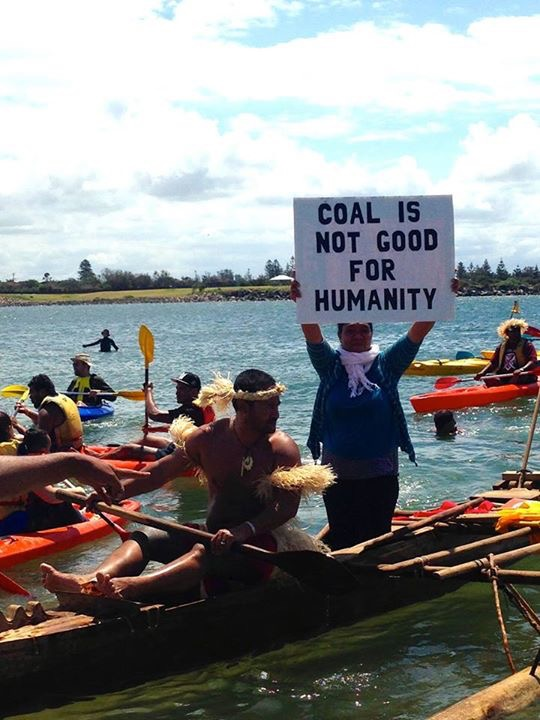
Coal is not good for humanity

As global Reclaim Power week comes to an end, Pacific Climate Warriors have blockaded  Australia’s largest coal port on the other side of the world. If it were a country, the coal  exported from this port would make it the 9th highest emitting country in the world.
image-4211

As global Reclaim Power week comes to an end, Pacific Climate Warriors have blockaded
Australia’s largest coal port on the other side of the world. If it were a country, the coal
exported from this port would make it the 9th highest emitting country in the world.

If you love me, make it official

ECO fought alongside many of you to win a second commitment period for the Kyoto Protocol. Whilst it’s not all that we wanted and it’s a shadow of its former self, it still has some valuable elements worth keeping alive in the international climate system. The international rules-based system and its common MRV system, alongside its common land use accounting rules, common base year, common sectors and gases, common commitment period (of five years) all aid transparency and understanding.

But the second commitment period still languishes in legal limbo. Not enough Parties have signed on. In fact, only 18 countries so far have ratified the amendments, with only one of them being a developed country. Until at least three quarters of Parties have done so, KP CP2 will not be legally binding.

ECO hopes that others will follow the lead of these 18 Parties and ratify, showing their public support for the important rules-based system embodied within the KP.