Category: Previous Issues Articles

SIDE EVENT INVITATION Tuesday, 2 December 2014 – 13:15-14:45. Room: Paracas

The importance of equity in the 2015 agreement has broad support, but what an equitable agreement applicable to all actually means is both an unclear and controversial issue. Disagreement exists on the operationalisation and scope of equity, and on approaches for assessment of the INDCs.

To break the deadlock in the negotiations, CAN has made a detailed proposal for a dynamic Equity Reference Framework that is explicitly rooted in the Convention’s core equity principles. This side event will further articulate the proposal and provide an opportunity for discussions on how to bring this framework into the negotiations.
Party Respondents: South Africa (confirmed), Bolivia, Brazil, China, Colombia, India (requested).

Please join!


Missing Money for Green Climate Fund earns first Fossil

Fossil of the Day 405x332
image-4471

The first Fossil of the Day at COP20 goes to Australia, Belgium, Ireland and Austria (alongside the other non-pledgers: Iceland, Greece, Portugal, and the European Union) for being the only Annex 2 countries failing so far to contribute to the GCF. After a string of encouraging initial contributions, it seems this band of Annex 2 free-riders see no need to contribute. This is not acceptable and stands to jeopardise the Paris agreement, under which all countries are expected to take action. To the free-riding ministers: Bring your chequebooks to Lima.

COP20: 
It’s All On Our Shoulders Now

We are very happy to be in Lima, and ECO is ready to get right to it. COP20 needs to deliver on enough confidence building measures to ensure climate action and a successful outcome from next year’s COP in Paris. The wheels have already started turning:
-The Peruvian COP presidency has shown commitment and substantial
effort to guide the negotiations onto the right track.
-The US-China climate announcement, on the heels of similar action by the EU, has injected positive impetus into the political aspect of the negotiations – and is pressuring significant laggards and defaulters, who can no longer claim inaction by the G2 to wiggle out of doing their part.
-The IPCC is shining clear light on the latest science, pointing urgently to deeper climate action as well as the fast-rising costs of delay.
-The GCF is seeing some light at the dim end of the climate finance tunnel with pledges at $9.7 billion for initial capitalization – though that’s welcome, it must not distract from the pressing need to scale up finance within the new agreement.
Are these announcements and developments enough to create the right confidence building measures across countries, cement the foundation for greater political will and achieve success in Paris?
... Read more ...

#Fast for the Climate Today

At the Vigil for the Climate outside the Pentagonito, Christiana Figueres, executive secretary of the UNFCCC, and Manuel Pulgar-Vidal, the Peruvian Minister for the Environment and incoming COP president. The lighting of candles begins the celebration of the first year of monthly fasting by faith and environmental groups around the world in the Fast for the Climate.

Today, on the occasion of the opening of COP20, marks the largest climate fast on record, with the whole nation of Tuvalu called on to fast, and empty tables being erected round the world.

Fasters can be found in Zone C at lunchtime, and the Fast for the Climate press conference is 3 pm in Room 2.

Fossil Fuel Subsidies: 
Nowhere to Run, Nowhere to Hide

Let’s start off this COP with a bit of a reality check on the progress (or lack thereof) on phasing out dirty fossil fuels – particularly in developed countries. Scientists have shown that we currently have many times more fossil fuels in existing reserves than our global carbon budget can withstand in a 2 oC scenario. Yet governments continue to subsidize the exploration and production of even more fossil fuels. So again ECO reminds about their existing commitments to phase out these subsidies.

Recently, however, there have been hopeful signs. France announced that it plans to join the US, UK and Netherlands in severely restricting export credit financing for coal projects in developing countries. Though this indeed is a welcome step, ECO suggests that such a move needs to have a clear timeline, and that these countries need to take concrete steps to phase out all fossil fuel subsidies. Next in line should be other big developed countries (take note, Germany, Japan and Poland). The spotlight on developed countries to phase out fossil fuel subsidies is getting stronger and there is no excuse for any further delay.

In addition, a crucial point. Countries must immediately phase out support for exploration of new fossil fuel reserves.
... Read more ...

To negotiations and beyond

ECO has become increasingly concerned about the slow progress towards negotiations based on draft text for the elements of the 2015 agreement.

The Co-Chairs’ approach to this task reminds ECO a bit of the movie “Groundhog Day”, where the main character relives the same day over and over again. Sure, the workshop approach has yielded some interesting exchanges of views and even a few new ideas. But the exercise of Parties continually repeating their well-known positions has its limits. And it seems to ECO that this should really come to an end now so that real negotiations can begin.

Negotiators will notice there is strong asymmetry between the various texts, with actual draft decision text for the INDCs and for Workstream 2, but only a Co-Chair’s paper listing Parties’ ideas for elements for the 2015 agreement.

This delay in moving to text appears to be rooted in fears of being overwhelmed by a comprehensive text running to several hundred pages and polarisation of Party positions. The fear of a long text can be addressed by Parties agreeing on a proper mandate for the Co-Chairs. Yet, the fundamental differences in positions are real. ECO believes it could help to bring them out in the open so they can be confronted directly by ministers and leaders.
... Read more ...

The end of king coal?

As delegates prepare to leave these halls, many may be feeling that there’s only been a lot of talk. ECO turns its eyes back to the real world—and sees actions that offer a glimmer of hope. China’s “war against pollution” may be one of those, with Chinese President Xi urging an“Energy Revolution”. It’s signs that China’s transition away from dirty coal is gaining momentum. For the first three quarters in 2014, both production and consumption of coal in China have decreased by over 1% compared to last year, pushing down the price of coal to its lowest level in many years (due to a lack of demand). As a result, the coal industry, often referred to as “King Coal”, is suffering from huge profit loss and ominous future prospects.

China’s coal use was booming until 2012. Now, a potential coal peak is seen as possible in the coming years. Cement, iron and steel production could also peak by 2020. ECO hardly needs to point out how significant such a shift would be to the global effort to limit carbon emissions.

The main driver of these developments is China’s economic restructuring efforts. However, there have also been recent environmental and low-carbon policies that may lead to a sustained transition and enable a more appropriate and strong price signal to the market.
... Read more ...

Take-aways on finance

ECO would not want negotiators to leave Bonn with the feeling that no progress was made on finance–which is what will enable the implementation of any fair and ambitious agreement reached in Paris.

The good news first: ECO senses convergence on the view that future finance arrangements should build on the existing architecture. This includes the Green Climate Fund, the Adaptation Fund, the Least Developed Countries Fund, the Standing Committee, the Strategies and Approaches process (a work in progress, hopefully useful), the biennial ministerial engagement, and the MRV provisions (modest and with room for improvement). This fact should keep the developed countries happy, and allow negotiators to focus on the substance: how to get more money flowing to climate action.

But before money can get out, it will first have to get in–that is, into the Green Climate Fund. The Fund is waiting for pledges.This week the G77 and China called for an initial capitalisation of  at least US$15 billion. Thanks to the remarkable pledge by Sweden, we are inching closer. Will the US, the UK, Japan, Norway, Canada, Australia, New Zealand, Belgium, Finland, Austria, Iceland, Ireland, Poland and others rise to the challenge?

ECO is pleased that climate-proofing of investments has gained a lot of attention and support here in Bonn, perhaps even enough to be expressed through  specific decisions to be made in Paris.
... Read more ...

The EU 2030 package: on time, yes, but where was the ambition?

ECO waited with bated breath for the European Council decision on the EU’s climate and energy package as news trickled through in the early hours of Friday morning.

Is this package, setting a reduction target of “at least” 40% by 2030, up to the challenge of preventing dangerous climate change and staying well below 2°C? The short answer is no. The longer answer is still no, unless other Parties are willing to make up the remainder of the EU’s fair share.

Either way, the package shows that the EU isn’t serious about the necessary transformation away from dirty fossil fuels towards 100% clean energy by mid-century.

Of course, the EU is first in the class to submit its homework (take note, fellow developed country Parties). But being the first does not mean being the best, and ECO sees a lot of room for improvement. The EU may want to review and improve its proposed 2030 target with the word ambition always in mind. There is at least an opening for such an outcome, as the two key words “at least” leave room to bring the reduction target (and the renewable energy and energy efficiency targets) more in line with the 2°C limit.
... Read more ...

Hungry but still walking in the Philippines

SolidarityMR
image-4236

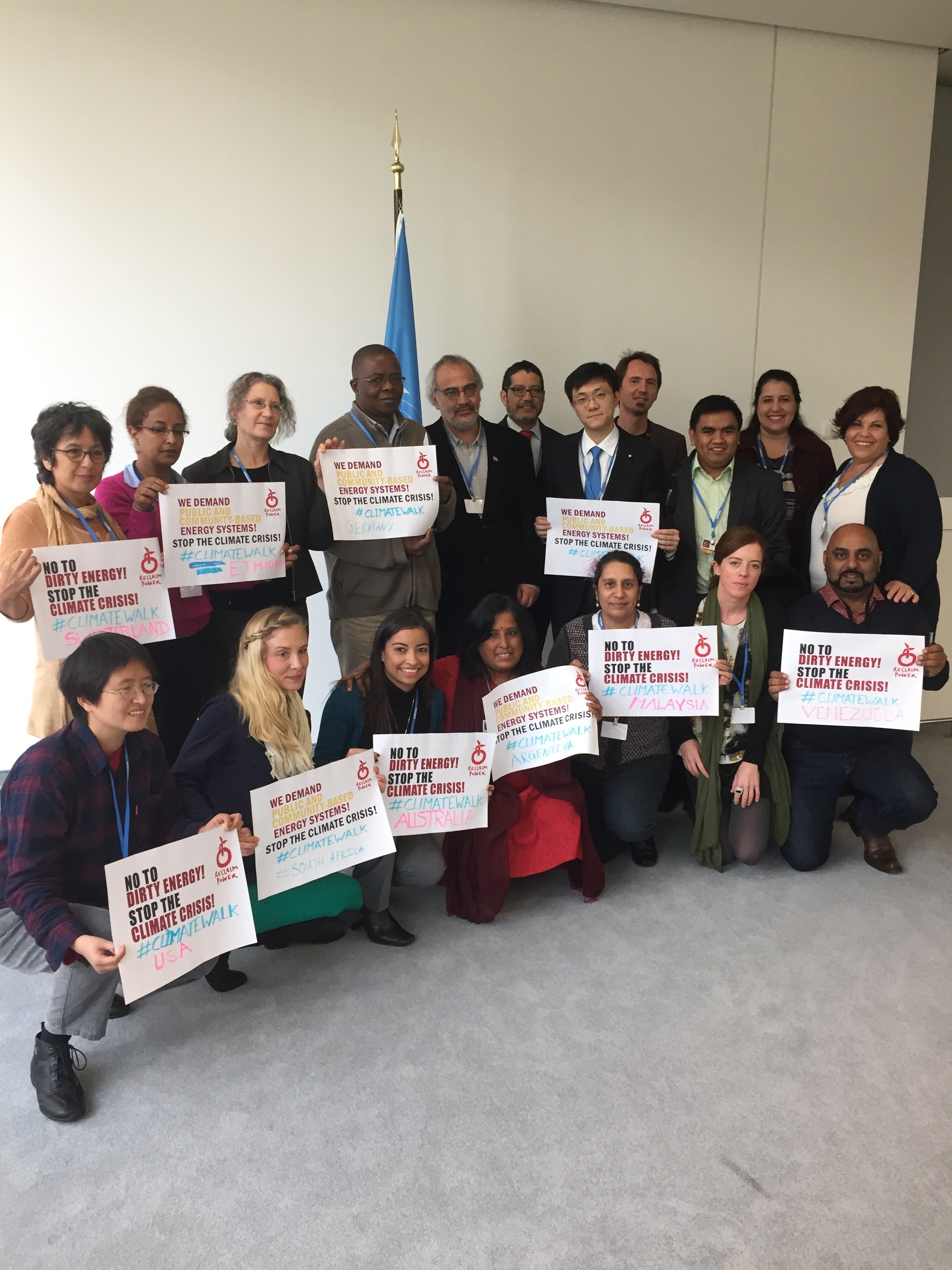
ECO wonders if delegates have noticed that a distinguished fellow negotiator from the Philippines, Yeb Saño, has been absent from this intersessional. Saño, alongside 12 other dedicated fellow walkers, is engaged in a 1000km #ClimateWalk from Manila to the “Ground Zero” of Tacloban city to mark the one-year anniversary of Typhoon Yolanda. Known outside the Philippines as Typhoon Haiyan, this superstorm has a semi-official death toll of 15,000, with many people still unaccounted for even a year later.

Along their mammoth journey, the climate walkers are visiting villages devastated by the typhoon, delivering disaster resilience kits and holding forums to discuss how communities can adapt to a changing climate. They will also join the global fast for the climate on November 1st, adding hunger to tiredness in solidarity with the many people whose lives are being affected adversely by climate change.

Delegates who would like to show their support are invited to send their support on social media using #fastfortheclimate and #climatewalk. The campaign continues after the walk concludes, where the first day of the COP in Lima will see many fasting. ECO invites all to participate to set the right tone for the start of COP20.