
Category: Previous Issues Articles

An Inconvenient Gap

ECO would like to draw Parties’ attention to new analysis out today: even though only two-thirds of the world’s emissions are covered by currently submitted INDCs, there is a substantial gap in mitigation ambition as we speed toward Paris. Submissions for 2025 put us on a dangerous track to warming of well over 1.5°C, and the 2030 goals are simply not good enough. And the 2030 commitments submitted thus far would make 2°C “essentially infeasible”, and 1.5°C “beyond reach”.

Then there’s the pesky problem of actually meeting the commitments put forward so far, let alone any new ones. Only the EU and China have realistic pathways to meet their 2025 targets. Everyone else needs to step up their game to ensure stabilisation of the climate.

It’s time for countries to take a hard look at global goals and play their part. ECO has three prescriptions: increased ambition for 2025 targets, 5-year cycles to ensure an opportunity for course correction, and strong encouragement to increase ambition back home to pass policies in line with stated commitments.
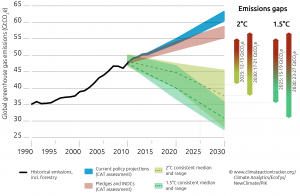
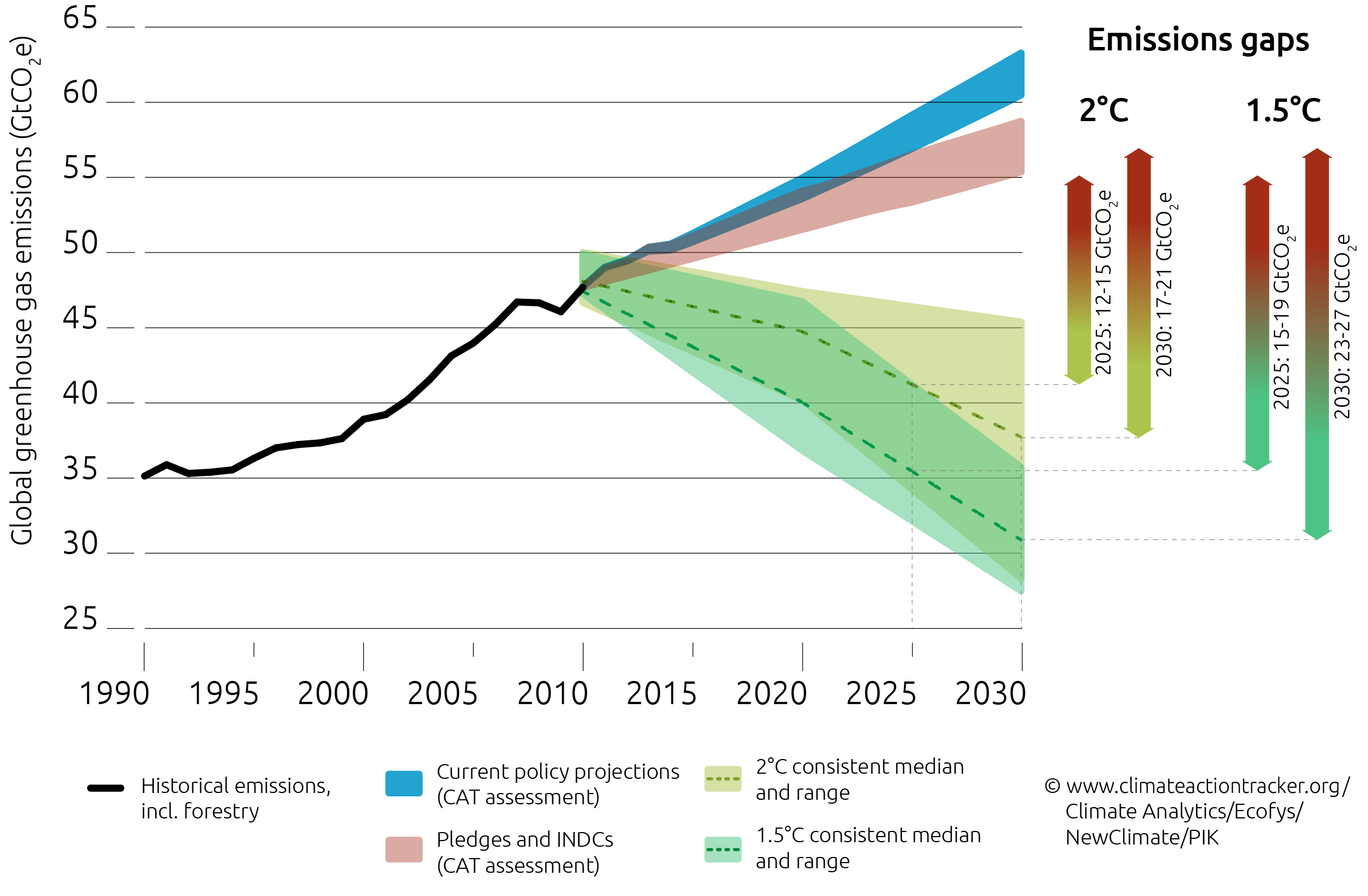
Ambition Graph
image-5680

Innovative Public Finance: Fruit Ripe For Picking

Many delegates have spent years, inside and outside of this process, on the seemingly enticing topic of innovative finance. ECO understands if some of you are getting tired of this work–so now is the time to harvest the fruits of your labour and lock in new, predictable and significant sources of finance that aren’t at the whim of treasuries!

The ground has been prepared by studies, such as those of the High-Level Advisory Group on Finance, the Leading Group on Innovative Finance, and others who have scoped the landscape.

Trial plantings have been made with a share of proceeds of the CDM that initially provided funds for the Adaptation Fund. Unfortunately, this fruit has withered on the vine.

Early seedlings in ICAO and IMO have so far come to nought–it seems they need UNFCCC fertiliser to grow. And if there’s one thing the UNFCCC can produce, it’s fertiliser.

Now that the ground has been prepared, and the Paris agreement is well placed to ensure that, within a year, we are harvesting the fruits of innovative public finance.

We need only one more ingredient: a process to agree on new innovative sources of public finance. Paragraph 82 in Part II is a good start, but should be spliced with the detailed options found in paragraph 54 and paragraph 64, Part III.
... Read more ...

It’s the Scale, Stupid

In the endless repetition of long-standing positions that passes for climate finance negotiation these days, one message comes through loud and clear: the Paris agreement–yes, the core legal agreement, currently largely in Part 1 of the co-chairs’ tool–must address the scale of finance to be provided post-2020.

Failure to do this will undermine trust, contribute to a lowest-common denominator deal (or even no deal), and bring us closer to the 3 or 4°C-warmer future we all dread.

ECO is well aware of the difficulties: post-2020 is beyond national budgeting cycles, finance ministries and political leaders must be engaged, etc., etc.

But let’s move into solutions mode. ECO concedes that firm numbers will not be in the core agreement. But let’s think about what can go there. Here is a start:

  • The US$100 billion-by-2020 commitment will be a floor for post-2020 finance.
  • Financial support will be scaled up over the post-2020 period until climate goals are met, and (to pick up on what the EU said yesterday) the most capable countries will contribute such financial support.
  • Ex-ante financial targets (aggregate and/or individual countries) will be agreed on a rolling basis, on a 2- to 5-year cycle.
  • Mechanisms, provisions or processes to enable developing countries to identify their needs to enhance action.

... Read more ...

Productive Differentiation Times

ECO has spent years calling for serious discussion on differentiation, and was pleasantly surprised when, yesterday, one materialised. Even better, the “spin off” meeting unfolded as a probing exercise that cast some real and useful light.

The fundamental question – what is the purpose of differentiation? – saw lots of good answers. One, offered by Mali, was that a proper differentiation system would ensure that all countries, whatever their level of development, could make their “best efforts”. ECO wants to add that in an economically stratified world like ours, a differentiated regime is key to equity, trust, solidarity, and action.

If the level of effort is nationally determined, one crucial point – repeatedly noted – is that we must not lose focus on the need for developed countries to take the lead. Self-differentiation, the theme of yesterday’s discussion, is what we have to work with. And clearly, we have to make it work.

The EU said that it never wanted self-differentiation, but rather a “spectrum of commitments” that takes the complexity of the modern world into account. Can we reach that same goal by a path other than self-differentiation? It won’t be easy, but that’s because the only spectrum currently open is one of nationally determined actions.
... Read more ...

Bold Words and Empty Promises

The Arctic is one of the regions hit hardest by the climate change, and on Monday, the US convened the GLACIER summit – Global Leadership in the Arctic: Cooperation, Innovation, Engagement, and Resilience – to muster ambition among Arctic Council nations ahead of Paris.

With reluctance from Canada and Russia, a joint statement on climate change and the Arctic was signed. Notably, it did not commit to any concrete actions. “We take seriously warnings by scientists,” they said, but only recommended fossil fuel companies voluntarily join an Arctic methane mitigation program.

President Obama stressed that not enough was being done. “This year in Paris has to be the year that the world reaches an agreement. None of the nations represented here are moving fast enough.” He also added that: “any so-called leader who does not take this issue seriously or treats it like a joke — is not fit to lead.”

ECO would like to remind GLACIER countries, now that you have affirmed your commitment to climate action, it’s time to walk your talk in Bonn.

Loss and Damage FAQ

ECO is pleased that Parties have started substantive discussions on the important issue of loss and damage. Equally, ECO is glad to have been helpful to Parties with our debunking mechanism–as was mentioned in today’s loss and damage facilitated discussion, which dove into the hard questions. Key amongst them were:

If were creating a durable agreement at Paris, in the context of available science, how could we justify not including loss and damage in this durable agreement?

The answer for this question was given in the moving intervention from Dominica about the devastating impact of Hurricane Erika, supported by the many references by others to the need for finance for the impacts of climate change. Zambia also pointed out that the circumstances of vulnerable countries are likely to be very different in 20 or 50 years–some of these countries will face existential crises in that time frame. As the Marshall Islands, the US and others noted, this is an existential question for low lying countries–and not an end-of-century problem. It is real and urgent , and it is not going away. Vulnerable countries need certainty and they need permanence that we will deal with the threats to their existence.
... Read more ...

WS2: How To Do Better

Constructive proposals have pleasingly been coming out of the Workstream 2 discussions. Crucial emissions gap language, missing since June, has been reintroduced. This includes discussions around a forum to move WS2 towards implementation, improved Technical Experts Meetings, appointment of champions for actionable initiatives, and a Technical Examination Process on adaptation, among others.

Efficient systems and processes need to be put in place to close the ambition gap. It is important that WS2 be enhanced, as it could be a pilot for future efforts to close the emissions gap left by inadequate INDCs. ECO appreciates that many Parties recognise the potential of non-state actors in these processes, too.

However, while this—collaborative actions and actions by non-state actors—are critical components of closing the emissions gap, they cannot account for the full 8-10 Gt CO2e gap that is still expected for 2020. Governments will have to play their part, especially developed countries. ECO is concerned that some interventions by developed countries, though constructive in part, consistently avoid the fact that developed countries should set an example through enhanced domestic action.

Unexplored mitigation potential, as South Africa put it, in developing countries exists due to lack of access to technology, capacity or finance.
... Read more ...

Agenda 2030 — Share the Love in Paris

ECO is truly enthusiastic about the global sustainable development agenda: “Transforming our World: the 2030 Agenda for Sustainable Development” which received a standing ovation when adopted last month in New York.

ECO strongly urges negotiators to support the proposal currently captured in preambular paragraph 33 of section III, which references the post-2015 agenda, to ensure alignment of the climate and development processes.

Here is why: Agenda 2030 includes 17 Sustainable Development Goals. One specifically urges action on climate change and its impacts when fighting global poverty, inequality and injustice. But, fret not about your role in the bigger picture, Agenda 2030 also says that the UNFCCC is the primary intergovernmental forum for negotiating a global response to climate change.

Although these two processes have different starting points, they both recognise the need to eradicate poverty. Agenda 2030 is the first UN document of its kind that tells us to look at development and climate together. It reminds us that the choices we make today when tackling hunger, improving energy access or building infrastructure will affect mitigation and adaptation to climate change.

Agenda 2030 calls for these goals to be achieved while keeping the global average temperature increase below 1.5°C or 2°C.
... Read more ...

Unlock Ambition with the Keys to Success: 5-Year Cycles and Robust Ratchet Mechanism

With over 50 INDC submissions, representing more than 60% of global GHG emissions, it’s already clear that the ambition underpinning those contributions will be far from sufficient to keep warming below 1.5°C. Parties need to urgently address this huge ambition gap. To ECO, it is obvious that a robust and legally binding ambition mechanism with 5-year commitment periods should be at the heart of the future climate regime.

The first step is to agree a 5-year timeframe for commitments, as it will help secure stronger commitments, and this should be clearly established in the core agreement text. Countries also need to agree other key components of the mechanism, such as review cycles, timing of communication and inscription, and upward enhancement processes.

Consistent 5-year intervals for all country targets will also allow for better aggregate collective progress assessments, which will need to be supplemented by individual country assessments. These assessments will review existing ambition across all elements of the Paris agreement, including finance, and ensure that global ambition is revised upwards to meet the ultimate objective of the Convention.

A key element to the commitment mechanism is the combination of a “no backsliding” principle and a clause requiring new commitments to actually be more ambitious. 
... Read more ...

How Long-Term is a Game Changer

ECO has joyfully watched the birth of a new vision for the world’s economy – one where fossil fuel emissions are rapidly phased out, and clean, renewable sources of power are phased in. Millions of citizens from the global north and south, thousands of leading businesses, faith leaders and health professionals are now demanding this transition.

We all passionately believe in this vision — not least because science tells us that without it, and early deep cuts in GHG emissions, we will not be able to achieve the ultimate aim of the Convention: the stabilisation of GHG concentrations in the atmosphere at a level that would prevent dangerous anthropogenic interference with the climate system.

If our global energy systems are not fully decarbonised by 2050 there would be neither equity nor fairness. It would mean a world where hard-won development is lost to dangerous climate change. The transition must happen in a fair, just and sustainable manner. Those with greater responsibility and capability must act first and support others to get to a new energy future. That means insuring that we do not neglect the challenges of adapting to the climate change impacts happening already today.

In this spirit, ECO has some proposals:

  • A long-term goal on mitigation that reflects the need for differentiation.

... Read more ...