ECO Newsletter Blog

Cheatsheet for Parties
How to answer questions at the high-level facilitative dialogue on enhancing ambition, a 101.
Where should Parties be with regards to mitigation ambition by 2020, and what should the factors for success be?
- All Parties—particularly developed countries—need to take more action by 2020, including providing more support to developing countries.
- Many Parties are on track to over-achieve their 2020 targets, which should be welcomed by the COP, but it should also be noted that over-achievement opens the door for more ambitious targets in the future.
- In addition to stronger near-term efforts and future targets, Parties should be participating in meaningful initiatives e.g. on renewable energy.
- Stronger political will and a spirit of cooperation are important factors for success. They have enabled the Paris Agreement’s early entry into force, and now need to be applied to enhance action pre-2020.
What immediate domestic steps should countries take to raise overall ambition, and how can these be facilitated?
- Announce at least one of these: fossil fuel subsidy reform, public funds divestment from fossil fuels, coal phase out, new fossil fuel infrastructure cancelling, efficiency standards increases, renewable energy support, affordable and attractive public transport, natural forest retainment and restoration, agricultural practice improvements, or reduction in wasteful consumption.
... Read more ...
Adaptation Fund
ECO is concerned about the survival of the Adaptation Fund. Created in the old times of the Kyoto Protocol, it was given the chance for a new life through the Paris Agreement. However, the way developed countries are “revisiting” its existence has us really worried about all those issues we thought we had clarified in Paris.
“We fully support adaptation finance”, they say. “But we don’t see how the Adaptation Fund itself is ‘technically and legally’ ready to serve the Paris Agreement. The Fund was created to be supported by Clean Development Mechanism (CDM) revenues. Since that has failed, we will have to rethink the Fund itself”.
Readers, can ECO remind our dear negotiators to re-read some old decisions they took right here in Marrakech back in 2001 when the Fund was established?
Let’s remind each other that 15 years ago we decided to establish the Adaptation Fund, period! We also agreed that the CDM would fund it, along with other sources, including finance provided by Annex I Parties (developed nations).
We truly hope that these rhetorical battles will end soon and Parties acknowledge once and for all the importance of the Adaptation Fund serving the Paris Agreement.

Financing Adaptation, the Struggle is Real!
On Monday, while we were busy following the negotiations, the World Meteorological Organisation (WMO) announced that preliminary data shows that 2016’s global temperatures are approximately 1.2° Celsius above pre-industrial levels. They warned that 2016 will very likely be the hottest year on record, with global temperatures even higher than the record-breaking temperatures of 2015.
Many parts of the world are becoming less habitable due to the effects of a warming climate. As developing countries face the wrath of climate change at their doors, the need for adaptation finance to help people cope with floods, droughts, sea level rise and other climate extremes is urgent and growing. This year’s El Niño has opened our eyes to the kinds of impacts that extreme weather events can have on vulnerable populations, leaving over 400 million people affected. El Nino has led to record droughts in a year that has also seen record levels of CO2 and the highest temperatures ever. In Africa alone, an additional 40 million people face hunger because of climate change and El Niño. The struggle to adapt is real, and financing solutions to build resilience and adapt is fundamental and urgent – and a lifeline for many of the world’s poorest countries and communities.
... Read more ...
Insurance – No Silver Bullet
Parties will be leaving Marrakech with plenty of work ahead to enhance action and support in order to address loss and damage. With key decisions now reached, let’s take a moment to look at the main tool in the loss and damage toolbox: insurance.
The ability to cope with loss and damage from climate change is going to involve financial mechanisms, including insurance. ECO hopes and expects that many more vulnerable communities will be supported in their efforts to cope with the losses and damages they are already facing. Such support must be guided by pro-poor principles including accessibility, participation of affected communities in designing the support, and the integration of insurance within a comprehensive risk management approach. Importantly, those who have contributed fewer emissions to global carbon pollution cannot and should not be expected to pay for protection against mounting climate risks. In other words, an equitable and rights-based approach to insurance must include financial support to make premiums affordable.
But let us get one thing straight: it’s not possible to insure ourselves out of the climate change problem!
So whilst ECO strongly welcomes efforts to expand climate risk insurance, we urge Parties to waste no time in developing a comprehensive approach to loss and damage that includes raising finance, addressing slow-onset events and non-economic losses, and a long-term, rights-based approach to migration, mobility and displacement, in the context of climate change.
... Read more ...
Finally, Fossils!
Yesterday not just one, or two, but three Fossil of the Day awards!
The first went to the European Commission for its mean-spirited “winter package”. Leaked copies of proposed renewable energy legislation reveal a real lack of ambition. The proposed target is to increase renewable energy a mere 27% of total energy by 2030… only 7% more than its 20% by 2020 target. The Commission is failing to send the strong signal to investors necessary to boost clean energy investment, in line with the Paris Agreement. Moreover, if European Commission President Juncker is serious about fulfilling his promise to make the EU “number one in renewable energy” then the proposals in the package need to be substantially improved before they are approved.
Indonesia won second prize for making really, really bad plans to boost power generation 35GW by 2019 (which is good), but 60% of this is to come from coal (very, very bad!). Coming just days after new UNICEF research showed that more than 300 million children worldwide, particularly in South-East Asia, are exposed to air pollution with detrimental health impacts. Indonesia included ‘clean coal’ in its NDC, but this is no solution to premature deaths from choking smog or global warming.
... Read more ...
VIP Checklist
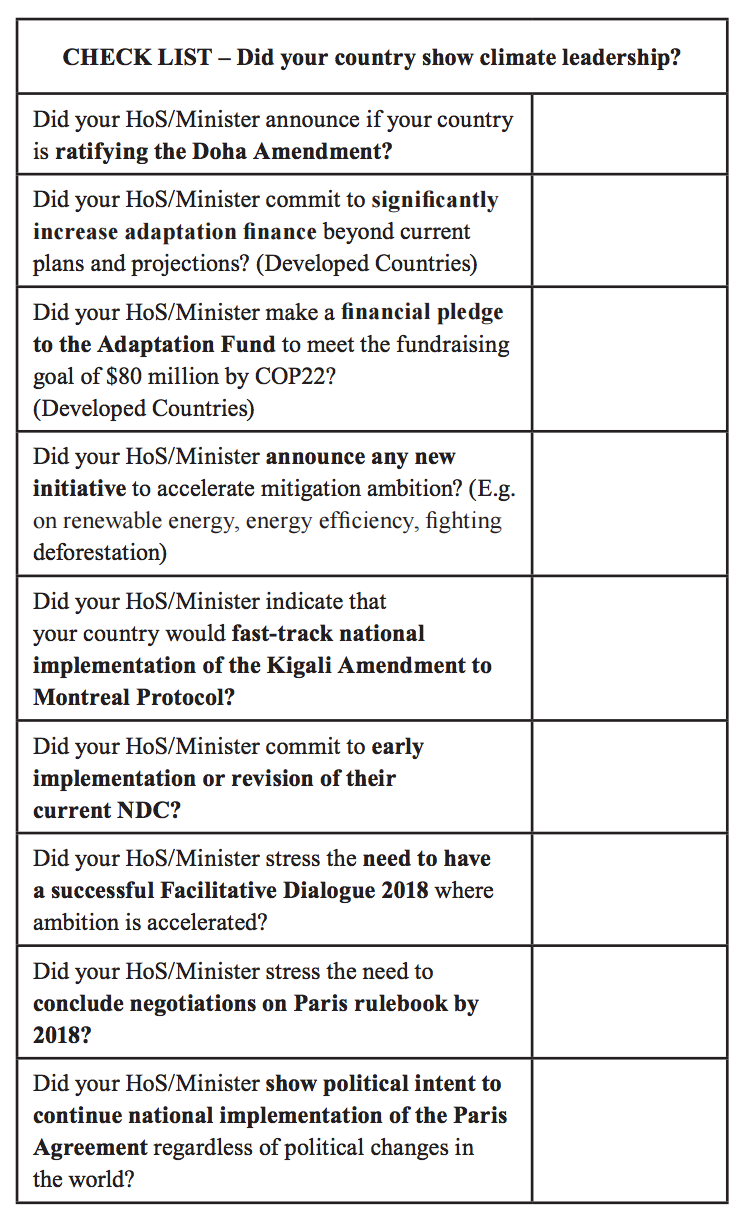
ECO is delighted to hear that approximately 80 Heads-of-State and Ministers made their way to Marrakech to show continued climate leadership in the high-level segment of the COP, the CMP and the CMA today.
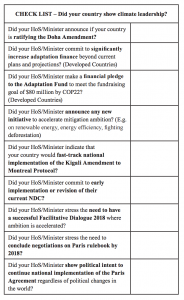
Want to know the level of leadership shown by your Heads-of-State and Ministers? Keep track by completing this check list (tick all that apply). Come on, you know you want to…
Ministers Wanted
The Facilitative Dialogue on ambition and support will be held on Wednesday at 10am. ECO knows this should be obvious to all, but we would like to emphasise that the whole point of a high level “ministerial deliberations” is the presence of Ministers. This is particularly important when the topic is how to muster the political will needed to significantly ramp up Parties’ ambition and support!
ECO reminds Ministers that the planet is already suffering from a climate-induced high fever. Unless Ministers are able to present a note from their personal physicians justifying their absence, their countries will stand an excellent chance of receiving a Fossil of the Day.
Capacity Building Takes Off
ECO welcomes the capacity building decisions adopted yesterday.
Given the increased expectations that have been placed on developing countries by the Paris Agreement, capacity building—as well as other means of implementation—will be crucial to enable these Parties to successfully implement their commitments. This is especially true for those Parties with the least capacity, and for those most vulnerable to climate impacts.
Cooperation on matters related to capacity building represents, perhaps, one of the most promising avenues for accelerating implementation of the Paris Agreement. Working together can enable Parties to develop collective ambition, while simultaneously providing important benefits for participating countries. The adoption of the Paris Committee’s terms of reference will enable the Committee to become operational as early as next year, and to rapidly initiate its work.
The decisions adopted yesterday also invite the Paris Committee to take into consideration cross-cutting issues such as gender responsiveness, human rights and indigenous peoples’ knowledge. ECO welcomes this important mandate. It will enable the Committee to support Parties as they implement climate actions in a manner that is coherent with existing human rights obligations and related international principles, such as the Sustainable Development Goals.
ECO hopes this commitment to consider cross-cutting principles in climate action, as reiterated in Paris, will also be reflected in the negotiations under the APA more broadly.
... Read more ...