
ECO Newsletter Blog

Fossil of the Day

image-8511

Saudi ArabiaOn Behalf of the Arab Group

It’s great to be consistent – reliable is good, right? Seems old habits die hard, especially if your allies keep the door open for you …

So, given that we are at COP 24, it is no shock that there are some offenders that keep on coming back.

This Fossil award is for the most consistent, insistent and persistent voice undermining ambition in the negotiations so far this week – Saudi Arabia. On Tuesday, an intervention by Saudi Arabia on behalf of the Arab Group, summarized their overall approach.

In the session on the Global Stocktake, Saudi Arabia, called for deletion of the term “ambition mechanism” in the preamble to the Global Stocktake text on the grounds that it pre-judges the outcome of the GST. The IPCC SR 1.5 and the entire Paris Agreement makes it clear that we need much more climate ambition if we are to meet the agreement’s long-term objectives.

Saudi efforts to undermine ambition don’t stop there. Saudi Arabia (speaking for like-minded developing countries or LMDCs for those not in the know) opposes agreement on any new information for NDCs to promote Clarity, Transparency and Understanding, and supports a“no text”outcome.


... Read more ...
Switzerland Astray: Parliament Decides to Kill the Domestic Reduction Target

ECO still cannot believe what happened in Switzerland earlier this week! While we all listened carefully to President Alain Berset’s opening speech on Monday, reminding everyone (in particular his MPs it seems) that“we can only succeed […] if all states – really all – reduce their emissions”,his Parliament back home almost simultaneously decided to abolish the domestic emission reduction target for the period 2020-2030!

Yes, you read correctly: Switzerland may have no target for domestic CO2- emissions reduction past 2020! ECO wonders what’s happening in the small but pristine and wealthy land of milk and honey (ahem.. chocolate) behind the Alps!

Wasn’t Switzerland the first country in the world to announce an ambitious INDC well ahead of Paris? And isn’t the Swiss delegation known for their persistent push on a robust transparency framework, strict criteria (“same for all!”) and a mechanism to continuously increase mitigation ambition?

Perhaps ECO isn’t alone having fallen for a slightly distorted picture of a seemingly progressive, clean and (self- proclaimed “recycling champion”) country. Time to lift the curtain of cheese and fondue:

Indeed, Switzerland announced in early 2015 its INDC of a reduction by 50% of CO2 emissions by 2030 (compared to 1990). But what the Swiss government did not mention back then is the intention to achieve almost half of it abroad.


... Read more ...

Top Tips For Delicious Climate Accounting Finance

How would you like your accounting, readers? Consistent, well done, and accurate? (In that case I’d recommend our MDB special.)

Or maybe you’d like a loan soufflé? Or perhaps lots of different methods all mixed together – with sprinkles of figures plucked from the air (for the climate component of aid programmes)?

Seriously though, accounting rules are important, as this is what will incentivise good quality climate finance.

The SCF and the OECD both delivered reports this week. They gave us some figures, which sound very nice, but when we looked a bit closer they seem inflated. And there are worrying trends on adaptation, and on flows to LDCs.

We have some top tips:

  • Measure what matters: We need to encourage more spending on adaptation. Both the OECD and the SCF show that this is still underfunded. No more than one quarter of climate finance, which is far from the Paris Agreement’s stating that “provision of resources should also aim to achieve a balance between adaptation and mitigation”.
  • Furthermore, the need to keep track of how much goes to LDCs. The OECD forgot. Standing Committee on Finance said this was only 24%, and 2% to SIDS. Grant-equivalent accounting: We’d also recommend you account for the climate finance that developing countries pay back to donor countries – those South-North flows – because loan repayments are not captured at the moment.

... Read more ...

Make Human Rights and the Rulebook a Happy Family for Christmas

As the weather gets colder and Parties work to make a complete rulebook, the spirit of the Paris Agreement — the eight rights based principles included in the Paris preamble are looking forward to being part of that happy family.

How do their chances look? Advocates argue that effective implementation of the Paris Agreement requires people to be at the centre of all climate decisions-making processes and actions. Parties must include the following fundamental elements throughout their implementation guidelines: human rights, indigenous peoples’ rights, public participation, gender equality, just transition, food security, ecosystem integrity, protection of biodiversity, and intergenerational equity.

But some feel their presence in the Paris preamble is enough to allow them to thrive in climate action around the world, or that mere reference to the preamble in the Rulebook would be enough or that maybe just one or two of the principles need to be included.

Including human rights language within the Rulebook itself will help Parties develop and implement the effective climate action needed to stay below 1.5oC. Ultimately, this is what the Rulebook is about: giving guidelines to Parties, to help them to put general principles into concrete steps for necessary climate actions.

We were pleased to see many of the rights have a home in the current text in APA agenda item 3 on the planning processes of NDCs, but we are wondering why some elements are still left behind.


... Read more ...

Takeaways for a Successful Talanoa

The purpose of the Talanoa Dialogue is to take stock of the collective efforts of Parties in relation to progress towards the long-term goal of peaking GHG emissions as soon as possible and achieve net zero emissions by mid-century, in order to limit global warming to 1.5°C. The outcome of the Dialogue shall also “inform” the preparation of countries’ nationally determined contributions.

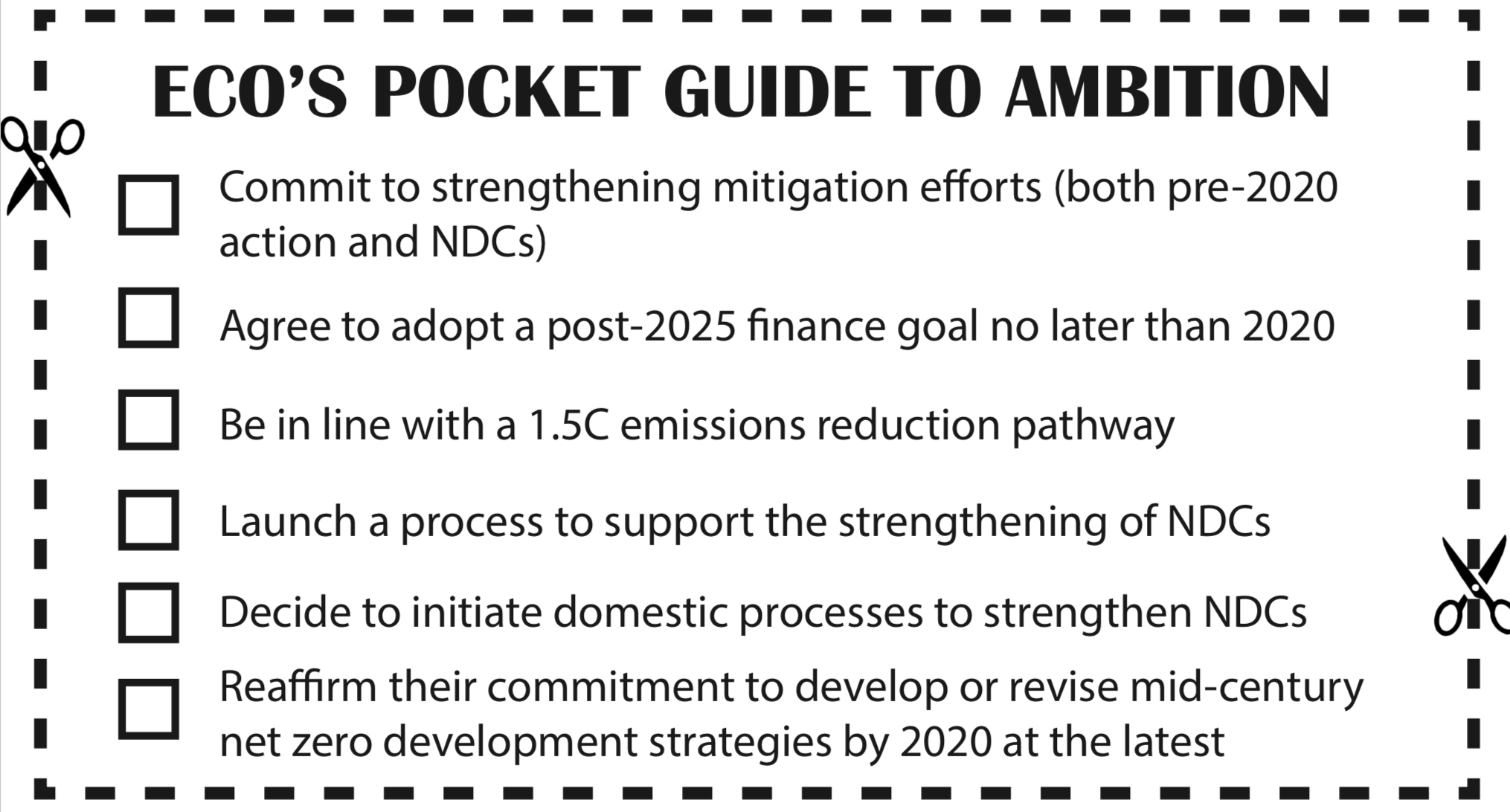
The IPCC SR1.5 makes clear that the world is not on track to limit warming anywhere near 1.5°C. The only conclusion that can be drawn from this exercise is that the current level of ambition is woefully inadequate. In Katowice, Parties must correct course, by agreeing on six key elements of a COP decision on Ambition.

To help negotiators stay on track, ECO has put together a helful pocket checklist:

image-8700

12 Years Left: What Have You Done to Respond to the SR1.5?

ECO was blown away by the SBSTA-IPCC presentation yesterday. The IPCC started off with a presentation that not only woke up weary delegates in the plenary but also woke them up (if they had somehow missed it previously) to the urgency of the need to act. The IPCC stressed that if Parties want to stay below 1.5°C and cut CO2 emissions in half by 2030, immediate action on every level is needed. They cannot start in 2029. Each year matters, just as each tenth of a degree does as well.

Some Parties questioned the feasibility of these scenarios. The SR1.5 report contains a number of pathways that could be followed to limit warming to 1.5°C, some being riskier than others. Ultimately, however, feasibility is not a question the IPCC can answer as it comes down to political will.

In terms of responding to the SR1.5, ECO expects to see the growth of political will throughout these two weeks, as negotiators streamline the text for the rulebook and when Ministers arrive to set the course to strengthen NDCs. Pursuing the most ambitious pathway to limit warming to 1.5°C has several co-benefits for people, biodiversity and future generations, and should be the moral imperative for any leader on this planet.

Planning a Koronovia Bumper Crop

Koronivia is a long way from Katowice, but progress on the Koronivia Joint Work on Agriculture (KJWA) at COP24 is well within reach.

Every farmer knows that success depends on maximizing the time avail-able within the growing season. This means knowing the landscape with-in which you are working, assembling the resources you need to do your work, and planting and harvesting according to a clearly structured plan.

The same applies to the KJWA.

In order to make the most of the short negotiating season available here, ECO suggests Parties consider the following ways of bringing clarity to the work ahead of them:

  1. Ask the Secretariat to undertake a mapping of the work of the Constituted Bodies, and a review of available means of implementation – both financial and non-financial. This will allow Parties to identify and discuss existing gaps related to each of the workshop topics.
  2. Ask the Secretariat to simultaneously undertake a review of available means of implementation, both financial and non-financial.
  3. Agree that a key deliverable of the KJWA could be criteria or guidance for NDCs, GCF, Adaptation Fund & Constituted Bodies, to ensure they reach five overarching objectives: food security, adaptation, absolute and equitable emission reductions, ecosystem integrity and gender responsiveness.

... Read more ...

3 Billion Reasons to Freak Out About Brazil

Brazil, the birthplace of UNFCCC and a so far trusted broker of the Paris Agreement negotiations, is about to become one of the world’s climate rogues. All thanks to president-elect Jair Bolsonaro and his set of very peculiar ideas about climate change and the Amazon rainforest.

Bolsonaro is not even in power yet and has already embarrassed Brazilian delegates here in Katowice by backtracking on hosting COP25 less than 10 days before the start of COP24. It’s, for sure, a shame, but let’s stay positive and keep an eye on the silver linings: can you imagine a COP President who thinks global warming is nothing but a Marxist plot to transfer power to China? No, you haven’t read it wrong, and those are Ernesto Araújo, the incoming Brazilian Foreign minister, words.

Even if Bolsonaro doesn’t follow the steps of his BFF Donald Trump and keeps Brazil in the Paris deal, his grand vision for the Amazon is gut-wrenching: drop deforestation control, open up Indigenous lands for agribusiness and mining, scrap protected areas and crack down on activists, just for good measure.

The cost for the climate would be nothing short of catastrophic: deforestation has already increased by 32% between August and November.
... Read more ...