ECO Newsletter Blog

Uplifting News from Down Under

At last, some great news from Australia. But you can bet your bottom Aussie dollar it doesn’t come from the coalition government. Action over the weekend demonstrated in the clearest possible terms how far off the track they are with the people of Australia.

On Sunday 60,000 people, from all the state capitals and from tiny Outback towns, took to the streets to set the record straight. To be honest, it takes a lot to get those laid-back Aussies riled up in late spring. But not even torrential rain in Sydney could keep people indoors, with 10,000 showing exactly where Australians really stand. In Melbourne they numbered 30,000. Whether in gumboots or sandals, no matter the increasingly unpredictable weather, the country was on its feet this weekend rallying for climate action.

For years, politicians have ignored a simple fact – the majority of Australians want more action on climate change. On Sunday the message could not have been louder. As we head into week two in Warsaw, let’s get one thing straight: Australians are not happy with what their government is doing on climate change, and they are not happy with what is going on here. They are rightly and loudly demanding more.

Contest

Excitement is growing as Ministers start arriving for the High Level Segment. The Bali Action Plan saw near-global inaction, the Copenhagen Accord covered over discord and Durban’s platform is unsteady. Given this short-of-the-mark track record, ECO is responding by running a little contest to name the Warsaw outcome. Will it be a name to signify real action or coal’s last choke?

It’s a party driven process, so you tell us. Send proposed names for the Warsaw >>? to ECO via the CAN exhibit booth.

Fossil of the Day – Nov 17

In a case of doubling down on a dastardly display, Australia was handed the First Place Fossil of the Day award for an unprecedented fourth time in a row at the Warsaw climate negotiations.

This is getting silly, folks. It’s almost like the new Australian Government is trying to compete with Canada for being handed the most fossils in a UNFCCC session.

After their first fossil on Monday for refusing to make any new finance commitments, Australia has today gone even further with their nasty rhetoric, willfully and completely undermining the very concept of climate finance.

The Australians said obligations for new, predictable and reliable finance from developed countries are ‘not realistic’ and ‘not acceptable’. This is nothing short of an attack on an important cornerstone of the UNFCCC.

In the same statement, Australia said that climate finance ’is not welfare transfer’. Indeed. Climate finance isn’t welfare – it’s a moral obligation (sorry Australia, it might not be acceptable to you, but it’s true) and a legal commitment that developed countries have made because of their responsibility in causing climate change.

New, additional, adequate and predictable finance – which must primarily be public money if it is to reach the poorest countries and communities and meet UNFCCC obligations – is not an optional part of the UNFCCC.
... Read more ...

Don’t Drop the Ball, Japan!

Even with help from friends and governments around the world, ECO can’t quite convey its outrage at Japan’s latest actions. The newly revised 2020 target announced by Japan yesterday is a 3.1% increase of carbon emissions compared to 1990 levels. That’s a huge increase from Japan’s Kyoto first commitment period target (-6% from 1990). The new target allows Japan to revert to business-as-usual by 2020. Forget about climate – welcome to the race to the bottom.

Even more surprising is that Japan seems to consider the target ‘ambitious’ based on its announcement materials. ECO wonders if Japan forgot the qualifier ‘raising’ that goes along with the ‘ambition.’ It’s simple maths, really. Targets should be in line with reducing the risk of devastating climate change (staying well below 2°C). When Japan decreased its target, it abdicated its ambition, further widening the gigatonne gap and leaving it for others will have to fill.

A growing number of people are fasting with a hope to have meaningful outcome from this COP, but Japan is betraying them and putting vulnerable countries in greater danger.

According to the Climate Action Tracker, the revision of the target will add another 356 MtCO2e/year to the atmosphere and widen the global emissions gap by 3-4%.
... Read more ...

Equity: Building With Brazil

No one will be surprised to hear that the Brazilian Proposal – which is to say Brazil’s move to reintroduce its classic 1997 analysis of historical responsibility – has been a bit controversial. But as a proposal to kick off a formal work program on Equity Indicators, Brazil’s move should be welcomed.

Historical Responsibility, after all, is a keystone Equity Indicator. In fact, it is one of five – Ambition, Responsibility, Capability, Development Need and Adaptation Need. Any serious attempt to operationalize equity must take them all into due and proper consideration.

Not that this will be easy. While it’s clear that there can be no acceptable road to climate stabilization that doesn’t take into account both responsibility and capacity, and both development and adaptation needs, it’s equally clear that there’s no precise agreement on the meaning of these terms.

Reasonable people can disagree about the proper definitions of responsibility and capability, and the relationship between the two. Which is exactly why we need an expert process to study the proper formulation of equity indicators, and why that debate must be mainstreamed into the ADP.

We’re long past the point where historical responsibility, taken alone, can usefully stand for the overarching problem of climate equity.
... Read more ...

Adaptation Fund: The Litmus Test

AF chart
image-2604

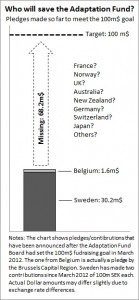
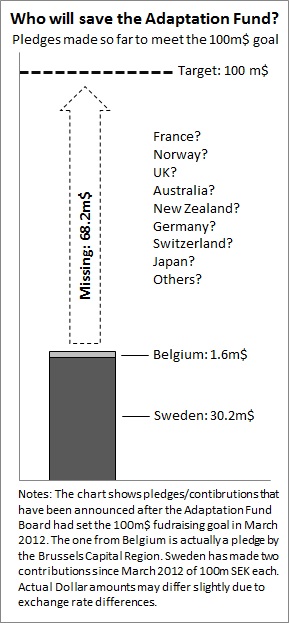
As delegates are reorganizing their first week notes for ministers back home, ECO offers the chart below for inclusion in their briefings. It shows the gap that developed countries should fill next week to meet the US $100 million fundraising goal for the Adaptation Fund.

We are confident that the goal can be met – how can we believe the claims that the long-term goal of mobilising $100 billion a year is within reach if they can’t provide even this much.We will keep track of forthcoming announcements and update the chart as needed.

Developed countries eager to be included in the chart with their contributions are invited to contact the ECO email.

Bunkers: No More Evasive Maneuvers

The way things are going, ships and airplanes will be able to cruise the seas and skies without serious emissions control measures for some years to come. Earlier this year the International Maritime Organization (IMO) indefinitely suspended its consideration of market based measures (MBMs) that can put a cap and a price on emissions in line with the polluter-pays principle.

In early October, the International Civil Aviation Organization (ICAO) decided to ‘develop’ (the text neglected to commit to actually ‘adopt’ or ‘implement’) an MBM by 2016 – not a particularly noteworthy achievement after well over a decade discussing these very measures. And the only emissions target mentioned in the agreement (but still in essence bracketed by party reservations) is carbon neutral growth after 2020. Meanwhile, under intense pressure from airlines and many governments, the EU is severely scaling back its ETS coverage of international air traffic, the only measure in the world that regulates aviation emissions.

The shipping and aviation industries must be very pleased with themselves. Thanks to their intensive lobbying of transport ministries and the tendency by governments to treat these sectors as a proxy for the broader negotiations, countries seeking action on emissions from these sectors have practically thrown in the towel.
... Read more ...

Brazil Goes in Reverse

There was rather astonishing news from Brazil this week. A report by the National Institute for Spatial Research (Instituto Nacional de Pesquisas Espaciais – INPE) reveals that deforestation in the Amazon region has increased by 28% from August 2012 to July 2013. This is the third largest rate of deforestation ever registered.

The real number is surely larger if you take into consideration cloud cover — and that the bad guys on the ground are getting smarter and cutting the forest in a greater number of ever smaller areas.

Although the Minister for the Environment is trying to put the blame on the States that make up the Amazon region, we are hearing that it’s really the Federal government that  bears the major responsibility.

For years, Brazil has showcased deforestation in these meetings as the main component of its voluntary mitigation commitment/promise. But the new forest law the government pushed through Congress last year included major concessions to the agro-business lobby.

And to be clear, no other sector of the Brazilian economy has contributed to emissions reductions – ever. So greenhouse emissions are on the rise everywhere. The momentum from the very substantial reductions of forest emissions in recent years is being reversed by

Brazil’s accelerated economic growth plan and the return of increased deforestation.
... Read more ...