ECO Newsletter Blog

Two Key Points

As you go about the conference on this final day, here are two key points to remember:

1. Adaptation must have a central place in the COP20 decision text for the 2015 agreement. It should also be included in the INDCs, albeit in a legally distinct manner from mitigation obligations and with a voluntary character. It is important to recognize the adaptation efforts of developing countries and assess the progress in terms of capacity as well as any funding gap. After Lima, detailing of global adaptation goals, principles and cycles needs to be done for the 2015 agreement, linking it with public finance and expected global average temperature increase levels.

2. Loss and Damage should be distinct from adaptation and be adopted as one of the key element of the 2015 agreement. Loss and damage must be seen as being in a continuum with mitigation and adaptation, acknowledging that inadequate mitigation and insufficient adaptation lead to more loss and damage. The IPCC AR5 clearly stated that “limits to adaptation” are being reached. Therefore, loss and damage must be recognized as a separate element from adaptation in the new agreement.


G7 King Coal

ECO likes to think of itself as an environmentalist with a spreadsheet. The practical kind that identifies what the biggest obstacle is standing between us and a 2 or better a 1.5 degree world, and tackles it head on. We did the sums and ran the mode, and here’s what should be top of your lists for pre-2020 action and a central part of your INDC.

And it was President Calderon himself who reminded Ministers today that we urgently need to stop burning coal. That’s the recommendation that jumps out of his New Climate Economy Report, the hefty volume found on the tables of Finance Ministers around the world. And its conclusion: rich countries need to stop building new coal-fired power stations immediately and accelerate the retirement of their old ones; whilst middle-income countries need to call a halt to new coal in 2025. And of course, coal phase-out needs to go hand in hand with a fair, managed transition for workers to a 100% renewable future.

To get the conversation going, ECO’s scorecard ranks G7 countries (Canada, France, Germany, Italy, Japan, UK and US) on how they are doing in the move away from coal. We looked at eight different indicators, including how much coal each country burns overall; their coal dependency; whether coal power plant capacity is being added or closed down; how much taxpayer money is being spent on coal at home and abroad; and how stringently a country’s coal-specific regulation is.
... Read more ...

Just Transition: To Change 
Everything, We Need Everyone

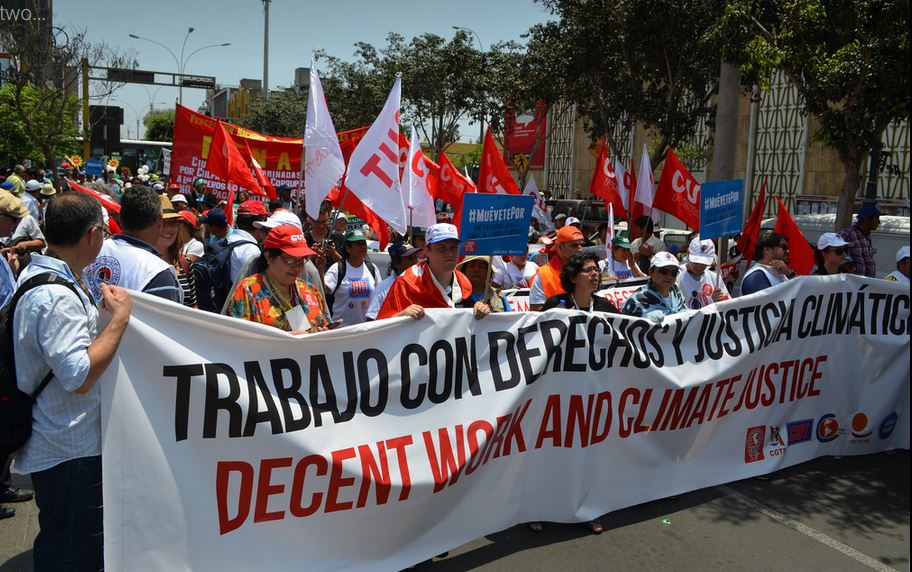
Representatives of the world’s working people expressed outrage yesterday that the draft text in these negotiations currently excludes any reference to the need for a just transition and decent work. The Cancun and Durban COPs included that language in the decisions.

Trade unions, supported by civil society in general, explain that – in addition to requiring ambitious emissions reductions and sustainable finance – it is critical that the Paris agreement also ensures that the transition to a clean energy economy will meet the needs of working families for decent and good quality jobs and protect the livelihoods of workers in carbon-intensive sectors. ECO joins the call to restore the reference to just transition and decent work in the text.

As 400,000 marching in the streets of New York said, to change everything we need
everyone.

The Untapped Potential of the Clean Transport Sector

In 2010, transport was responsible for 23% of energy-related CO2 emissions, with about two-thirds coming from road transport. Without concerted action, this number is poised to double in the next few decades. In order to stay beneath the IPCC recommended 2 °C scenario, it is essential that climate policy and action actively include transport.

Avoid-Shift-Improve (A-S-I) strategies provide strong potential in the transport sector, through mobility solutions based on sustainable transport systems. A-S-I works by avoiding or reducing the need to travel, shifting towards more environmentally friendly forms of travel, and improving the energy efficiency of vehicle technology and transport in general.

All components of this approach have been implemented at different levels both in developed and developing countries. Actions under this approach also have the great benefit of better air quality, and less road fatalities and congestion.

For example, the bus rapid transport (BRT) system in Lima, El Metropolitano, is a classic A-S-I project, and has expanded capacity and reduced travel times and emissions in ourhost city’s overcrowded streets.

Yet, the manner in which transport is being discussed in COP20 signals that parties are either not aware of the contribution of transport to GHG emissions, or they do not recognize the potential contribution transport can make towards respecting the 2° C  limit.
... Read more ...

Fossil

Australia’s worsening status as a climate wrecker was given even more attention with its fourth Fossil of the Day awarded today at the Lima COP20. Aussies like to win things, but most sensible Australians would be shaking their heads at this.

So what did they do this time?

Well the Australian Trade Minister who is here to ‘chaperone’ the Foreign Minister told big business leaders yesterday that his Government may not sign up to a new global deal if major trade competitors are not doing it too; he said Australia will not “get it in the neck”.

FossiloftheDayAwardlogo
image-4568

Dear Fossil Fuel 
Industry:
It’s over.

Dear minister,

You can’t say you’re in favor of the 2 degrees target and at the same time refuse to take adequate action on short, mid and long term mitigation. That just doesn’t work.

Isn’t it time you admit that we simply need to phase out fossil fuels from our
energy system, completely? Could Paris be that moment? “Dear fossil fuel industry, it’s over.” Try that! Feels good.

Doing the math with the IPCC carbon budgets for both 2 and 1.5 degrees warming clearly show that we must get carbon emissions to zero by 2050. In reality, that means phasing out fossil fuels completely – which is what the Catholic Bishops called for yesterday, along with a transition to 100% renewable energy.

Getting there in time means taking action now. Here in Lima you need to agree to:

• Take more pre-2020 action, because doing it later would be harder and more costly.

• 5-year commitment periods to increase ambition in 2025 so as to avoid locking in low targets for 15 years.

• Zero carbon by 2050 as the clearest expression of the existing temperature goal.

• Provide sufficient  means of implementation so that developing countries can leapfrog to provide access to clean, renewable energy for all.

The Least-Cost, Least-Risk Long Term Goal

lima-march-2
image-4552

The current elements text provides options for countries to consider as the long-term goal. Curiously, only one of the options refers to the science of the Intergovernmental Panel on Climate Change.

The IPCC science is, in fact, consistent with several possible long-term goals, and in particular with several different end dates. It’s just the background assumptions and choice of gases that differ.

However, there is one ironclad requirement for any goal that wishes to limit warming: CO2 emissions must most certainly, at some point, come down to zero. The particular day of reckoning depends upon how much warming and risks we are willing to accept.

To push back the day when CO2 emissions must drop to zero, one could, at least in theory, take on the rather daunting project of engaging so-called negative emissions on a massive scale – a scenario that relies on largely untested and fantastically expensive technology. IPCC science indicates that doing so, while attempting to limit warming to 2 °C, would only push the day of reckoning back to somewhere around 2070 for CO2.

However, to limit warming without relying on experimental technology that has unknown risks and potentially extreme costs, the the IPCC tells us that to keep below 2 °C, global CO2 emissions must drop to zero by 2050.
... Read more ...

PRE-2020 MITIGATION AMBITION: JUST DO IT

Today’s Lima Climate Action High-Level Meeting is the place for Parties to explain how they will start closing the mitigation gap. While that gap is huge, closing it is not as hard as it may sound. Here are a few easy pointers for developed countries, who should take the lead in the pre-2020 period: Obviously, you should start with fully implementing what you’ve already committed to do. This is particularly relevant for those who are backtracking on their 2020 commitments. But you will have to go beyond that. There are a few things you should simply stop doing – end all fossil fuel subsidies and block off the dirty fossil fuel pipeline – and others you should start doing, The EIA says that 80% of additional measures needed to close the pre-2020 mitigation gap would not impact GDP, and there are multiple co-benefits from reducing fossil fuel pollution (and everyone likes clean air and water). To help, here ECO has compiled a convenient list of a few of the big Don’t’s – things you simply must not do – in order to help save the climate. Even better, ECO has also identified many good Do’s that you can start implementing now.
... Read more ...

Renewable Energy,
Latin American Style

Today there is a lot of attention on increasing pre-2020 ambition. Our host region provides many great examples showing what is possible. The equation is quite simple: more investment in sustainable renewable energy and less money to perverse fossil fuel subsidies equals great benefit to everyone in LAC and the entire world. They are inspiring other countries – both developed and developing – for a path towards 100% renewable energy with sustainable energy access for all by 2050 at the latest.

Brazil’s electricity generation from renewables has almost doubled in ten years. Brazil’s supporting mechanisms – a fixed tariff for electricity fed into the grid and the more recently introduced technology specific auctions – have led to it becoming the region’s renewable energy giant.

Chile has a highly attractive investment environment for renewable energies, due to its policy set-up which includes a Law for Fostering Non-Conventional Renewable Energy.

Costa Rica has decided to go for a target of 100% renewable energy by 2021. That’s an inspiring example for other countries in the region and globally.

Mexico this year passed a Programme on Renewable Energy, setting the goal of 25% electricity coming from renewables before 2018, up from 15% in 2012.

Nicaragua is the renewable energy paradise of Central America, and over the period 2008-2012 had the highest annual growth in Latin America for non-hydro renewable power generation with almost 30%.
... Read more ...