ECO Newsletter Blog

Loss and Damage FAQ

ECO is pleased that Parties have started substantive discussions on the important issue of loss and damage. Equally, ECO is glad to have been helpful to Parties with our debunking mechanism–as was mentioned in today’s loss and damage facilitated discussion, which dove into the hard questions. Key amongst them were:

If were creating a durable agreement at Paris, in the context of available science, how could we justify not including loss and damage in this durable agreement?

The answer for this question was given in the moving intervention from Dominica about the devastating impact of Hurricane Erika, supported by the many references by others to the need for finance for the impacts of climate change. Zambia also pointed out that the circumstances of vulnerable countries are likely to be very different in 20 or 50 years–some of these countries will face existential crises in that time frame. As the Marshall Islands, the US and others noted, this is an existential question for low lying countries–and not an end-of-century problem. It is real and urgent , and it is not going away. Vulnerable countries need certainty and they need permanence that we will deal with the threats to their existence.
... Read more ...
WS2: How To Do Better

Constructive proposals have pleasingly been coming out of the Workstream 2 discussions. Crucial emissions gap language, missing since June, has been reintroduced. This includes discussions around a forum to move WS2 towards implementation, improved Technical Experts Meetings, appointment of champions for actionable initiatives, and a Technical Examination Process on adaptation, among others.

Efficient systems and processes need to be put in place to close the ambition gap. It is important that WS2 be enhanced, as it could be a pilot for future efforts to close the emissions gap left by inadequate INDCs. ECO appreciates that many Parties recognise the potential of non-state actors in these processes, too.

However, while this—collaborative actions and actions by non-state actors—are critical components of closing the emissions gap, they cannot account for the full 8-10 Gt CO2e gap that is still expected for 2020. Governments will have to play their part, especially developed countries. ECO is concerned that some interventions by developed countries, though constructive in part, consistently avoid the fact that developed countries should set an example through enhanced domestic action.

Unexplored mitigation potential, as South Africa put it, in developing countries exists due to lack of access to technology, capacity or finance.
... Read more ...

Agenda 2030 — Share the Love in Paris

ECO is truly enthusiastic about the global sustainable development agenda: “Transforming our World: the 2030 Agenda for Sustainable Development” which received a standing ovation when adopted last month in New York.

ECO strongly urges negotiators to support the proposal currently captured in preambular paragraph 33 of section III, which references the post-2015 agenda, to ensure alignment of the climate and development processes.

Here is why: Agenda 2030 includes 17 Sustainable Development Goals. One specifically urges action on climate change and its impacts when fighting global poverty, inequality and injustice. But, fret not about your role in the bigger picture, Agenda 2030 also says that the UNFCCC is the primary intergovernmental forum for negotiating a global response to climate change.

Although these two processes have different starting points, they both recognise the need to eradicate poverty. Agenda 2030 is the first UN document of its kind that tells us to look at development and climate together. It reminds us that the choices we make today when tackling hunger, improving energy access or building infrastructure will affect mitigation and adaptation to climate change.

Agenda 2030 calls for these goals to be achieved while keeping the global average temperature increase below 1.5°C or 2°C.
... Read more ...

Unlock Ambition with the Keys to Success: 5-Year Cycles and Robust Ratchet Mechanism

With over 50 INDC submissions, representing more than 60% of global GHG emissions, it’s already clear that the ambition underpinning those contributions will be far from sufficient to keep warming below 1.5°C. Parties need to urgently address this huge ambition gap. To ECO, it is obvious that a robust and legally binding ambition mechanism with 5-year commitment periods should be at the heart of the future climate regime.

The first step is to agree a 5-year timeframe for commitments, as it will help secure stronger commitments, and this should be clearly established in the core agreement text. Countries also need to agree other key components of the mechanism, such as review cycles, timing of communication and inscription, and upward enhancement processes.

Consistent 5-year intervals for all country targets will also allow for better aggregate collective progress assessments, which will need to be supplemented by individual country assessments. These assessments will review existing ambition across all elements of the Paris agreement, including finance, and ensure that global ambition is revised upwards to meet the ultimate objective of the Convention.

A key element to the commitment mechanism is the combination of a “no backsliding” principle and a clause requiring new commitments to actually be more ambitious. 
... Read more ...

How Long-Term is a Game Changer

ECO has joyfully watched the birth of a new vision for the world’s economy – one where fossil fuel emissions are rapidly phased out, and clean, renewable sources of power are phased in. Millions of citizens from the global north and south, thousands of leading businesses, faith leaders and health professionals are now demanding this transition.

We all passionately believe in this vision — not least because science tells us that without it, and early deep cuts in GHG emissions, we will not be able to achieve the ultimate aim of the Convention: the stabilisation of GHG concentrations in the atmosphere at a level that would prevent dangerous anthropogenic interference with the climate system.

If our global energy systems are not fully decarbonised by 2050 there would be neither equity nor fairness. It would mean a world where hard-won development is lost to dangerous climate change. The transition must happen in a fair, just and sustainable manner. Those with greater responsibility and capability must act first and support others to get to a new energy future. That means insuring that we do not neglect the challenges of adapting to the climate change impacts happening already today.

In this spirit, ECO has some proposals:

  • A long-term goal on mitigation that reflects the need for differentiation.

... Read more ...

Afraid of Compliance?

ECO is happy to see that compliance is high on many priority lists, with many agreeing on the importance of enshrining a compliance mechanism in the core agreement. After all, Parties must want to comply with what they commit to when they commit to it, right? Sure.

While observing the deliberations on compliance, both by itself and in conjunction with differentiation, ECO has come up with a handful of thoughts on the inter-related issues of bindingness, accountability and effectiveness.

The Paris agreement’s effectiveness depends upon it being binding under international law, and also on adequate commitments, participation of major emitters and effective implementation. This prompts the question: how can the new regime ensure that nations respect and comply with these key commitments? ECO notes that compliance mechanisms should help to identify potential cases and causes of non-compliance at an early stage, and then formulate appropriate responses. As such, they promote enforcement across the board while fostering coherence in implementation.

The Kyoto Protocol has this type of compliance mechanism. It involves a facilitative branch to provide support to Parties in their implementation process, as well as an enforcement branch to deter non-compliance. By contrast, the Cancun Agreements disregarded enforcement and instead set up two parallel MRV systems for developed and developing countries.
... Read more ...

Finance: A Three Part Act

As negotiators prepare their last-minute assessments of the finance section, ECO doesn’t think that it’ll be too hard to guess which Parties will be rather happy with how the finance section of the Geneva text was distributed across the co-chairs’ tool.

Part One (to become the core agreement) contains useful language on some aspects. Yet, it fails to include any constructive proposals to organise the mechanics of future financial support. For some reason, these were thrown into Part Three. ECO is puzzled, because what would go into a treaty if not the mechanics? This needn’t frustrate delegates, since ECO has been assured many times, Part Three is not a dumping ground of any kind.

ECO will be looking out for suggestions to move some of the key ideas from Part Three into Part One. For example, the countless references to needs assessments to ensure climate finance is matching The needs would logically be placed in Part One. Also, counting the number of paragraphs that suggest setting (and regularly updating) some form of targets for the provision of financial support should also belong to the core mechanics of future support. For instance, by setting collective targets every five years, based on above-mentioned assessments of support requirements, with separate targets for adaptation.
... Read more ...

Technology: The Final Frontier

It’s heartening that many Parties (though by no means all!) are pushing hard to get the right amount of climate finance on the table in Paris. It should be clear to all that without it, there will be no intergenerational equity.

Equally important is how that money is spent. With growing angst that the Kyoto Protocol’s Joint Implementation mechanism has fallen far short in promised emissions reductions, we must likewise make sure that any technology deployment provisions in the new post-2020 agreement are held to a high standard. Let’s talk frankly about how we can make that happen.

The legal agreement must include a Global Technology Goal that ties Technology Transfer to success in meeting the pathway to the temperature goal accepted by the agreement. At present, this provision (paragraph 70) is relegated to Section III, where the Co-Chairs have placed text needing further clarity.

We need to reference the existing Technology Mechanism in the Paris agreement and keep open the opportunity to include other such efforts into the agreement as they come online; there is no time to reinvent the wheel. That said, we should also make the improvements needed to ensure excellent outcomes as part of COP decisions. These would include:

  • Strengthening of the Technology Mechanism to include special circumstances in Africa, the LDCs and SIDs, emphasising the most marginalised.

... Read more ...

Wheels Up, Emissions Down

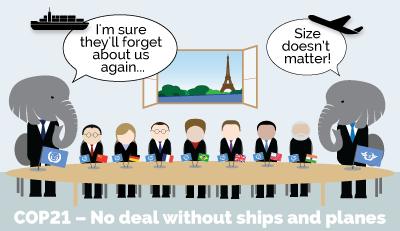
Did you have a safe flight into Bonn? Even if there were no complaints and your flight was uneventful, ECO doesn’t doubt that delegates would have preferred a plane that emits less GHG, uses the best energy saving technologies and generates funds to support the most vulnerable among us. Delegates, you’re in luck—this could be made possible this week through supporting the text that asks the International Civil Aviation Organisation and the International Maritime Organisation (IMO) to have shipping and aviation do their fair share on climate action. The sector could also contribute to climate action by having ICAO’s new Market Based Mechanism designate a share of the proceeds towards efforts on adaptation and loss and damage. No sector can be left out, as the LDCs and the EU have noted in their support for action on international transport emissions. Now it is up to the Parties here to call on the aviation and shipping industry to do their part.

Aviation Image
image-5658